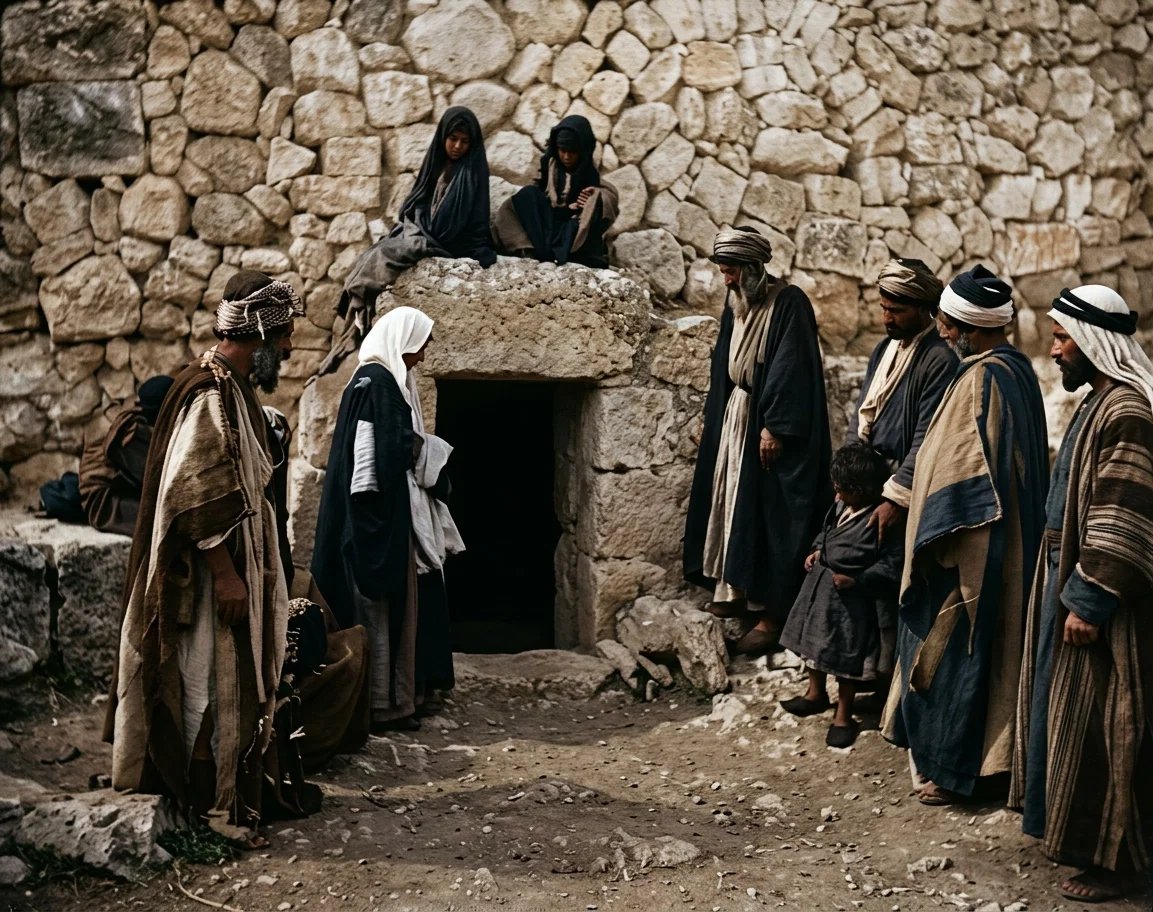
THE tombs of our loved ones speak to us in no consoling voice. They are places of sadness, mourning, and weeping. To many of earth the grave closes over their brightest hopes and fondest aspirations. In it is locked to them forever an only child, a noble son, a talented daughter, and the light of their home has been put out.
THE TOMB OF LAZARUS.
It is to such ones that Satan comes with the old Edenic lie, “Ye shall not surely die;” your loved one is not dead; he has entered on a higher sphere. But this does not comfort the mourner. Death seems just what God’s Word calls him, an “enemy.” He struck elasticity from the step, strength from the arm, brilliance from the eye, the roses from the cheek, and finally crushed out the life of our loved one, and locked him forever from us in the tomb.
TO SUCH comes the old question asked by the Idumean emir so many thousand years ago, doubtless old to him also, “If a man die, shall he live again?” Job 14:14. Will the grave give up its dead? Will we again clasp the hands of those who sleep? Will we again look into the eyes of those we love? Science says, “No.” Unbelief says, “No.” God’s Word alone gives us answer. Jesus Christ is “the resurrection and the life.”
DEATH came in consequence of sin; it is sin’s finished fruit. Only by conquering and removing the cause can the effect be banished. Jesus Christ removed the cause. He came into the stronghold of sin, the human flesh; He there fought the conflict against all the powers of spiritual darkness; “was in all points tempted like as we are,” and conquered gloriously. He died for us, the sinners; but He Himself was righteous. He had won the battle thru faith, and the grave could not hold Him. Acts 2:24. He came as the Son of man, bearing all the weaknesses of humanity. He conquered, and demonstrated Himself in character to be the Son of God. Rom. 1:4. He bestows that same character of righteousness upon all who will receive Him. “As many as received Him, to them gave He the right to become children of God, even to them that believe on His name; which were born, not of blood, nor of the will of the flesh, nor of the will of man, but of God.” John 1:12, 13, R.V.2 (226)
TO SUCH sorrowing ones the grave has lost its terrors; its power has been triumphantly overthrown. This overthrow was manifest in the resurrection of Jesus; but it was accomplished in His own triumphant victory over all sin in His perfect life in the flesh. It was wrought out in the wilderness of temptation, in the “prayers and supplications with strong crying and tears,” in “the things which He suffered” on the mountain heights alone, or in Gethsemane’s Garden. There Jesus, the sinless One, conquered sin, and vindicated His right to the name of the Son of God. Rom. 1:4.
A MANIFESTATION of this same power was seen at the grave of Lazarus, the friend of Jesus, at whose home the Master found a sweet, refreshing resting-place. Lazarus lived at Bethany, about two miles east of Jerusalem, with his sisters, Martha and Mary. The village is now called by his name, el-Aziriyah.
THE story is found in John 11. It is this in brief: Toward the close of Christ’s ministry, Lazarus was taken sick. The sisters sent to Jesus a messenger bearing the news, “Lord, he whom Thou lovest is sick. . . . When Jesus heard that, He said, This sickness is not unto death, but for the glory of God, that the Son of God might be glorified thereby. . . . When He had heard therefore that he was sick, He abode two days still in the same place where He was. . . . After that He saith unto them, Our friend Lazarus sleepeth; but I go, that I may awake him out of sleep. Then said His disciples, Lord, if he sleep, he shall do well. . . . Then said Jesus unto them plainly, Lazarus is dead. And I am glad for your sake; that I was not there, to the intent ye may believe; nevertheless let us go unto him.”
SHORTLY after the messenger was despatched, Lazarus died; and when Jesus arrived in the little village, he had been dead four days. The beautiful narrative tells us of the weeping sisters, the comforting friends, and the arrival of Jesus. When Martha met Him she (and Mary also) said to Christ, what doubtless they had often said to each other, “Lord, if Thou hadst been here, my brother had not died.” And then she continued, hope awaking in His bodily presence: “But I know that even now, whatsoever Thou wilt ask of God, God will give it Thee. Jesus saith unto her, Thy brother shall rise again. Martha saith unto Him, I know that he shall rise again in the resurrection at the last day. Jesus said unto her, I am the resurrection and the life; he that believeth in Me, tho he were dead, yet shall he live; and whosoever liveth and believeth in Me [at the last day] shall never die. Believest thou this? She saith unto Him, Yea, Lord, I believe that Thou art the Christ, the Son of God, which should come into the world.”
THE sisters, who had sat under the direct teaching of Jesus, while they did not grasp His omnipresent power, knew that death was not His presence, but rather that His presence meant life. Had He been there, He could have healed the sick, but now it is too late. So Mary feels. So some of the sympathizing friends felt. So thousands feel to-day. “If Jesus were here, we would go to Him.” But as He was when bodily present, so is He when spiritually present to the child of faith.
THEY bring the “Man of Sorrows” to the tomb. “Jesus wept.” Some said, “Behold, how He loved him.” But it was not because of sorrow for Lazarus that Jesus wept. He knew that in a few minutes God would speak power to the lifeless clay; even as He had spoken power to Him in His own life. “Jesus wept” because He saw in the death of Lazarus and the weeping sisters the deaths of the future, and the mourning multitudes beside closed graves. His sorrow was over the desolation, and sadness, and destruction, and misery sin had accomplished and would accomplish before all men would have the privilege of learning the better way, and sin would be destroyed.
“Jesus therefore, again groaning in Himself, cometh to the grave. It was a cave, and a stone lay upon it. Jesus said, Take ye away the stone. Martha, the sister of him that was dead, saith unto Him, Lord, by this time he stinketh; for he hath been dead four days. Jesus saith unto her, Said I not unto thee, that, if thou wouldst believe, thou shouldst see the glory of God? Then they took away the stone from the place where the dead was laid. And Jesus lifted up His eyes, and said, Father, I thank Thee that Thou hast heard Me. And I knew that Thou hearest Me always; but because of the people which stand by I said it, that they may believe that Thou hast sent Me. And when He thus had spoken, He cried with a loud voice, Lazarus, come forth. And he that was dead came forth, bound hand and foot with grave-clothes; and his face was bound about with a napkin. Jesus saith unto them, Loose him and let him go.”
THESE are the lessons taught us in this wonderful miracle: (1) That Jesus wishes to perform this miracle in the life of every sinner, in raising him from a death in trespasses and sins to a new life in Christ Jesus; for the power of God in the resurrection is power over sin; and that power must first be manifest in the life and character. Of every bound sinner who believes, He says, “Loose him and let him go.” (2) It brings comfort to all Christian sorrowing souls who have laid in the dark, cold grave their loved of earth. Faith hears triumphant over the closed tomb, “I am the Resurrection and the Life.” The dead shall rise again. Christ has conquered. In Him all may conquer. “This is the victory that overcometh the world, even our faith.”