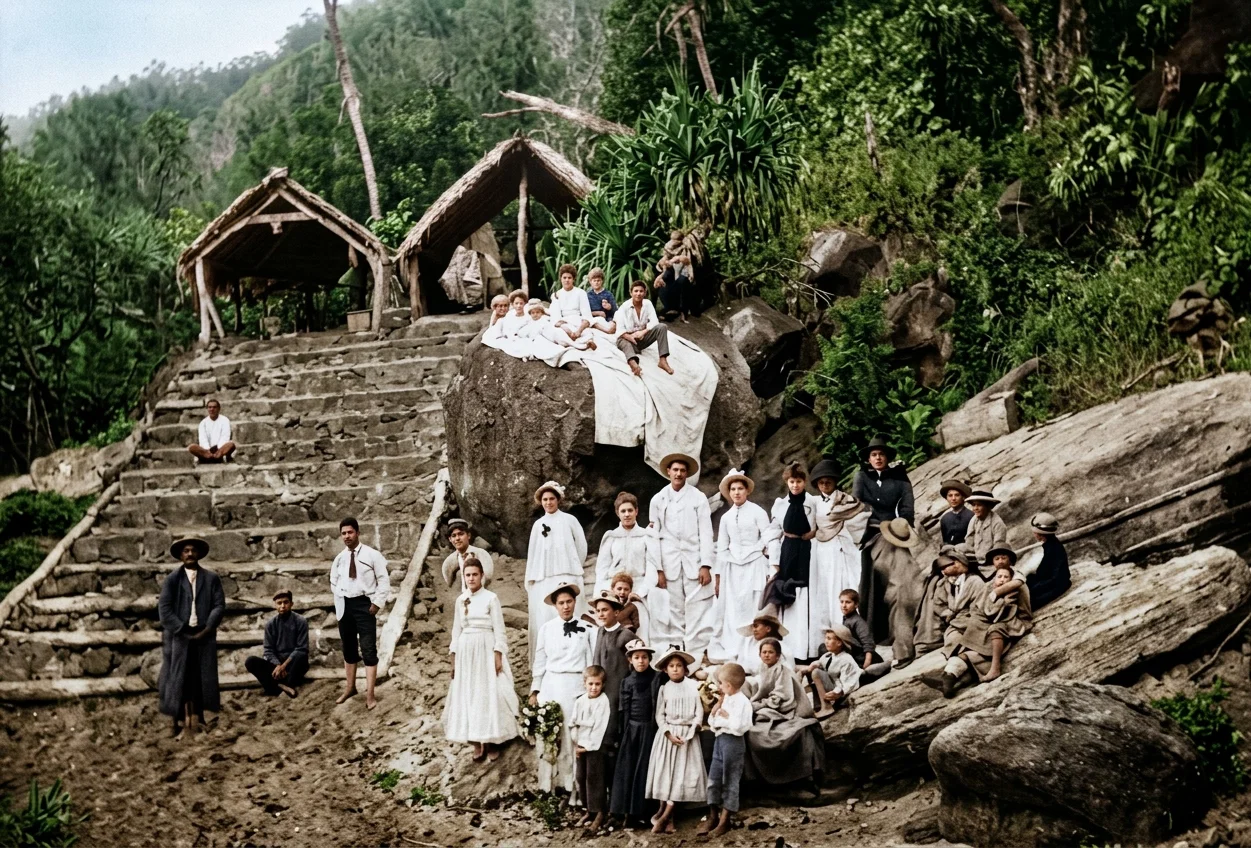
MANY of our readers have heard of far-off Pitcairn Island. It lies a little south of the Tropic of Capricorn in longitude 130° west from Greenwich, a trifle west of directly south from San Francisco. Its nearest neighbor of account is the Gambier group, about 300 miles to the northwest. Of these islands Mangareva is the chief.
Some of our readers know also of the story of the settlement of Pitcairn Island by the mutineers of the English ship Bounty, with their captured Tahitian wives. The early years of this settlement bore the fruits of the crimes of the mutineers, and jealousy, hatred, murder, and suicide followed, till in their sore straits the remainder sought God. From that day forward a higher standard of Christianity has been manifest among the simple natives than in any of the tropical islands. Situation apart from the great ocean highways of travel has not been an unmixed evil. The innocent people are largely ignorant of the arts and wiles and sins and vices of civilization. God in His goodness has preserved them from the vices which are destroying the peoples of other lands.
Usually persons are not permitted to remain on the island, because there are people enough there now for the size of the island, and because the faithful men among them do not wish to see on Pitcairn the corrupting, demoralizing influences which have been spread by sailors and men of commerce in the other islands of the sea.
It was not long ago that a ship’s crew were rescued, and the result to the islanders was a fearful scourge of typhus fever, and a manifestation of vicious corruption on the part of some of the rescued sailors.
One of those, who seeks thus faithfully to guard his people, who is indeed a father as well as governor to the dwellers of the island, is J. R. McCoy, a proof of whose love for his people is given below.
The Landing-place, Pitcairn Island, Which Was Damaged by the Tidal Wave.
Not long since there was told in the papers of the burning of a great British ship with her cargo on the island of Mangareva; but the brief despatches told naught of the tale of simple faith and true heroism connected therewith. The ship first came to Pitcairn Island, and her captain desired to beach her there, but Mr. McCoy, knowing the possible calamities to the islanders involved in such an act, refused, and was willing to risk his own life that his people might be saved from the possible dangers, especially morally. But the story we will let him tell, as he has told it in a letter to Mr. C. H. Jones, manager of this office, told it not for publication, but to a friend and brother:—
“Mangareva, Gambier Islands, Dec. 7, 1900.
“Just one week ago to-day I left Pitcairn Island on a four-masted British ship, the Pyrenees, of Glasgow, as pilot for this port. Her cargo was discovered to be on fire fifteen days previous to her arriving at Pitcairn. The captain’s intention was to run her on the island in order to save the crew, if possible. Owing to strong contrary winds and heavy sea on the shore, I found it impossible to carry the captain’s plans into effect, and planned, or advised, that she come to this place. At first the whole ship’s company refused to come, knowing that it was a great risk, and that the fire might break thru the deck at any moment. When the captain asked me to pilot them here and I gave my consent, the ship’s company were made willing to come; for they saw that I was willing to risk my life for their sake.
“It was after dark when I landed from the ship. A public meeting was called in the school-room, and I told my people of my intention to pilot the ship to Mangareva, if they would consent to my leaving them for a few weeks or perhaps for a few months. After an hour’s talking and advising the people, and reminding them of the time when they had shipwrecked men on the island and of the trouble made by them, I asked that all who were willing for me to leave the island for humanity’s sake should raise their right hand. The majority were in favor of my going. I told them that I was not taking my life into my own hands as some might suppose; neither did I consider the big and strong fire that would be burning underneath me every day and night; but that I did consider and realize that the strong ‘everlasting arms’ would be underneath me. Jesus left His Father’s throne and His bright home above for humanity’s sake. Why can not we?
“There was no sleeping in Pitcairn that night. While I was attending to family affairs the women were cooking food for the distressed ship’s company; the men were getting potatoes, fowls, bananas, pumpkins, etc., and at 6 A.M. I bade farewell to home and people, and sailed with a strong and fair wind for Mangareva, a distance of 296 miles (about). On Sunday morning we failed to get the chains from the hold of the burning ship to anchor her, so we ran her on the beach and saved ourselves, our effects, and a few stores. Two days later the fire broke out from the hold, and now she is all in flames and will continue to be so until her cargo of wheat and barley is burned up. The ship’s stores being in the hold, the men can not get at them. We in Pitcairn supplied them water and food sufficient to last them till they reached this place.
“We found the people here very short of provisions, there being only enough flour in the whole group to last four days. We were disappointed in not finding a vessel here to take us on to Tahiti. If a vessel does not come from Tahiti in another week with provisions, the people will be in a very serious condition. On account of recent gales the native foods are very short also. There is no breadfruit at all, when there ought to be plenty at this season of the year.
“I am glad to report that former visits to these islands with our missionary brig have produced good effects, and many are seeking to know more of the truth. Inquiries are made as to when our ship will come again. The French governor said that the Adventists are very good for religion, they stick to it, and are not like other denominations.
“If I can not get a vessel here or in Tahiti to take me back to Pitcairn, I will have to go to San Francisco and take a merchant vessel, as I did before, and risk making the island. But the chance for going from here seems favorable. We have a large amount of arrowroot, chickens, dried bananas, etc., in the island, and some of the merchants from this place may go after them. I will take dry goods from here and go home as soon as possible. This will be decided when the schooners arrive from Tahiti. I have been talking to one of the merchants here, an old friend of mine, in regard to purchasing a small vessel to run our produce from Pitcairn here. It would cost $3,000 or $4,000 Chile coin, and he wished to pay in some himself. We in Pitcairn can pay our part when we find a way of getting our produce from the island. All in Pitcairn are anxious for another camp-meeting, which I intend to hold this summer should I remain in the island.
“Your loving friend and brother in the work,
“J. R. McCoy.
“P. S.—I may charter a vessel for $700 Chile coin for home. If I do not write from Tahiti, it is because I return home from here.
“December 20. In two days I will be on my way home again.”