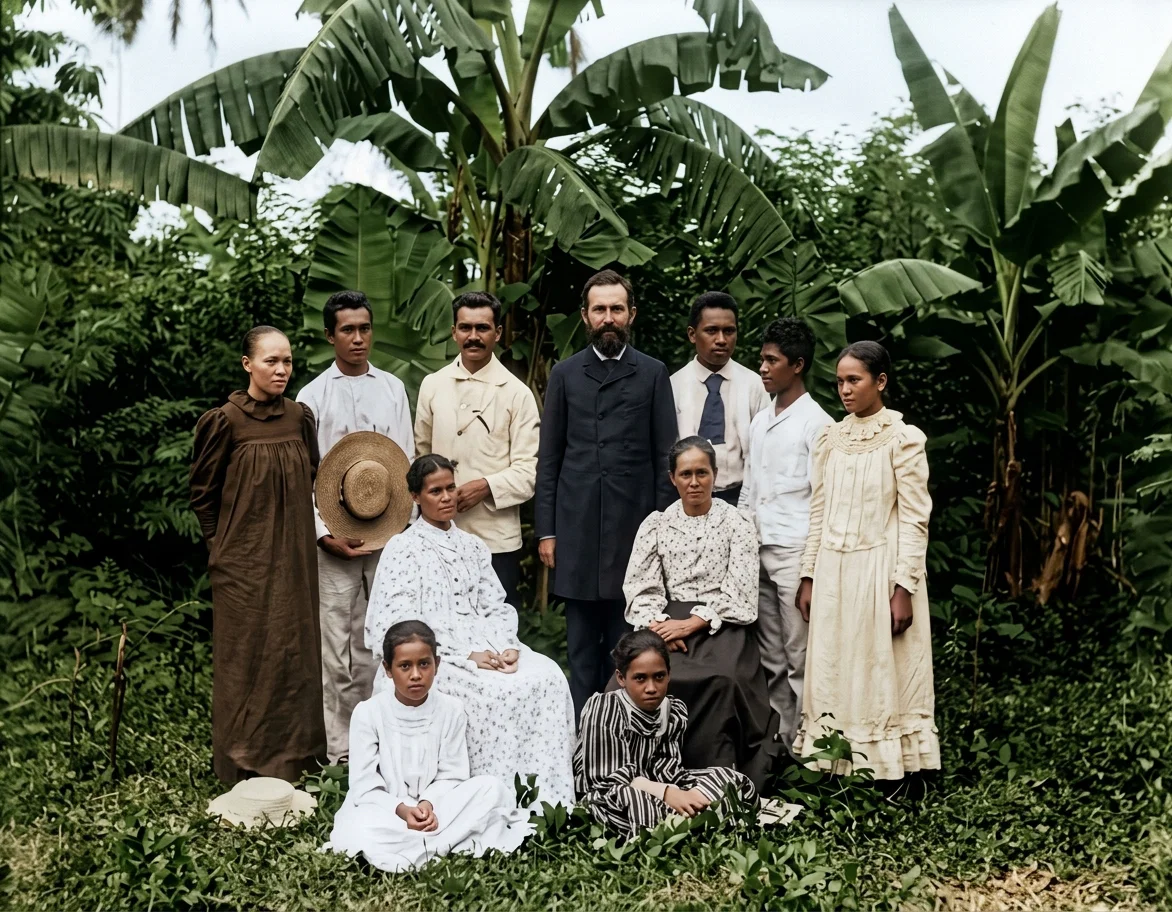
We have a very good system of education in our public schools here in the United States; and we have besides many church schools where our children may receive a practical education in the Scriptures. The people of this country usually appreciate the importance of giving their children an opportunity to acquire an education. But it is not so everywhere. In the islands, where a few years ago the people were heathen and had no written language, they are unable to appreciate the true value of knowledge. Most of the people can read and write the Tahitian language, and we occasionally meet one who has a very limited acquaintance with the English or French, but all are very much lacking in education.
Missionaries with Their Pupils.
The parents are glad to have the children taught if it does not cost them anything, and they take great pride in a child who is unusually clever and intelligent. But they are easily satisfied in this line. When the child has learned to converse a little in English or French, the parent often thinks that he must know as much as his teacher, and has learned all that is necessary.
The home influences are very detrimental to the proper development of the children. Since the parents themselves are ignorant, they can not be expected to know the needs of their children. They train them as they themselves were trained by their parents. The children are allowed to do as they please, provided they do not stir up the wrath of the parent. If he should become angry, they have to suffer, whether they have done wrong or not, unless they are able to run away and keep out of his reach. But they can tell falsehoods, steal, and break most of the commandments, and the parent will not object; for he is ready to do the same things himself if he thinks he can do them without being found out.
But we find that the children are susceptible to good influences, and that they are naturally bright and quick to learn. We have followed the plan of taking them into our family and teaching them, with quite satisfactory results. They readily pick up the English, since we usually converse in that language in our home. Besides learning English, some have become quite proficient in music, and two of our boys have learned the printer’s trade. Although the natives are considered to be naturally disinclined to exertion, the children can be trained so that they will enjoy work as well as their white brethren do. We have had, in all, nineteen young people in our home since we first went to the islands. All of them are doing well, and the majority of them are endeavoring to live Christian lives.
As we believe that much needs to be done for the children and youth, we are planning to start an industrial school, where we can take young people and surround them with Christian influences, and teach them such things as will fit them for usefulness in their island homes. We have already bought a lease of about 200 acres of land on the island of Raiatea, and consecrated it to the Lord to be used in His service as a school home for these youth. The place has about 3,000 coconut trees and 5,000 vanilla plants. We must furnish for the students employment which will keep both their minds and their hands busy, and at the same time help to pay the expenses of their schooling. The school is to be made self-supporting as far as possible, for there will be no other regular source of income.
The natives themselves do not sufficiently appreciate the value of a proper education to make much of a sacrifice to gain it. They expect everything in that line to be free, and prefer to use what little money they have in other ways. So we shall have to meet them where they are, and do what we can to lift them up.
The school-farm is somewhat isolated, as a school of such a nature should be. It is better for the students to be separated from the influence of their people as far as possible, and to be where they can not see and hear all the evil that is transpiring from day to day. They should have nothing to distract their minds from their studies and work.
An intellectual education alone would not be useful to them. They need to be taught how to work as well as how to study. So our aim is to give them a practical education that will make them well-balanced Christian men and women.
So far, our school enterprise has moved slowly. We have sacrificed all that we have in its interests, but still there remains much to be done. We have some small buildings, but more are needed. The buildings need not be as expensive as ours are in the United States. The climate being warm, much less lumber is required. But the lumber is more expensive there, as it must all be shipped from this country. If we had the sum of $1,000 to assist us in erecting buildings, it would give us a good start.
Not a part, but all of us, owe a duty to our fellow-men to work to uplift them from the depths of ignorance and sin, and to lead them to Christ. In striving to do this, we are walking in His footsteps. Surely, we are our brother’s keeper, no matter what his color may be, whether black, white, or brown.