SOUTH AMERICA

6%

Pacific Press Publishing Company · Oakland, California · Feb 6, 1901

FromSigns of the Times, Vol. 27, No. 6.

Read the full edition

SOUTH AMERICA.

The statement that intensity is taking hold of everything is as true of South America as of other parts.
Not to go much out of Argentina, several significant events in the political and religious worlds have been taking place of late. First among them is to be mentioned the reciprocal visit made by Mr. Campos Salles, the Brazilian president, to Buenos Ayres. No effort was spared by the people and the government to make this a great event. The president’s suite was made up of some of his ministers (war, navy, and foreign affairs), generals, and senators. Some fine war ships were selected to convey the distinguished gentlemen hither. An elaborate program of receptions, banquets, rides, etc., was carried out with enthusiasm. The people joined heartily in the spirit of the festivities, and the illuminations at night gave to the La Plata metropolis for one week a fairy, fantastic aspect.
As I happened to be eye-witness to one of the public ovations made to the two presidents, I could not keep from contrasting in my mind the methods of the two kingdoms—the kingdom of Christ and the kingdom of this world. Everything in Christ’s triumphal entry into Jerusalem was a token of self-denying love. Here, all is brutal force. And, as if the soldiery were not a sufficient reminder of the element on which human governments are based, there were the long line of cadets from some orphanages, with rifles on their shoulders. The presidents came along riding in a carriage between a compact crowd, and smiled pleasantly as they were cheered. How few were thinking of the ominous events which these manifestations were designed to avert!
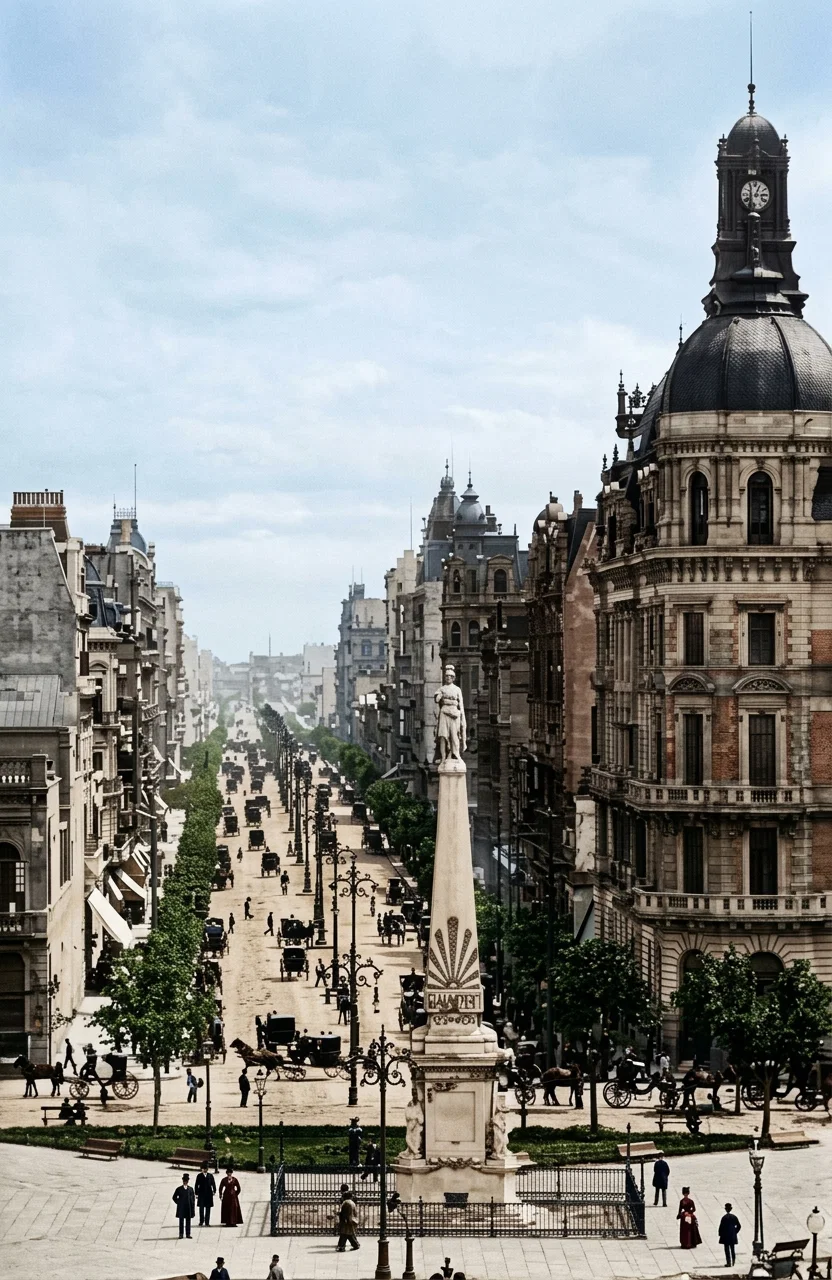
Mayo Avenue, Buenos Ayres.
It was an open secret with almost every one that Brazil and Argentine were making a military alliance in view of future invasions and continental wars. And this, the gathering of nations by the spirits of devils for the battle of the great day of the Lord Almighty, has reached South America. I do not think of any land now which this satanic summoning has not reached.
Is South America really going to make up the third chapter of this great dividing of the world, of which Africa and Asia were the first two divisions? What is the real, secret meaning of the Spanish-American Congress now being held in Madrid? The two leading dailies here have let it out as it looks to them: a gathering together of the Catholic nations as against Anglo-Saxon and Protestant supremacy in the political and religious worlds. According to a cablegram, the Mexican delegate made a speech November 26 at said congress on the conquest of California by the United States “as one of the greatest crimes of history.” It would be well enough to search out all the political iniquities committed by even the best nations as a means of exposing tyranny and injustice, but not of covering up worse tyranny and worse injustice.
“Old controversies will be revived and new controversies will arise.” This rivalry between the Catholic and the Protestant nations savors very much of the days of Charles the Fifth, Philip the Second, Louis the Fourteenth, Charles the Twelfth, and Gustave Adolphus. Let the church of God be at least ready in these ominous times and all will end well.
While I am on this subject, mention must be made, altho it be a geographical digression, to the coming Pan-American Congress in Buffalo, N. Y., to which the South American States are especially invited, and in which “Uncle Sam” will do his level best to cheat old Spain out of the affections of her natural daughters, and to settle some of the old South American family quarrels, thus making sure of this continent as belonging to his “sphere of influence.”
Last summer’s heat having been fatal to the archbishop of Buenos Ayres, his successor was only recently appointed by Rome, in the person of Bishop Espinosa, who, according to the Church-and-State arrangement existing here, had to swear fidelity to the constitution in general and the “Patronato” in particular. The “Patronato,” a relic of Spanish legislation, as the name indicates, gives the State the supervision of the church in almost everything relating to its organization, hierarchy and economic life. The State enters into such matters as appointing general and provincial councils and synods, and the places where they shall be held; it decides in what cases papal bulls shall not be circulated; it has a voice in the appointment by the pope of archbishops and patriarchs, in the erection of churches and convents, in the ordination of priests, and in the amount of their allowance by the parish. Before 1822, as in Spain, a tithe was the main income of the church. It was then abolished, and all the real estate of the church was taken by the government, which assumed the support of the clergy.
All this “Patronato” legislation looks very severe and threatening to the church, while the fact of the case is that the church commands, and the State obeys. The church accepts all this Napoleonic legislation because she knows that it is a dead letter, and that the government has very little desire to meddle or interfere with ecclesiastical affairs, which would only make it unpopular.
That friendship to the church is an important factor of popularity is well shown when the president of the republic and men in high position, altho freemasons, do not think it unworthy of their time to attend special festivals and pilgrimages in honor of some miracle-working old wooden image, and to serve as godfathers to the idol.
Ed. Laboulaye has remarked, altho a Catholic, that a church so imperialistic in its spirit as the Catholic Church was better preparedto furnish citizens to a monarchy than to a democracy, and cited as an example the poor results of South American republicanism.
I met an instance of this truth the other day, chancing to step into a Catholic congress for an hour. It was a general meeting of the Saint Francis de Sales corporations. It had its president, secretaries, etc. But they did not seem to figure, or at least they were eclipsed by the gorgeous figures and splendid array of the archbishops of Montevideo and Buenos Ayres and of several bishops. The central chair on the platform stood empty for the use of the papal legate, Mgr. Sabatucci, a recent addition to the clergy. And, O, how absent from these gentlemen was the spirit of the meek and lowly Nazarene, who came not to be served but to serve, and who taught His disciples that humble service and self-abasement are the best title to pre-eminence! The dignitaries just mentioned, clad in purple robes, made their entrance into the hall in a body, and were loudly cheered by the audience. As one of these haughty and majestic prelates would leave or come in, the proceedings of the meeting must be waived for a moment to give the people a chance to cheer; the people nearest them would kiss their hand, putting one knee on the floor. Some educated laymen had been selected to make the speeches, which they did to their credit—leaving out some of the sentiments expressed. After each discourse a long list of resolutions, previously printed and scattered thru the audience, were read by a clerical secretary. My reader will now expect a word on the discussions which followed. Don’t be mistaken! No sooner were the resolutions read than the archbishop of Buenos Ayres, a smiling face by the way, would motion to the congregation to vote by rising, with which everybody in the audience immediately complied.
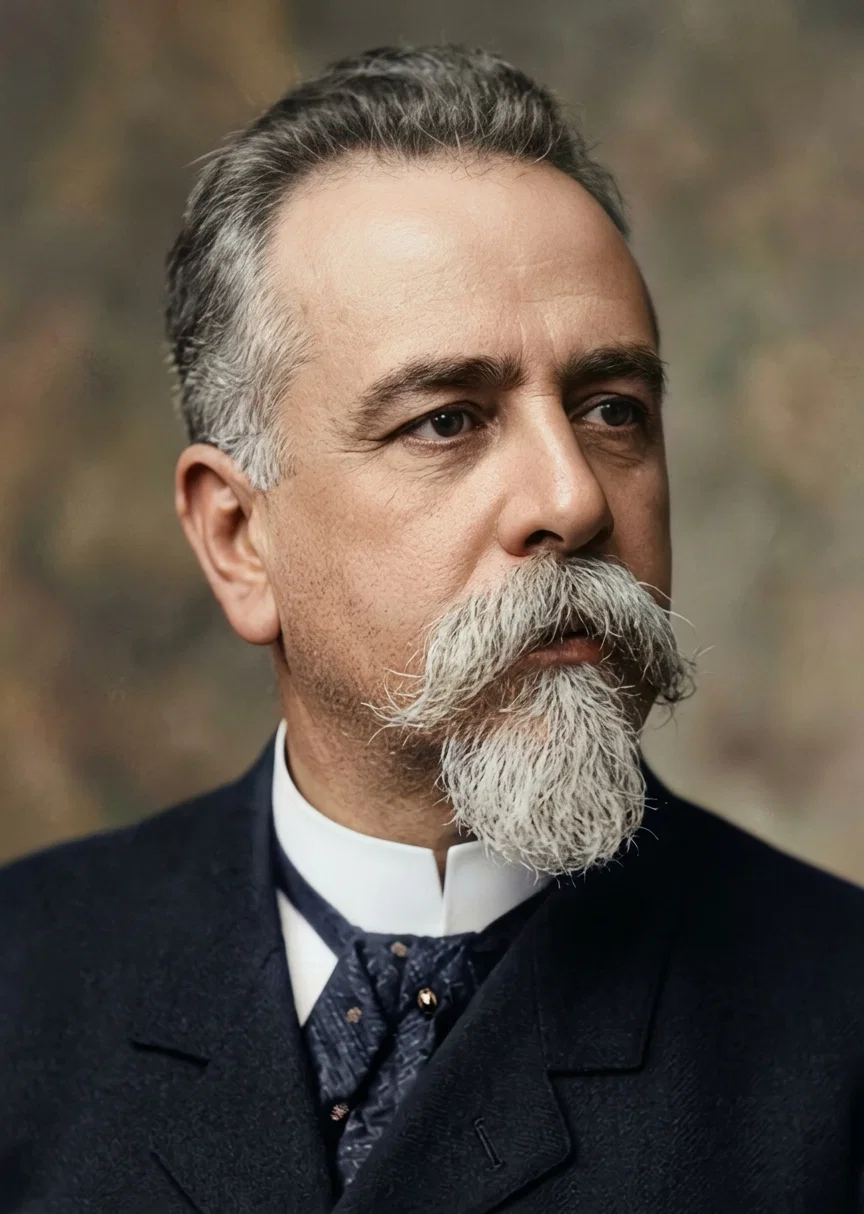
Dr. Manuel Ferraz De Campos Salles, President of Brazil.
JEAN VUILLEUMIER.
Buenos Ayres, Nov. 28, 1900.