CONFIRMING THE WORD

7%

Pacific Press Publishing Company · Oakland, California · Jan 16, 1901

FromSigns of the Times, Vol. 27, No. 3.

Read the full edition

CONFIRMING THE WORD.

A Lesson of Hope.

IN contrasting Himself with false gods, the Lord by His prophet uses these words: “Remember the former things of old; for I am God, and there is none else; I am God, and there is none like Me, declaring the end from the beginning, and from ancient times the things that are not yet done, saying, My counsel shall stand, and I will do all My pleasure.”
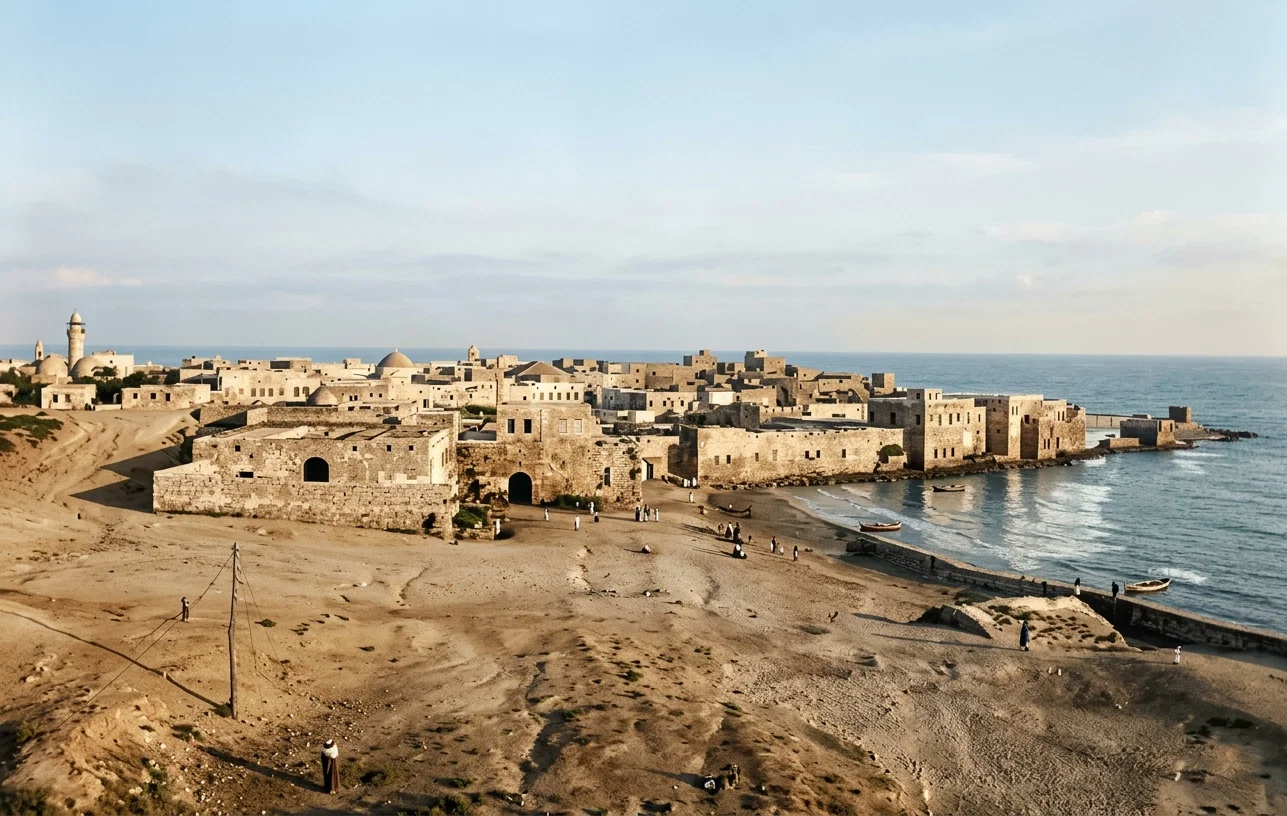
MODERN TYRE.
MODERN TYRE.
ONLY He who has all power, who is from everlasting to everlasting, can declare from ancient times things not yet done. Men oftentimes guess, and some of the guesses come true. Sometimes they argue from present facts what must be in the future. But in most cases their predictions prove false and the results bitterly disappointing.
THIS is not true of the prophecies of the Lord. He does not guess. He does not calculate. He declares what shall be, and He “worketh all things after the counsel of His own will.”
GOD does not ask the doubter to take these declarations without proof. He may in justice demand that men, created and living by His power, shall believe His word; but He is more than reasonable. He wishes to make this truth intensely practical to His children. Hence the accumulated evidence.
AMONG the many proofs that the Lord is God are His declarations concerning cities; and prominent among these cities is that of the ancient “mistress of the seas,” Tyre. The word means a rock, named doubtless from its foundation.
ANCIENT Tyre was a celebrated city of the wealthy kingdom of Phenicia, on the eastern coast of the Mediterranean Sea. Its site was originally an island, but it grew to the mainland, till its circumference equaled seventeen miles. Herodotus dates its beginning as far back as B.C. 2750. It was a “strong city” in the time of Joshua. It was closely associated with its powerful neighbor, Sidon, twenty-one miles to the north. Its king held friendly relations with Israel in the days of David and Solomon, many Jews dwelling there at the time, as we would judge by the extension of David’s census of his people to that city.
THE Tyrians were noted for artistic skill and commercial enterprise. They furnished the timber for Solomon’s temple and other great buildings in Jerusalem. Carpenters, masons, stone-cutters, and artistic workers in metal and the costliest webs came from Tyre to Jerusalem. A fleet of vessels accompanied one of Solomon’s to the richest countries of earth, bringing back the gold of Ophir, ivory, perfumes, birds of costly plumage, and rare tropical trees. Isaiah calls Tyre “the mart of nations,” “the crowning city, whose merchants are princes, whose traffickers are the honorable of earth.” A century and a half later Ezekiel names her “the merchant of the peoples,” whose builders had perfected her beauty. There were no such richly and well-built ships as those of Tyre, with sails and awnings of finest linen, blue and purple. From all the nations of earth—Persia andLydia and Arvad and Tarshish and Javan and Meshech and Tubal and Dedan and Sheba and Damascus and Arabia, and scores of other places—came men and money and wares, till the prince of Tyre, lifted up in his own conceit, said, “I am a god, I sit in the seat of God.”
It would seem to human understanding that the merchant city of the earth, so necessary in a commercial way to the nations, would endure forever. But God spake otherwise. Tyre’s very exaltation and idolatry were corrupting the kingdoms of earth; and God in His mercy could not have it thus, and He pronounced her doom.
He who knows the end from the beginning did not merely say that Tyre should be destroyed. He tells us in particular what her doom should be. Not less than eleven prophecies speak of her fate, concerning a period of two centuries. Tyre’s fate was not to be that of Damascus, “a ruinous heap,” nor that of the cities of Aroer, a place “for flocks,” nor that of Babylon, an utter desolation, where wild beasts dwell. God declared that Tyre should fall; that “they shall destroy the walls of Tyre, and break down her towers; I will also scrape her dust from her, and make her a bare rock. She shall be a place for the spreading of nets.” “Thou shalt be built no more; for I the Lord have spoken it, saith the Lord God.” Nebuchadnezzar captured it, and Alexander destroyed it. The later and present city was built on the land from the ruins of the old Tyre. Some remains of magnificent ruins, and a few fishers’ huts are found where once stood “the crowning city,” and on the bare rocks and stones the fishermen spread their nets to dry. Men may now read the prophecy of 2,400 years ago in the ruins of that once proud city. Prophecy and fulfilment are the twofold witness to all that Jehovah is God, there is none else.
BUT all these declarations are lessons of encouragement to every doubting, sin-sick soul. Listen again: “Declare ye, and bring it forth; yea, let them take counsel together; who hath showed this from ancient time? who hath declared it of old? have not I the Lord? and there is no God else beside Me; a just God and a Saviour; there is none beside Me. Look unto Me, and be ye saved, all the ends of the earth; for I am God, and there is none else.”
ALL this is of the greatest encouragement. The same God who so clearly declared Tyre’s doom declares the salvation of every trusting soul. As truly as He took the beautiful “crowning city” and made it, because of its wickedness, an eternal disgrace, so surely will He take the soul that submits to Him, even the soul that Satan has made a ruin and disgrace, and make it “to the praise of the glory of His grace” to all eternity. He has pledged His power to do it. He has pledged His love in the gift of Jesus Christ. He has multiplied evidences without number that His word is sure. Now, dear soul, will you not look unto Him and be saved? This is a lesson, a precious lesson of assurance to us from the history of Tyre.