MODERN medical science and the treatment of the large number of chronic diseases of the present day have made marked changes and progress during the last decade. Science has revealed so much relative to the human body and the changes in its functions and tissues by the innumerable disturbances which cause diseases, that medicine has a much more rational basis upon which to work. On the other hand, the art of healing has been undertaken by such a variety of methods that the invalid can meet his benefactor at almost every turn. Among these methods a well-equipped and conducted sanitarium is recognized as the best place where many classes of diseases can be most successfully treated.
The St. Helena Sanitarium is the oldest and largest institution of its kind on the Pacific Coast. It was first established about twenty-five years ago, and in 1878 was incorporated under the name of the Rural Health Retreat Association. Its growth has since been gradual and healthy, and at the present time it has facilities for doing a large amount of work.
The location of the sanitarium at Crystal Springs, near St. Helena, is most favorable for the kind of work which it undertakes. It is the repeated testimony of those who have visited similar institutions in this country and abroad that they have not seen its equal for scenery, surroundings, and climate. St. Helena, two and a half miles from the Sanitarium, is a small village in the Upper Napa Valley. This valley is one of the first settled and best cultivated in the State. The institution is situated on a small plateau upon the mountain-side to the east of the valley, and about 300 feet above it, and has an elevation of 800 feet above sea level. The hillside rises abruptly from the back of the building, and it is but a short distance to the summit of Howell Mountain, which is 1,800 feet high.
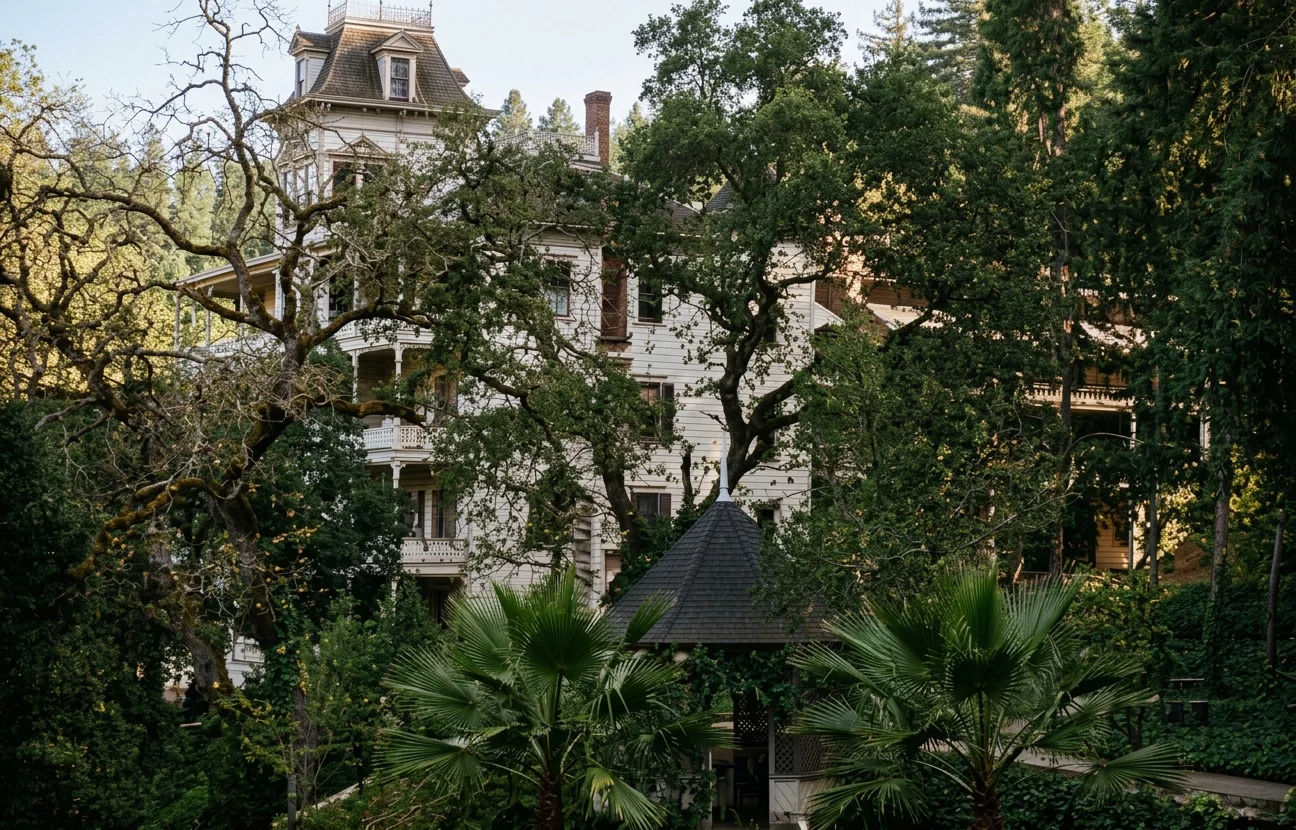
Immediately surrounding the Sanitarium are natural groves made up of a variety of trees, among which are live-oak, fir, madrona, and manzanita. The outlook in front of the building includes a small triangular valley, embracing about 300 acres of land, and occupied by well-cultivated ranches, presenting to the view a series of vineyards, orchards, and meadows. On the opposite side is a narrow pass which opens into the main valley. North and south of the institution small mountain ranges wend their way into the side of the valley, making a series of densely foliaged foot-hills, valleys, and canyons, the view to the north including Mount St. Helena, which rises to a height of 4,400 feet. Across the Napa Valley, which at this place is only about a mile in width, is another range of mountains equally broken and picturesque.
The climate of the Upper Napa Valley is one of the most healthful that can be found anywhere in the State. The region is separated from the coast by two mountain ranges, which disperse the fogs and temper the harsh winds, and yet it does not get the intense heat of the more inland valleys. The amount of rain during the winter season is sufficient to produce a good vegetation and prevent the long droughts common to the southern part of the State. Yet the atmosphere during the larger part of the year is dry and clear. From the published proceedings of the California Medical Society during the year 1893 (where the comparison is made of the climate between this and other parts of the State) it is found that, with the exception of January and February, the average humidity of St. Helena is less than San Diego and Los Angeles. The average mean temperature is 62.8; the average maximum temperature is 73.2; the average minimum temperature is 52.4.
The institution, being located on the mountain-side, has special advantages for sanitary surroundings. The atmosphere is most healthful, and the sewage system is well maintained. The water supply comes from a spring located near the buildings, which affords the purest of water. The soil about the place is a red sandstone with various volcanic rock, and is easily drained and fertile.
The main building is a five-story structure with a four-story ground addition situated between the main building and the hillside, and having horizontal walks leading back to the mountain-side. This building contains the dining-room and all the offices and treatment-rooms, besides about fifty rooms for the accommodation of guests. It is furnished with a hydraulic elevator, and has steam heat and electric bells. There are seven cottages also, containing from four to twenty rooms each. The other buildings include a natatorium, bakery, engine-house, laundry, and stables. These, with a large number of tents used in the summer season, make quite a little settlement. A great deal has been done during the past ten years to render the grounds about the place most pleasant and attractive. Two small circular lawns are situated directly in front of the main building, and there is also a large flower-garden, with a lawn in the center of it, situated between the main building and the new cottage. With careful planning, walks have been laid out in the immediate vicinity of the Sanitarium, which also lead back among the hills to the various canyons, waterfalls, caves, mountains, and other places of interest. There are about fifteen miles of these walks that have been measured, and serve a useful part in the daily prescriptions of the physicians, giving to the patients a most healthful form of exercise and recreation.
The institution, depending as it does for its therapeutic measures upon the rational treatment of disease, uses only such remedies as may aid nature in its restorative work. It is well equipped for all forms of hydrotherapy, electricity, massage, Swedish movements, etc. It has commodious bath-rooms, and trained manipulators have charge of all the treatments given, which are always administered according to the prescription of the physicians.
The treatments are prescribed according to the conditions of the patient as well as the disease from which he is suffering, and the central idea is that of health-getting and physical development. Nature has among her resources sufficient power to cure every curable disease, and in much of the treatment prescribed the object is to restore the full possession and use10of her own powers. Most of the diseases from which people suffer at the present day are brought on not so much by the immediate cause of the disease, as by the long-continued violation of nature’s laws, which have weakened the various parts of the body, and laid waste nature’s powers. It is the aim of the methods employed at the sanitarium to correct wrong physical habits, and to restore and strengthen every weak portion of the body. Hence exercise, rest, diet, and healthful occupation of the mind are important factors in the patient’s getting well.
Every patient when coming to the sanitarium is subjected to a careful and thorough examination, and upon this, together with the study of the history and physical tendency of the case, is prescribed what course of treatment is to be pursued.
The institution employs four regular physicians, who devote their entire time to the interests of the patients, and to the education and training of the assistants that are in the employ of the sanitarium.
Recognizing the important relation of diet to the maintenance of health, the institution takes special pains to have everything as perfect as possible. The Health Food Department makes a specialty of developing the most healthful articles of food. These have been used in the sanitarium for a number of years, and are so much appreciated that tons are each month sent out to different parts of the State to supply former patients, and those who have become accustomed to the use of our foods. The tables of the sanitarium are free from condiments, stimulants, and everything not of a wholesome nature. They are spread with a large variety of carefully-prepared foods, such as will meet the needs of the great variety of patients.
Social life and surroundings at the sanitarium are made as homelike and restful as possible, being free from everything which has a tendency to excite or tax the nervous system. Frequent parlor talks are given by the physicians upon the subject of healthful living, and matters of sanitation and individual hygiene are set forth as fully as possible.
A healthful Christian influence prevails, and the institution, along with its effort to relieve suffering, becomes a permanent blessing in the life of many of its patrons, and in the communities in which they live.