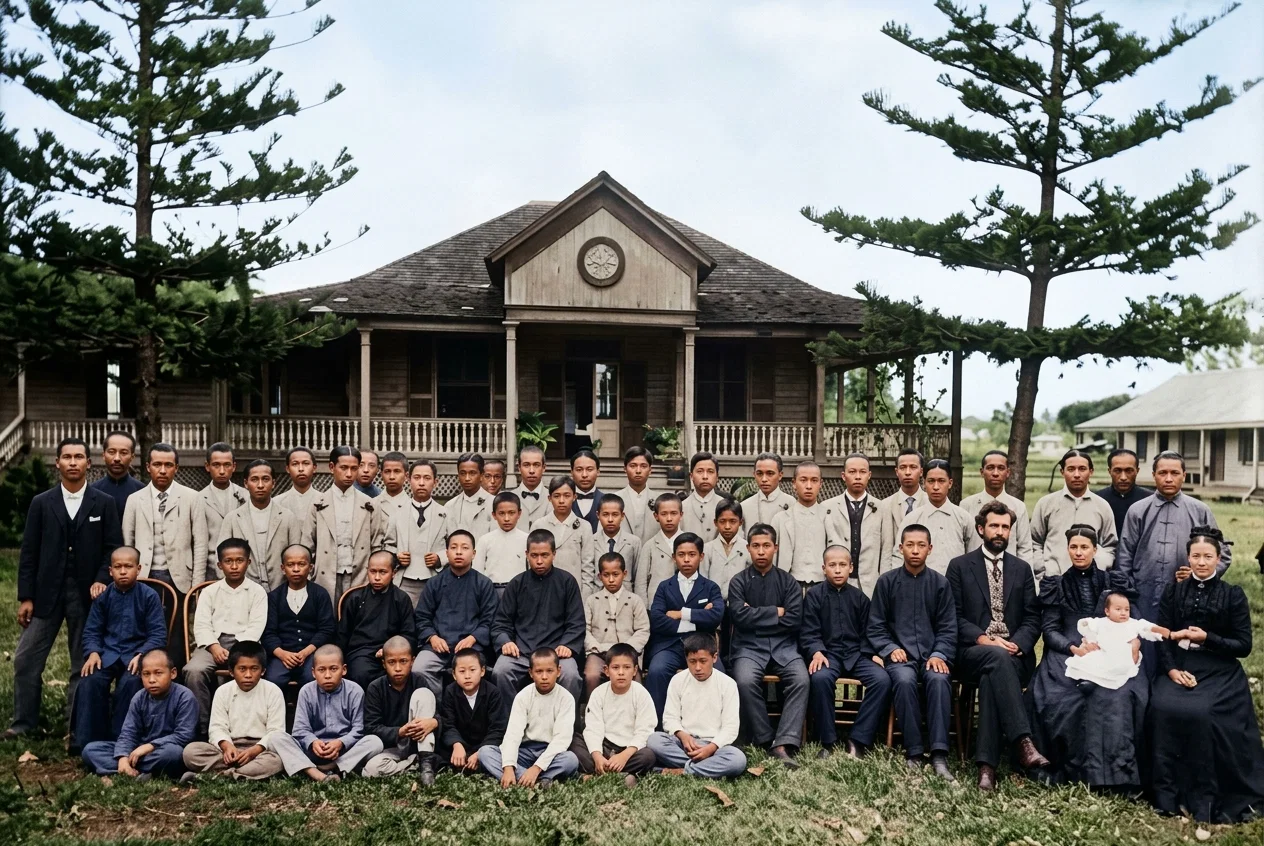
PROF. W. E. HOWELL AND HIS CHINESE SCHOOL, HONOLULU, HAWAII.
CHINA, A NATION WITHOUT GOD
By W. E. Howell
To-day the eyes of the whole civilized world are turned toward China. The grasping greed of nations finds here one more, and it may well be said the last, great territorial opportunity to sate itself on a grand scale; one more country rich in resources, weak in political power, of which to take advantage; one more bone of contention over which there may be a general scramble. With Russia, a military autocracy, intruding from the North and West; with England, the peerless trader, urging her demands and privileges from the South and West; with these two great powers, and also Germany, France, and Japan, having so strong a foothold on the seaboard that China has not a single respectable harbor left for herself; with “Imperial America” approaching; and with internal dissensions gnawing at her vitals, the ultimate fate of China seems fixed. If the Turk “must go,” the Chinaman will follow hard upon him.”
But the eyes of the Lord of lords and King of kings, as they run to and fro throughout the earth, are also upon China, beholding the evil and the good; and He in whose hands are the destinies of nations, while He may permit the hand of greed and oppression to enthral, is sending His silent messengers with good tidings unto the meek, to loose the bands of wickedness, to undo the heavy burdens, to let the oppressed go free, to break every yoke—moral, social, political. The Gospel, this good tidings of the power of God, while it makes no “demonstration” or “parade,” is yet unto salvation; and it is exercised purely in behalf of “humanity.” It will be ultimately successful; and officers and privates and recruits will be impartially “promoted.”
That which will be the downfall of China, considered internally and externally, is described in the Scriptures as “the root of all evil,”—inordinate love of gain. While this has become emphatically the national sin, if there be such, probably in no nation has it become more universally the individual sin than in China. Other nations of importance have preserved at least the form of worshiping the true God; but the Chinese have so far departed from the principles of righteousness that noted writers and thinkers disagree as to whether they ever possessed a knowledge of the true God. One thing is perfectly evident, they are now faithful devotees of Mammon; and since no one can serve God and Mammon, God is the one neglected—they are “without God.” And being without God, they have no hope.
Accepting the Scripture statements applicable to these as well as to all others who have no hope, “Your iniquities have separated between you and your God,” and, “The love of money is the root of all evil,” let us notice briefly some of the results of such separation upon this vast portion of the human race “given to filthy lucre.”
1. “They speak lies.” Perhaps nothing will lead more directly and certainly to lying than greed of gain. In speaking of sincerity, which the Chinese class as one of their five national virtues, one writer says, “If this virtue had been chosen as a national characteristic, not only to be set at defiance in practise, but to form the most striking contrast to existing manners, a more appropriate one than sincerity could not have been found.” Another, of long residence among them, writes: “In China it is literally true that a fact is the hardest thing in the world to get.” And the Chinese themselves frequently say, “As soon as we open our mouths, a lie is born.” So confirmed has the habit of speaking lies become that in detection the speaker evinces no shame, even in “conceiving and uttering from the heart words of falsehood.” It arouses no indignation in a Chinaman to call him a liar.
2. None “pleadeth for truth.” As a result of habitual lying and deceiving, “truth is fallen in the street.” It is painful to see with how little seriousness a lie is regarded. When one of their own number, even a brother, son, or friend, is detected in a lie, it is passed by with some light remark, as a trivial matter. While truth lies prostrate, no one pleads for her, no one tries to lift her up; there is none to rescue—“yea, truth faileth.”
3. “None calleth for justice.” Where truth faileth “equity can not enter,” “and justice standeth afar off,” “neither doth justice overtake us.” Government officials, almost without exception, resort to the selling of justice and so extorting for personal enrichment the substance of their subjects and subordinates ; and they bribe their superiors for self-aggrandizement. Any remonstrance from the victimized is regarded as rebellion against authority, and instantly suppressed.
4. He “shutteth up his bowels of compassion.” Of whom can this be more emphatically said than of those “that will be rich”? Job says of this class: “Thou hast taken a pledge from thy brother for naught, and stripped the naked of their clothing. Thou hast not given water to the weary to drink, and thou hast withholden bread from the hungry.” “Thou hast sent widows away empty, and the arms of the fatherless have been broken.” Among the Chinese, indifference to the sufferings of the sick; desertion of those afflicted with contagious disease, or helpless from any cause; unwillingness to aid, without pay, those in misfortune or distress; derision of the physically or mentally deformed and the childless; rude treatment of the young bride; the woes of daughter-in-law and concubine; inhuman methods of punishing prisoners unable to buy their exemption; and ruthless cruelty in general—all attest, as one writer puts it, that, “tho the10Chinese have ‘bowels,’ they certainly have no ‘mercies.’”
5. “My Sabbaths they have greatly polluted.” The extreme of Sabbath pollution is found in total disregard of its sacred character. The Chinaman knows no Sabbath. He “esteemeth every day alike.” He absorbs all time for pursuing the object of his heart’s desire.
6. They “eat unclean things.” In addition to the many abominations that serve the white man as food, may be mentioned, in the case of the Chinese, the horse, the mule, the donkey, the camel, the dog, and the cat; and these, too, without reference to the cause or manner of death, whether from accident, epidemic, malady, or poisoning by strychnine for riddance—affording opportunity to sell for gain that which costs little or nothing.
7. “Destruction and perdition.” As a culmination to the evil of which the love of money is the root, and as a sequel to its various manifestations pointed out above, those who embark with Mammon as their pilot, are drowned in destruction and perdition.
While in the eyes of the world the Chinese Empire is destined to become the vassal of some greater power, or to be partitioned among several of them, because of their superiority in diplomacy and military strength and the present instability of that tottering kingdom, the Christian sees that “departing from the living God” is in itself suicidal to the nation as well as to the individual; and that hence from internal causes the doom of China is fixed. She “hath grievously sinned; therefore she is removed.” “Her filthiness is in her skirts; she remembereth not her last end; therefore she came down wonderfully.”
And the student of prophecy, recognizing that “the kingdom is the Lord’s, and He is the governor among the nations,” sees only the working out of His providence in releasing a fourth of the human race from the most abject social and moral thraldom ever inflicted by any political power upon its natural subjects. “All her people sigh, they seek bread; they have given their pleasant things for meat.” “The adversary hath spread out his hand upon all her pleasant things.” “How doth the city sit solitary, that was full of people! how is she become as a widow! she that was great among the nations, and princess among the provinces, how is she become tributary?”
“In transgressing and lying against the Lord, and departing away from our God,” darkness has covered “the place of dragons,” “and gross darkness the people.” But “through the tender mercy of our God, the dayspring from on high hath visited us, to give light to them that sit in darkness and in the shadow of death.” “The entrance of Thy words giveth light.” But before the Word may enter with a welcome, may it not be necessary that “the haughty shall be humbled,” and cry, “Behold, O Lord; for I am in distress; my bowels are troubled; mine heart is turned within me; for I have grievously rebelled; abroad the sword bereaveth, at home there is as death.” “The Lord hath trodden underfoot all my mighty men in the midst of me; he hath called an assembly against me to crush my young men.” “He hath made my strength to fall, the Lord hath delivered me into their hands, from whom I am not able to rise up.” “For these things I weep; mine eye, mine eye ranneth down with water, because the comforter that should relieve my soul is far from me; my children are desolate, because the enemy prevailed.” “There is none to comfort me.” “See, O Lord, and consider; for I am become vile.” Then “the Lord shall arise upon thee, and His glory shall be seen upon thee. And the Gentiles shall come to Thy light, and kings to the brightness of Thy rising.”