It was a wonderful meeting, there is no denying it, altho some who did not attend are inclined to doubt the reality of the power which was present, and intimate that it must have been a most fanatical affair, led on by a few cranks. It all came about in this way:—
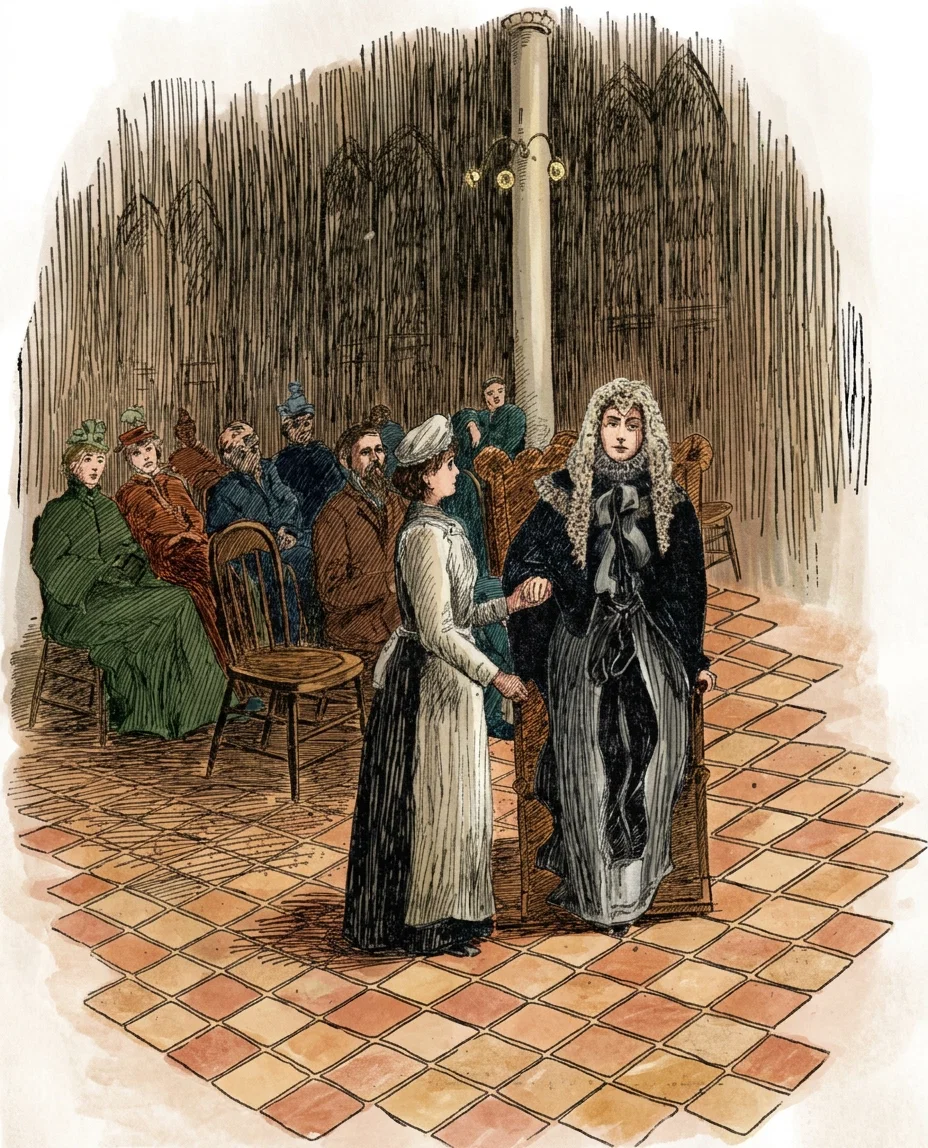
“Taking firm hold of the nurse’s hand, she . . . stepped out upon the floor.”
Our little church organization was in a dreadfully run-down condition. We all knew it; but, much as we deplored the fact, we were all waiting for somebody to take hold and do something, presumably our pastor. That dear old man was fast approaching the grave because of his anxiety and hard work, tho we little realized, then, that we were the cause of it all. The Sabbath before Thanksgiving he astonished his congregation by announcing that there would be no regular service on Thanksgiving day; and then he requested all who felt they had any special blessings to be thankful for, to meet him in the Sabbath-school rooms the evening before Thanksgiving.
To say that we were astonished is really putting it very mildly. The most of us were simply speechless for a time. Omit our Thanksgiving service! When had such a thing been heard of in all the respectable history of our church? We always had the largest congregation of any church in town, for the reason that we owned the finest organ, and could boast the finest choir. Surely the dear old man must be losing his mental balance. And then the appointment of such a queer meeting the evening before! It would only be a cause of mortification and additional worry to him; for no one would attend—at least I was quite sure they wouldn’t if they all felt as I did.
It had been the worst year, financially, ever known in Newton. Our schools, even, had been closed for a part of the year, the town feeling itself too poor to hire sufficient teachers; and sickness had visited the homes of rich and poor alike. We could sit in church and listen to never so elaborate a praise service conducted by our pastor and trained singers; but when it came to individually telling of some blessing received—well, that would be quite another thing.
Wednesday evening came. I had been exceedingly busy that week, too busy to make any calls, and as it happened no one had been in to see me. The most of the housewives had been occupied like myself, I suppose, cleaning house and getting ready for company and a big dinner on Thanksgiving day. So I did not know if any one remembered the appointment for that evening. I had determined that I would go anyway. I had been doing considerable thinking that week along the line of the pastor’s suggestion, even while busy with housework, and had discovered a good many blessings,—blessings which I had been receiving all along; the only trouble had been my stupidity in not recognizing them before. The more I thought about it, the more I felt that the least I could do would be to offer praise in the congregation—provided there was a congregation. I somehow had an impression that I would be the greater part of the congregation that night. A few might come.
Well, I had a chance to be astonished again, for the main room was nearly full. And I think nearly every one else must have felt the same way I did, judging from the way they kept smiling at each other, and looking around every time some one came into the room. It was surprising, the kind of people who were there, too. Not only were the old standbys present, who always came to prayer and missionary meeting, but there was a goodly number of the better class, that is to say, those who considered themselves the élite of the church, and there were a good many more who were usually strangers to meetings of this kind. Even Miss Julia Childs, the judge’s daughter, had been lifted into the room in her elegant reclining chair, and wheeled down the aisle, and she never goes into public unless it happens to be something very special. For over five years she has been unable to bear her weight on her feet, and the judge has spent the greater part of a comfortable fortune taking her to renowned doctors and famous water cures; for she is his only child.
The choir members, without exception, were missing. I think they felt hurt about the Thanksgiving service; for they had practised some lovely anthems, so I heard. Perhaps Elder James had anticipated this; for there was a liberal supply of “Gospel Hymns” scattered around in the chairs when we got there. Even the organist was absent, too; but the doctor’s wife went to the organ, and the way we all sang “Praise Him,” would have been an astonishment to that choir, I think, if they could have heard us. Some of us used to sing in the choir years ago; but I presume many who sang that evening had, like myself, almost forgotten they ever knew how to sing.
After the song, Elder James offered a brief but very earnest petition, and then remarked that the meeting was ours. Whoever felt that he was the most indebted to the Lord for blessings might be the first to begin. He had scarcely ceased speaking before old Mr. Henry was on his feet. “Miser Henry” was the name he had gone by among the townspeople for some years. He lived by himself in a neat little house, and while always at work, never appeared to accumulate anything. Indeed, frequently came to church looking decidedly shabby; but we knew nothing of his life, for he rarely had anything to say to his neighbors, and never was known to give a cent toward any enterprise.
“Friends,” he began—and it seemed to me from where I sat that I could see tears gleaming under his shaggy eyebrows, but perhaps I imagined it—“when I went home after the announcement made here last rest day, I was nearly ready to curse the pastor here, churches in general, and even the Creator. But I feel thankful to-night that I know the power of that God to change even the hardest heart. I have a son who years ago ruined me financially, and has ever since been nothing but a cause of shame and sorrow. What had I enjoyed in the way of blessings from the hand of God? All I loved was laid in the churchyard, and many’s the time I’ve wished that the one left me had been put there too. But this week that thought of blessings would keep to the front.
“Early in the week a letter came. I knew from the postmark that it was from my son, probably a demand for more money, and so tossed it onto the table without opening it. That’s one of my blessings, I said to myself, as I went off to my work; and the letter lay there for two days. But I felt all the time that I ought to open it; and when I did”—here the old man’s voice faltered a little—“it contained news that melted even my old heart. My son had been converted. His letter was brimful of confession to me, and of all the wonderful things that the Lord Jesus was doing for him. Isn’t there a text, pastor,” turning toward Elder James as he spoke, “which says something about the hearts of fathers being turned to their children? I’m sure I’ve heard you repeat something like that, tho I couldn’t find it. I tell you if any man has reason to feel grateful to the Almighty, it’s John Henry—and that’s my name. And here, deacon,” turning to one who sat next him, and at the same time diving his hand down into his pocket, “here’s all I have now, but with His blessing there will be more after this; for all that I am and have, unworthy as the gift is, have given to Him.”
The amens just rolled through that room when he sat down. I think I must have said something myself like, “Praise the Lord,” right out loud. I know I felt like it. And then occurred what to us was still more astounding.
As Mr. Henry sat down, we noticed Miss Julia, the invalid, you know, motion to her attendant, who quickly stepped forward to her chair. Taking firm hold of the nurse’s hand, she first raised herself up, and then stepped out upon the floor. Not only that, but, seeming to gather new strength from each effort made, she let go the hand of her nurse, and, stepping firmly across the room, mounted one step to the little13platform where Elder James was sitting. We could all see her distinctly, and her face was radiant with the light of a power the manifestation of which for the moment seemed to paralyze us. In that brief space of time, when she stood facing us, I felt almost afraid to breathe, the silence was so intense. Then she spoke, and the memory of her voice on that occasion thrills me yet.
“What you see,” she said, “is simply the Lord fulfilling His part of a compact which I made with Him several days ago. No, do not think me irreverent,” she continued, seeing the look which came into the faces of some before her; “for never was compact more solemn than this one; and it only remains, now, for me to fulfil my part of it.”
Then she told how for some weeks she had been seeking the Lord to know the reason of her affliction; how she had humbled her heart before Him, confessing every sin; but it was not until she left off looking at her own suffering, and began to look to Jesus, that she saw the blessings surrounding her. Then peace came into her heart. One morning she opened her Bible to the thirtieth psalm, if I remember right. She read only to the second verse; for it contained a statement which struck her with force. She repeated it so distinctly: “O Lord my God, I cried unto Thee, and Thou hast healed me.” Like a flash it seemed to come over her that if God did that for David, why would He not do it for her? Glancing up, her eyes rested upon another portion of the Word—an illuminated text hanging just over her couch, “I will go in the strength of the Lord God; I will make mention of Thy righteousness.” Her education had been such all her life that she was very much opposed to women having anything to say in public; but now a resolve was made, and she told it to the Lord. She promised Him she would attend the next social meeting—and this Thanksgiving praise service was the next—and that if He would there give her strength to get upon her feet, she would acknowledge before all present that it was of the Lord. “Now I can indeed say, ‘I cried unto the Lord, and He has healed me.’ All that I am, the new life He has given me, I here consecrate to Him and to His service.”
When she crossed the room again, and sat down, this time not in her cushioned wheel-chair, but in one of the chairs by the side of her astonished and wondering nurse, there was still the same silence. We felt so deeply, it seemed no place or time for any one else to speak. Then the voice of our pastor broke the silence, singing:—
“There shall be showers of blessing,
This is the promise of love;
There shall be seasons refreshing,
Sent from the Saviour above.”
Before he had finished the first line, we had all joined in, and by the time the chorus was finished, there must have been a dozen on their feet, all waiting their turn to speak. I wish I could remember all that was said. Every one either had some confession to make, or something of special interest to tell, and all were so full of praise.
Not every one in the room spoke; that would sound too much like a story. I suppose some came just out of curiosity to see what the meeting would be like; but I am sure they got all they came for. Why, that meeting never broke up until ten o’clock! There seemed to be no chance to close, even if Elder James had desired to, and I am sure he did not. All this time he sat there smiling, sometimes through tears, never saying anything but a good strong amen, or starting a verse of some familiar hymn.
Another thing: The meeting had not been long in progress before I appreciated the reason for its being appointed the evening before Thanksgiving. Almost without exception every one who testified to the goodness of the Lord wanted to give a little something substantial,—a thank-offering; and the way the poor box filled up that night must have gladdened the eyes of our pastor, who has been obliged for many months to withhold help that was sorely needed, because of the bankrupt condition of our poor fund. Strange, but it always seems to work that way. When the Spirit of the Lord begins to work on a man’s heart, it is sure to open his pocket-book. I have realized that the same is true of a woman also.
The result of it all?—Why, there was such an awakening in our little church as had not been witnessed in many years. As the revival was not started by any special sermons or evangelistic effort, the praise all belongs to the Lord. Of course some scoffed, and said, “Wait a little while.” But when men begin to praise the Lord, the blessings of a new life—a changed life—are sure to follow. And when a church is full of life—well, “I have set the Lord always before me; because He is at my right hand, I shall not be moved.”