JOTTINGS FROM PALESTINE. NO. 14. Bethany, Tombs of the Kings, etc.
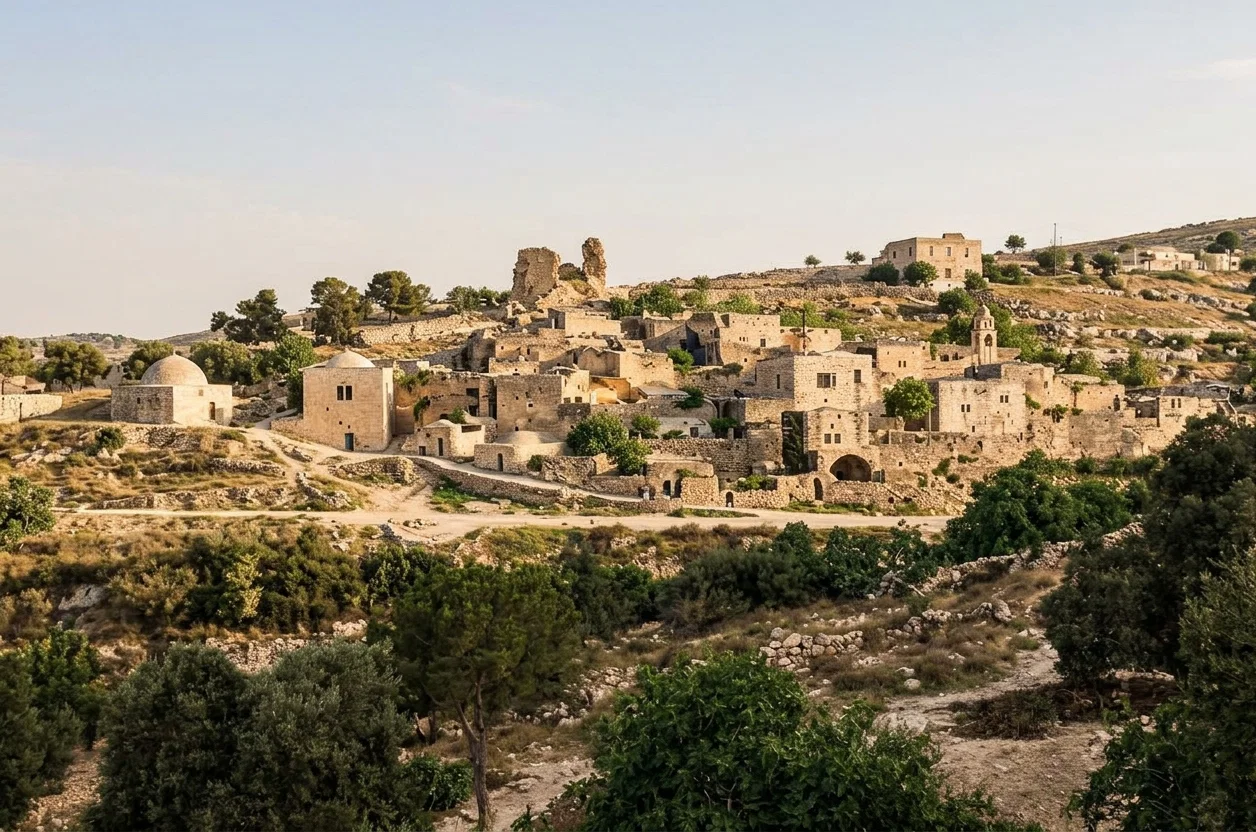
A VIEW OF THE BETHANY OF TO-DAY.
At the close of our last sketch we were on the Mount of Olives. Let us now pass over the summit to the east. In this direction, as well as to the north, the mount recedes gently, while to the south and west the descent is rapid, forming a deep valley. It is but a short distance from the summit down to Bethany, the home of Mary and Martha and Lazarus. Jesus made His home with this family more than any other during His sojourn in Jerusalem. During the day He was in the temple, teaching, but at night He returned to the Mount of Olives, to Bethany.
At present Bethany is a small village of Arabs, who evidently gain their living principally by begging of tourists and pilgrims. The village is full of children and youth, any of whom is ready to show, for a small fee, the tomb of Lazarus and where the house of Mary and Martha stood. Some of the smallest I met, just able to walk, had already begun to learn their future trade by lisping their first word, “Lazarus.”
Nothing certain is known about the house and tomb, but the village is known to occupy the same place now as anciently. Hence the general outlines of the place are the same now as in the time of Christ. Olive, fig, and almond trees are quite numerous here, giving the place a pleasing appearance in contrast with the rocky and more barren higher slopes of the Mount of Olives. Bethany is near the main road leading from Jerusalem to Jericho, at a distance of two miles. It takes about forty minutes to walk from Jerusalem to Bethany. The easiest way to reach it is by the Jericho road leading around the southern slopes of the Mount of Olives; but there is also a foot-path leading over the summit of the mount, and, judging by the Scripture narrative, Jesus took the latter route.
The Mohammedans regard Lazarus as a saint, and hence have a mosque near his tomb. The family of Mary and Martha and Lazarus must have been quite well known in Jerusalem; for at the death of Lazarus many came from the city to comfort them, and thus witnessed the resurrection of Lazarus. It was this miracle more than any other that stirred up the Pharisees to put Christ to death. John 11. Few scenes in the life of Christ are described in such detail as this; hence Bethany is a place of special interest. Here the Master sat and taught; here He wept in sympathy for mourning hearts; here He demonstrated the fact that He is the resurrection and the life; and here, while at the feast prepared for Him after the resurrection of Lazarus, Mary anointed His feet with the precious ointment and wiped them with her hair.
The next day after this feast at the house of Simon the leper, as Jesus goes to Jerusalem, at the descent of the Mount of Olives He is met by the throng with palm branches. The next day, in again going from Bethany to Jerusalem, the deceptive fig tree withers at His word. And when He takes His last walk with His disciples, it is over the Mount of Olives, doubtless by the same way which He had so many times traversed; passing for the last time the Garden of Gethsemane, He conducts them to Bethany, and thence ascends to heaven. Luke 24:50, 51. On going to the city after the ascension, it is stated that the disciples returned “from the mount called Olivet.” There is no contradiction here, as some have supposed; for Bethany is on Mount Olivet, but a short distance east of the summit, and considerably lower. In locating the point of ascension on the summit of Olivet half a mile from Bethany, tradition ignores the plain statement of the inspired record. The Mount of Olives is the last place which Jesus trod before He ascended, and it will be the first on which He will place His feet when He returns to restore all things. Zech. 14:4.
Returning from Bethany over Mount Olivet, and passing Gethsemane, we think of the returning disciples, as they went back to Jerusalem to wait for the outpouring of the promised Spirit; and we meditate on the words spoken from Olivet by the Master, which plainly indicate that we are in the time of the latter rain, when we, like the disciples, should seek with one accord the refreshing from the Lord.
Instead of entering the city, we walk up the Kidron Valley to the north, and follow a road leading from the Damascus Gate to the new suburbs here springing up, to the tombs of the kings. Like the catacombs of Rome, they are beneath the surface of the ground, and are hewn from the native rock. First, there is an extensive uncovered space for assemblies, and then large rooms in the rock round about. From the chambers in the rock are passages leading to other chambers, and places for the dead are cut in the rock on the sides of the chambers. The door from the assembly space to one of these chambers is of special interest, as it is believed to illustrate the form of door used in the time of Christ. It consists of a large disc like a grindstone, fitted in grooves in the rock above and below. To open the door, this stone, like a wheel, is rolled to the side. Some of the doors are so low that one is obliged to go on hands and knees to enter. The door of the tomb of Christ was so low that it required “stooping down” to look into it.
Not far from the tombs of the kings is a heap of ashes, believed to be the ashes from the temple sacrifices. What was formerly a large mound has now almost wholly disappeared, the ashes being used in making mortar. Judging by the Scripture statements about the crucifixion of Christ, it is quite likely that it took place in this vicinity, near the great route leading from the Damascus Gate. This was the road for all travel from Samaria, Galilee, and Syria,—the route which Jesus took when coming from Galilee to Jerusalem.10
Another walk which we enjoyed was from Jerusalem south to the plains of Bethlehem, a distance easily covered in two hours. An hour’s walk from Jerusalem, nearly south, brings one to a gentle height, affording a splendid view of the plain of Bethlehem, and the village standing out so boldly on its mound. From the time of Boaz and Ruth, Bethlehem and its plains have been of peculiar interest. At present the population, 8,000, is nearly all Christian. Many churches, schools, and various Catholic institutions are located here. Every event mentioned in the Bible as having occurred at or near Bethlehem has been located.
About an hour’s walk southwest of Bethlehem are the pools of Solomon, three huge reservoirs partly hewn from the rock and partly built up with stone walls, and fed by springs; these reservoirs were connected with Jerusalem by pipes, portions of which still remain.
We now return to Jerusalem by the excellent carriage road which leads to Bethlehem and Hebron. The many carriages coming and going indicate that there is lively traffic between the two cities. The fields on both sides of the road are tolerably well tilled. We also meet many pedestrians, some of whom are barefoot, and others wear sandals, an oval piece of leather covering the bottom and sides of the foot, and fastened over the top with strings. We have now completed our walks about Jerusalem, and will next continue our journey to Joppa.