THANKSGIVING DAYS

8%

Pacific Press Publishing Company · Oakland, California · Nov 17, 1898

FromSigns of the Times, Vol. 24, No. 46.

Read the full edition

THANKSGIVING DAYS.

The first record we have of national thanksgiving days is among the Hebrews. The Feast of Tabernacles, beginning on the fifteenth day of the seventh month, was the great thanksgiving feast of Israel. Instructions concerning it are found in Lev. 23:34-44; Num. 29:12-39, and Deut. 16:13-16.
It was a seven-day thanksgiving feast. So is its nature set forth: “Thou shalt keep the feast of tabernacles seven days, after that thou hast gathered in from thy threshing-floor and from thy winepress; and thou shalt rejoice in thy feast, thou, and thy son, and thy daughter, and thy man servant, and thy maid servant, and the Levite, and the stranger, and the fatherless, and the widow, that are within thy gates.” See Deut. 16:13-16; 1 Kings 8:2; Neh. 8:17; John 7:2, 37. The feast commemorated the wanderings in the wilderness; it was a season of thanksgiving to God for the fruits of earth; and it was typical of the great “harvest home” of God, when the weary pilgrims to Zion will wander no more, and the ingathering of God will have taken place. See Zech. 14:16-19.
On every seventh year the law was read at this feast. This national feast was really the feast of the church; for the nation was the church.
The harvest feast, held variously in various lands, with more or less heathenish custom connected with it, is no doubt the perversion of true thanksgiving services of grateful acknowledgment to God for the bounties of earth.
The first public Thanksgiving day of New England was held in the autumn of 1621. “Governor Braddock,” we are told, “sent out four men to gather game, so that the whole colony might ‘rejoice together,’ after they had garnered the fruits of their labor.” One queries whether they could not have rejoiced just as well without flesh food as with. The following year (1622) an old chronicle informs us they “solemnized a day of thanksgiving unto the Lord;” and another chronicler says that the Indian Massasoit and his court were invited to take part in the rejoicings, and that they remained three days feasting on venison. The services of those days would hardly be tolerated now in these times of nervous haste and waning devotion. A little more than two centuries ago two men went to Boston and attended church services, where one minister made a prayer at the beginning “of full two hours in length, after which an old minister delivered a sermon an hour long, and after that a prayer was made and some verses sung out of the Psalms. In the afternoon three or four hours were consumed with nothing except prayers, three ministers relieving each other alternately; when one was tired the other went up into the pulpit.” And here is a record of a thanksgiving day service of Dec. 22, 1630:—
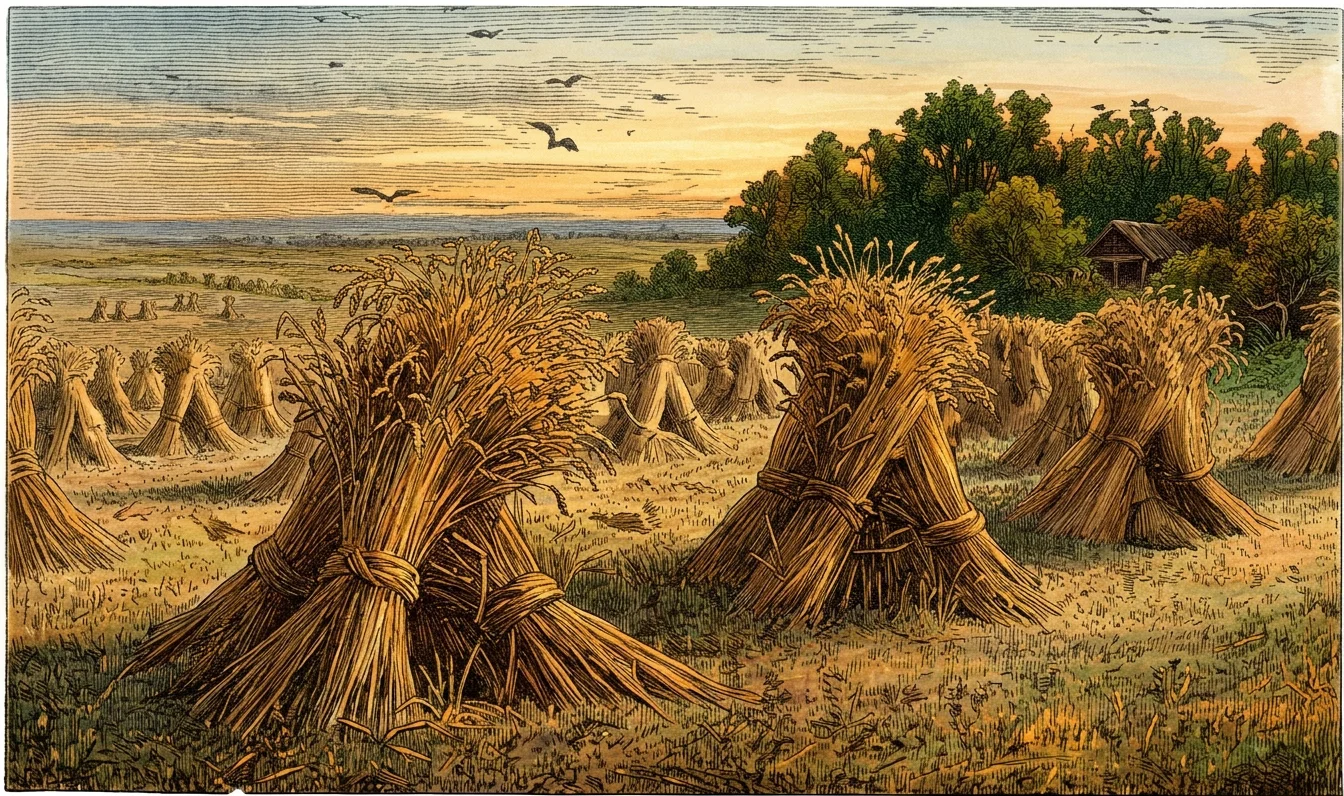
Harvest of Canaan.
Harvest of Canaan.
“Beginning some half an hour before nine, and continued until after twelve o’clock, ye day being very cold—beginning with a short prayer, then a psalm sung, then more large in prayer, after that another psalm and the Word taught, after that prayer and then a psalm.”
The first public thanksgiving, appointed by authority, in America, was proclaimed in Massachusetts Bay Colony in 1631. February 22 of that year had been appointed as a fast in consequence of a scarcity of provisions, but before the day came, a ship laden with provisions came, and the fast day was changed to a day of thanksgiving.
In February, 1644, a public thanksgiving day was appointed in New Netherlands by Governor Kieft, on account of a victory over the Indians, and again the next year, when peace was concluded. The custom, local and general, was in vogue in the several colonies, and the Continental Congress adopted it. The following days were appointed during the war of the revolution: Thursday, July 20, 1775; Friday, May 17, and Dec. 11, 1776; Wednesday, April 22, 1778; Thursday, May 6, 1779; Wednesday, April 6, 1780; Thursday, May 3, 1781; Thursday, April 25, 1782. These were made by recommendation of the Continental Congress to the several colonies. Washington appointed Dec. 18, 1777, a day of general thanksgiving by the continental army; again at Valley Forge, May 7, 1778. As President, Washington appointed Thursday, Nov. 26, 1789, as a day of general thanksgiving throughout the United States; also Thursday, Feb. 19, 1795.
The Protestant Episcopal Church, in its Book of Common Prayer, revised 1789, directs the first Thursday of November (unless another be appointed by the civil authorities) “to be observed as a day of thanksgiving to almighty God for the fruits of the earth,” etc. The custom in this country may be said to have originated in New England, gradually spreading to other parts.
It is only recently that Thanksgiving day has become a national holiday, with regular yearly appointment by the President and governors of the States on the last Thursday in November. As late as 1863 it was appointed for August 6.
Such a day, it will be evident to all, can not be arbitrarily appointed by civil authority, because civil authority can not make men thankful to God. At the most, a magistrate can only recommend it; the people should be free to elect as to its observance; for true thanksgiving must be willing. And it not infrequently is the case that a man could show himself to be more thankful by working than by using the day as directed by civil law. To be truly thankful there must be true appreciation of God’s goodness, and in the absence of this, civil authority can neither direct nor compel. In its presence, who is a better director than God, who inspires the gratitude? X.