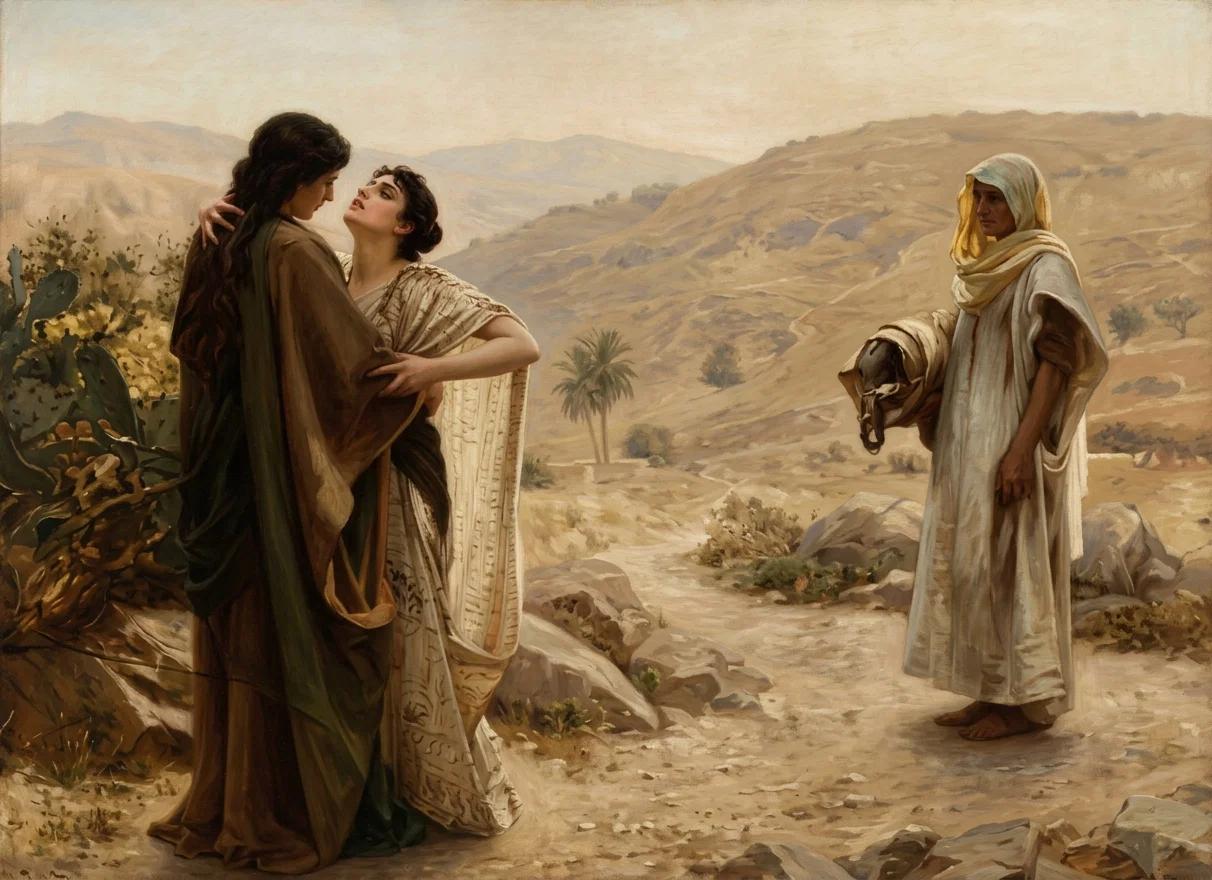
RUTH AND NAOMI

5%

Pacific Press Publishing Company · Oakland, California · Nov 10, 1898

FromSigns of the Times, Vol. 24, No. 45.

Read the full edition

RUTH AND NAOMI.

TRUTH, oftentimes, is stranger than fiction, and in many life histories is seen more real romance than is depicted by the pen of the imaginative novelist. Thus it is in the beautiful story of Ruth and Naomi.
“And Ruth said, Intreat me not to leave thee, or to return from following after thee; for whither thou goest, I will go; and where thou lodgest, I will lodge; thy people shall be my people, and thy God my God.” Ruth 1:16.
The recital begins at the little town of Bethlehem, the birthplace of our Lord, in the land of Judah. There is a severe famine in the land. A man by the name of Elimelech, with his wife, Naomi, and their two sons, Mahlon and Chilion, emigrate to the land of Moab, to the southeast of Judah, there to find sustenance. Sometime during this sojourn, probably in the early part, Elimelech dies. The two sons unite their life interests with two Moabitess women, Chilion, the younger, marrying Orpah, and Mahlon wedding Ruth, the chief and central figure in the narrative.
Shortly after the death of the father, the head of the household, the two sons likewise die, and Orpah and Ruth are left widows, together with their aged mother-in-law. Upon Naomi the bereavement comes as a threefold portion. In the death of her husband she had still the comfort of children as her support; but now, with all gone, no wonder that her broken heart turns with longing to her early home, to find in association with her old-time friends the comfort denied by the land and friends of her adoption.
Weeping for the last time over the tombs of her loved ones, with sorrowful heart she turns her face toward the western hills of Judah.
Shall she go alone? In the minds of Orpah and Ruth there is a question as to what is their duty to their aged mother, to whom they have become so greatly endeared by association and by their mutual afflictions. Can they leave their own blood relatives, their home, the gods of their fathers, and enter a strange land? Naomi, even in her great sense of loneliness, shows the unselfishness of her heart, softened and made tender by sorrow. She fears that if her daughters accompany her to the land of Israel, they will regret the step. With her larger experience, she counts the cost, the trial and hardship before them, and she tests their love by presenting to them the fact that there is no temporal advantage to be gained by them in husband or possessions. Orpah hesitates. She has been moved by feeling and sentiment, and not by genuine love and depth of principle; but Ruth has counted the cost; she will renounce her gods, her home, her friends, her all, and henceforth serve only the God of Naomi.
Orpah kissed her mother-in-law, and turned back again to the plains of Moab; “but Ruth clave unto her.” Again Ruth’s loyalty and strength of purpose are tested. “Behold,” says Naomi, “thy sister-in-law is gone back unto her people, and unto her gods; return thou after thy sister-in-law.” But Ruth said: “Entreat me not to leave thee, or to return from following after thee; for whither thou goest, I willlodge; thy people shall be my people, and thy God my God; where thou diest, will I die, and there will I be buried; the Lord do so to me, and more also, if aught but death part thee and me.”
Noble answer, showing strength of purpose, depth of devotion, and unswerving friendship. When Naomi “saw that she was steadfastly minded to go with her, then she left speaking unto her.” It can not be understood that Naomi was indifferent to the companionship of Ruth. In her sore perplexity and loneliness, she must certainly have appreciated such association; but she would guard Ruth against the disappointments of the future by so sifting her purpose as to demonstrate its real strength and its actuating motive.
The return of Naomi to her native town was an occasion for considerable stir and excitement. “All the city was moved about them, and they said, Is this Naomi?” The depth of her sorrow is indicated by her answer: “Call me not Naomi [that is pleasant], call me Mara [that is bitter]; for the Almighty hath dealt very bitterly with me.” It was evidently not the lack of faith that prompted this expression, but the oppressive, bitter sorrow of the soul which uttered itself in this lament.
The reduced circumstances of Naomi and Ruth required that immediate efforts be put forth to gain a livelihood; for the inheritance at one time possessed by the family of Elimelech must have passed to the hands of others, and thus Naomi was penniless in her own land.
The character of Ruth is again manifested in this experience. She goes into the harvest-field of a wealthy man named Boaz, to glean behind his reapers. In this occupation her discreet, modest demeanor, her filial affection for Naomi in supporting her by daily toil, became the subject of general and favorable comment, and all the people came to regard her as a young woman of virtue and uncommon worth. Boaz takes notice of her spirit, and instructs the reapers to favor her efforts at gleaning; he also takes pains to provide for her temporal necessities, by directing her to share the common meal, eating and drinking with his other maidens. And Boaz said unto her; “It hath fully been showed me, all that thou hast done unto thy mother-in-law since the death of thine husband; and how thou hast left thy father and thy mother, and the land of thy nativity, and art come unto a people which thou knewest not heretofore. The Lord recompense thy work, and a full reward be given thee of the Lord God of Israel, under whose wings thou art come to trust.”
That these comforting words of Boaz were not prompted by selfish motives is indicated by his relation as an employer to all engaged in his service. When he came from Bethlehem into his field, his salutation to the reapers was, “The Lord be with you,” and they answered, “The Lord bless thee.” A different relationship and a different feeling, truly, than ordinarily exist between employer and employee, especially in our own day, when the the prophecy of God indicates, and the facts prove, that the laborer is ground down by the men of power and wealth. What a lesson this kindly Christian courtesy, existing between Boaz and his reapers, furnishes!
Ruth soon learns from Naomi that Boaz is a near kinsman to her deceased husband. Naomi soon afterward proposes a plan to Ruth whereby she is to acquaint her employer of this fact, and learn from him if it is his purpose to fulfil the part of a kinsman toward her. The purpose of Boaz to do this had evidently not passed his mind; for he assures Ruth of his intentions according to the custom of the Israelites, to take her for his wife, purchasing back the inheritance of Chilion and Mahlon. But the priority of this privilege belongs to another kinsman who is of closer relationship to the family of Elimelech than is Boaz, and this right Boaz first accords to him. He refuses, and the way is opened for Boaz to make Ruth, the Moabitess, his wife.
“And Boaz said unto the elders, and unto all the people, Ye are witnesses this day, that I have bought all that was Elimelech’s, and all that was Chilion’s and Mahlon’s, of the hand of Naomi. Moreover Ruth the Moabitess, the wife of Mahlon, have I purchased to be my wife, to raise up the name of the dead upon his inheritance, that the name of the dead be not cut off from among his brethren, and from the gate of his place; ye are witnesses this day. And all the people that were in the gate, and the elders, said, We are witnesses. The Lord make the woman that is come into thine house like Rachel and like Leah, which two did build the house of Israel; and do thou worthily in Ephratah, and be famous in Bethlehem; and let thy house be like the house of Pharez, whom Tamar bare unto Judah, of the seed which the Lord shall give thee of this young woman. So Boaz took Ruth, and she was his wife.”
It is interesting to note in this connection that from this union sprang Obed, who was the father of Jesse and the grandfather of David, and of this line came Christ, the Saviour of men.
This is the story of the book of Ruth. Many are the lessons of practical value which may be gleaned from its perusal. The devotion of Ruth to Naomi, the mother of her husband, at this time an old woman, whose life had been saddened by sorrow, is indeed commendable.
Her purpose to accompany her mother-in-law to her own land, to labor and toil with her, and to care for her until she died, shows indeed the depth of a daughter’s true love. And all this, together with her subsequent decorous, modest conduct, makes her an illustrious example of decorum to every young woman in every age.
The influences of evil to-day are rapidly lessening the regard of the young for the aged and the infirm, and even for their own parents. With many of the young the practical duties of life are becoming positively distasteful. It is considered the prerogative of the father and mother to toil and labor, and the privilege of the child to spend freely the harvest of the toil.
The daughters may learn to play, to sketch, to do fancy work, to entertain callers; but, as many regard it, to the mother belongs the toil, the care, and the anxiety of the household duties. Nor are the children alone responsible for this estimate of the relative position of parent and child as held by many in the world to-day. While the parent has sought to give the child an education as pertaining to books, the practical work which should have been connected with the theoretical has been strangely neglected. They have failed to teach their children that physical labor was a Godsend instead of a curse, and that all kinds of honest occupations are honorable.
The reward received by Ruth in forsaking the gods of Moab, and turning to worship the true God, proved a justification of her practical faith. He who waits to engage in God’s service until some promise of temporal gain presents itself, is inspired at best only by selfish motives; but he who steps upon God’s naked promises demonstrates the loyalty of his love and the sincerity of his purpose; and, altho to that man there may appear many obstacles, and the road may seem dark before him, the end of the road will be lightened by the glory of God’s precious presence and the sunshine of His favoring grace. F. M. WILCOX.