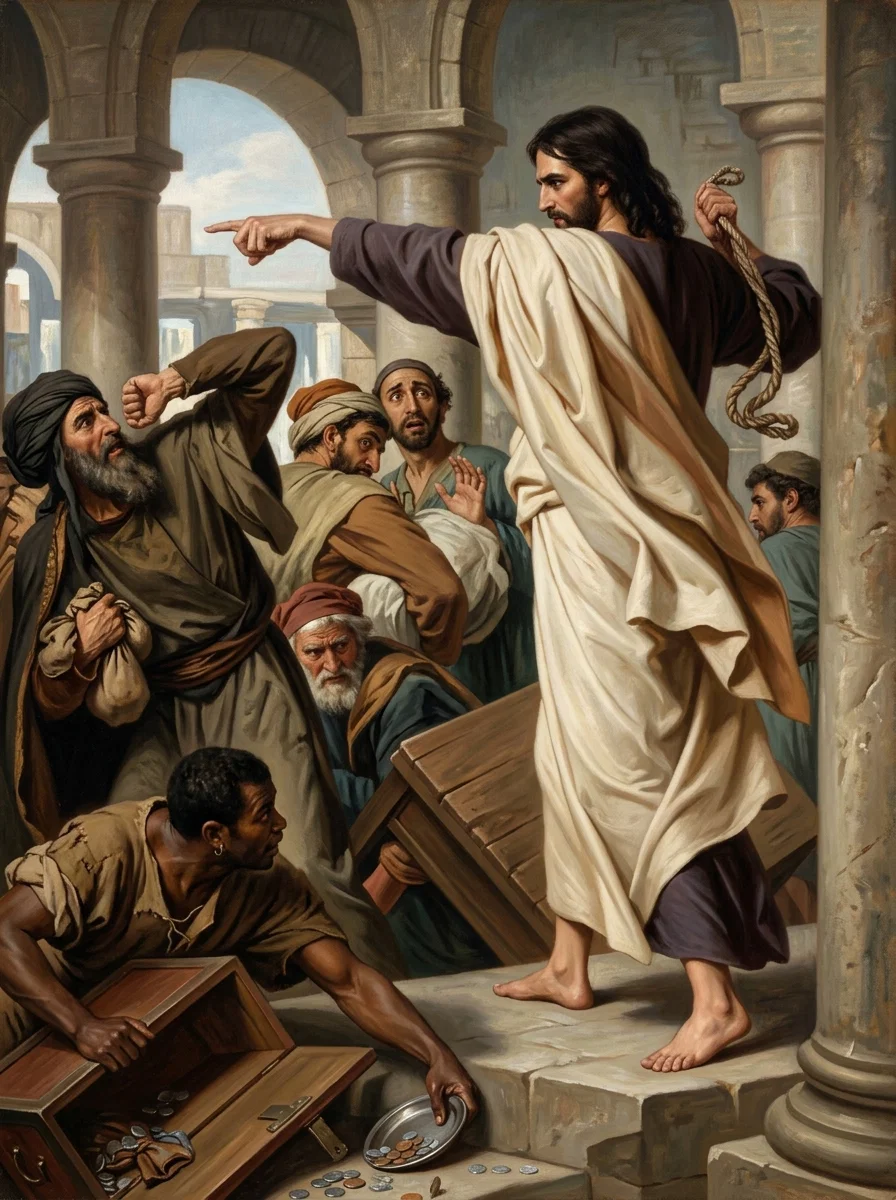
CLEANSING THE TEMPLE

7%

Pacific Press Publishing Company · Oakland, California · Nov 3, 1898

FromSigns of the Times, Vol. 24, No. 44.

Read the full edition

CLEANSING THE TEMPLE.

The invitation of God is for all mankind to come to Him. But in order that any, or all, may come into His presence, a mighty transformation must be effected in the human heart.
“And Jesus went up to Jerusalem, and found in the temple those that sold oxen and sheep and doves, and the changers of money sitting; and when He had made a scourge of small cords, He drove them all out of the temple, and the sheep, and the oxen; and poured out the changers’ money, and overthrew the tables; and said unto them that sold doves, Take these things hence; make not My Father’s house a house of merchandise.” John 2:13-16.
“Blessed are the pure in heart; for they shall see God,” are the words that define the character of those who shall stand before the great white throne, and look upon the spotless purity and ineffable glory of Him who sits thereon. In contemplating the majesty of the Lord, the question is forced from the lips of the inspired psalmist, “Who shall ascend into the hill of the Lord? or who shall stand in His holy place?” And the answer is, “He that hath clean hands, and a pure heart.” Ps. 24:3, 4.
Solemn words are these, for they are the knell of despair to the majority of the human race. Nevertheless, it need not be so, for there is a way whereby the natural heart can be cleansed of all its indwelling and natural wickedness.
Not long after the beginning of His ministry, Jesus, clad with zeal for His work, and with heart filled with love for a lost world, came up to Jerusalem, and to the temple. About this sacred spot clustered the memories of a thousand years. The sight of its magnificence recalled the glory of Israel in her better days, when God marched forth gloriously and gave victory to her armies, and when were brought to her feet the splendor and the wealth of all lands. Within its sacred precincts, hidden from curious gaze, were the mysterious rooms fashioned after that sanctuary whose pattern Moses saw in the mount, and where had dwelt, and still dwelt, tho trembling on the verge of departure, the holy symbol of the Divine Presence.
This was God’s house, His dwelling-place among the chosen people. Contemplating its great design, the mind of the Saviour sped back through a decade and a half of centuries, to a time when was uttered the promise that where His name should be recorded, there would God bless His people. Foremost in the thrilling history of those earlier days were the divine lessons teaching the sacred character of every appointment in His worship. The awe-striking manifestations at Sinai, the carefulness of conduct in and about the sanctuary enjoined upon all who approached it, and the swift and fearful judgments that came upon its desecrators, proclaimed in no uncertain manner in those days that the place where God met with His people was to be free from all pollution, a place whose courts were made holy by His presence.
But now, what a change! From those courts, dedicated to prayer and praise, there rolled the confused clatter and clangor of traffic. Upon the ear fell the sound of lowing of cattle and bleating of sheep, the shouts of buyers and sellers, the disputings and wranglings at the tables of money-changers,—in brief, the din of a city’s market in the courts of prayer. The occasion demanded a lesson. And Jesus drove them all out.
Never in all His work on earth did our Saviour perform an act devoid of special significance. So in this instance; failure on the part of those who professed to be bearers of light, to let that light into their own souls, had developed in them only darkness, and sacred things lost their sacredness, and were treated by them as common and profane. His act was first of all a rebuke, because of the use to which they had put the house where God had chosen to place His name. Thus it was a direct implication that they were not right in the sight of a holy God, and was designed to lead them to consider their spiritual barrenness and need of a Saviour.
With a convincing power more forcible than words of argument, it also showed them that the One whose power was sufficient to cleanse a temple of stone, was almighty to cleanse the soul temple of its pollutions and defilements, and that He yearned with the yearnings of infinite love to do the work for them. Not a new truth this, but one eternal as the ages, and the one great lesson for all time.
With a love as strong and as broad, and with power as infinite as in other days, the blessed Saviour stands to-day at the gates of each human soul temple and asks permission to enter and cleanse its courts of every abomination and unnamable defilement. He claims the temple as His, and would place there His name, and the name of the Father, and they two would dwell there, enthroned in the innermost chamber. “We will come unto him, and make Our abode with him.” John 14:23. “Whose house are we, if we hold fast the confidence and the rejoicing of the hope firm unto the end.” Heb. 3:6. “Know ye not that your body is the temple of the HolyGhost which is in you, which ye have of God, and ye are not your own? for ye are bought with a price; therefore glorify God in your body, and in your spirit, which are God’s.” 1 Cor. 6:19, 20.
Yes, indeed, despair would claim us if we were left to our own resources to reach the state of purity and holiness that must be reached to stand in the presence of a holy God. But be it known in all places of all His dominion, even in the darkest and most secret places, that the Lord of heaven and earth expects no one to do the work by himself, because there is absolutely no power in any creature to do the work himself; but “the blood of Jesus Christ His Son cleanseth us from all sin.” 1 John 1:7.
“Who may abide the day of His coming? and who shall stand when He appeareth? for He is like a refiner’s fire, and like fuller’s soap; and He shall sit as a refiner and purifier of silver; and He shall purify the sons of Levi, and purge them as gold and silver, that they may offer unto the Lord an offering in righteousness.” Mal. 3:2, 3. “Create in me a clean heart, O God; and renew a constant spirit [margin] within me.” Ps. 51:10. “Now ye are clean through the word which I have spoken unto you.” John 15:3.
Let Him do it now, for the cleansing and purifying of that day will be thorough, so thorough that with the sin will pass away all the dross,—everything upon or in which sin shall be found. And the glad part of it is that by His power He does the work in a moment, so that freedom and a new creation are only a moment away for any one, for you if you have it not now. Believe in the mighty power of God. O, believe! L. A. PHIPPENY.