The Mount of Olives

6%

Pacific Press Publishing Company · Oakland, California · Nov 3, 1898

FromSigns of the Times, Vol. 24, No. 44.

Read the full edition

The Mount of Olives

JOTTINGS FROM PALESTINE. NO. 12.

The Mount of Olives.
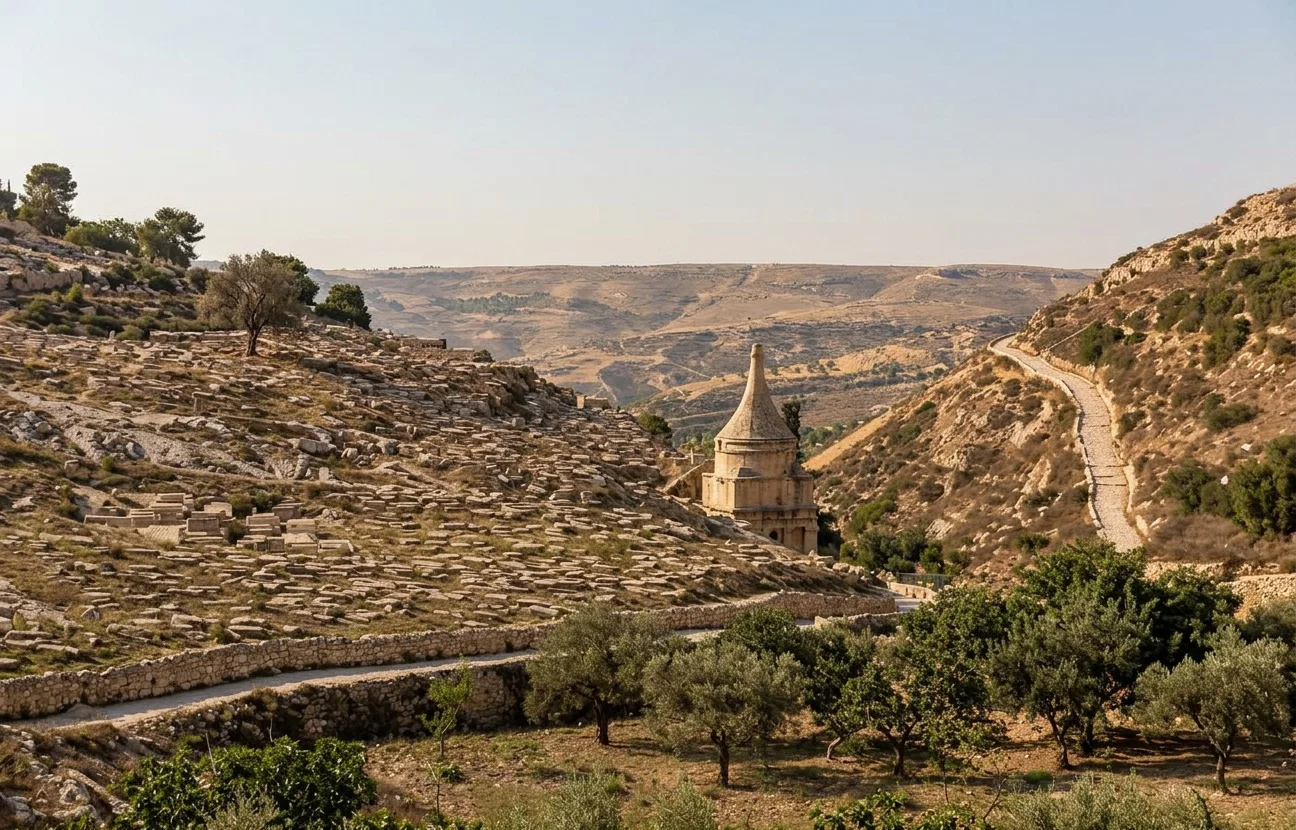
Nothing about Jerusalem had so great attraction for me as the Mount of Olives and vicinity. To visit this most interesting place we leave the city by Stephen’s Gate, the only one in the east wall; it is located but a few steps north of the temple area. The Golden Gate, leading to the temple grounds, is walled shut. From the gate we have a good view of the Kidron Valley, the Garden of Gethsemane, and the Mount of Olives. Looking down the Kidron Valley to the south, we see several monuments, the first of which is that of Absalom, which he himself had erected. Evidently he was afraid to trust this to his survivors; and, judging by the course of the Jews to-day, he was not mistaken in his fears; for when they pass by his monument, they pelt it with stones. Excepting the top, this monument is cut from the native rock, and will stand as long as time lasts.
ABSALOM'S TOMB AND VALLEY OF JEHOSHAPHAT. This monument is a cube measuring 22 feet on a side, hewn out of the solid rock. The total height above the present surface of the ground is fifty-four feet.
On the left side of the valley, beyond Absalom’s monument, is a Jewish cemetery, and on the opposite side of the valley, but north of Stephen’s Gate, is a Mohammedan burying-ground. These places are chosen because both the Jews and the Mohammedans believe that at the judgment the nations will be gathered in this valley.
Viewed from Stephen’s Gate, Mount Olivet presents rather a pleasing, friendly appearance. It is considerably higher than the hills on which Jerusalem is located; and its side facing the city is covered with buildings and olive and cypress trees. From the gate the descent is quite rapid to the bottom of the valley; we descend in about five minutes. The road we follow, if not exactly the same, is very near the one which Christ took when, after the supper, “He went forth with His disciples over the brook Cedron [Kidron], where was a garden, into the which He entered, and His disciples. . . . For Jesus oftimes resorted thither with His disciples.” John 18:1, 2. All the way from the gate we have a fair view of what is believed to be the Garden of Gethsemane.
The garden, in possession of the Latins, is in the form of an irregular quadrangle, over two hundred feet across, and is inclosed by a wall. It contains eight olive trees; the gnarly trunks, bursting open with age, are filled within and braced without with stones. The oil made from the olives of these trees sells at a high price, and also the articles made from their wood. Many flowers are grown in the garden, and pressed and mounted on cards to sell as souvenirs.
But the garden itself interests me far less than the wonderful event which took place here; the only satisfaction in visiting the garden is found in the fact that it brings this event more vividly before the mind. Perhaps through all eternity few events will be so often considered, and so vividly in the memory of the human family and of angels. In Gethsemane we behold the Creator of the universe bending beneath the awful weight of the sins of the whole world, that He may redeem a lost race. It would seem that at this hour, above all others, the destiny of the human family for all eternity hung trembling in the balance. We shall never tire of viewing the spectacle, and never cease our anthems of grateful praise for the infinite victory here gained in our behalf.
We pass through the bed of the valley, which is now many feet higher than in the time of Christ, as it has been gradually filling with the rubbish of centuries. The brook Kidron is now dry all the year. We pass the Garden of Gethsemane, which is but a few steps up the sides of the mountain, and ascend to the summit. It is quite steep, and the winding path quite rugged; there are several buildings on the side of the mountain, while on the summit there is a village, several churches, and a high Russian tower.
We pass first through the Arab village, whose wretchedness is equaled only by its filth. In this village is the Church of the Ascension, claimed to mark the very spot from which Christ ascended. But we promised to lose no time with uncertain traditions; so we do not take pains to learn the name and place of all the events which tradition has invented and located, and built churches and towers to commemorate, but ascend to the highest point, and content ourselves with the events which the Bible locates on Mount Olivet.
As we reach the summit, we are delighted with the general view. Two hundred feet below us, just across the Kidron Valley, lies Jerusalem; the general surface of the city slopes towards the Mount of Olives, thus affording a much clearer view than if it was level. The lower portion of the city is the temple area, in the southwest corner; this is believed to be Mount Moriah, where Abraham came to offer Isaac. The opposite side of the city from the temple, nearly the highest point of all the city, is called Mount Zion, now surmounted by David’s tower. In the time of Solomon there was a deep valley between Mounts Moriah and Zion; but this has been filled with rubbish to a depth of ninety feet. Anciently this valley was spanned by a bridge connecting the two mounts.
As the atmosphere in Palestine is pure, especially at the altitude of Jerusalem, which is 2,550 feet above the Mediterranean, in clear weather the city stands out beautifully distinct when viewed from the Mount of Olives. It is a picture that one can enjoy looking at for a long, long time. We think especially of the time when Jesus, coming from Bethany over the mount, rode triumphantly into the city. “And when He was come near, He beheld the city, and wept over it.” Then we see the enthusiastic throng pass down through the valley, up the slope to the gate, and into the city, and finally see Jesus enter the temple and cast out the traffickers.
And again: “As He sat upon the Mount of Olives over against the temple,” the disciples ask Him when the temple will be destroyed, and what will be the sign of His coming and the end of the world. In answer to these questions follows that remarkable sermon on the signs of the times recorded in Matthew 24.
As we sit upon this mount, and, looking over the city and the place of the temple, review history, seeing how completely the first part of this sermon was fulfilled, we appreciate with increased emphasis the fact that the latter part, concerning the end of the world, will in its time be just as promptly and literally fulfilled.
We turn to the south, and are greeted by a view of Bethlehem and its plain, which stand out in surprising clearness. Like a flash our minds go back to that memorable night when Jesus was born in Bethlehem, when the wise men, guided by the star, wended their way thither, and when the shepherds on the plain heard the glad tidings and the rejoicings of the angelic host, and saw the plain lighted up with the glory of God. Turning to the southwest, our eye passes over receding, dome-like, barren hills, and follows down into the deep depression, till it rests on the blue waters of the Dead Sea; and then, looking beyond, follows a long stretch of mountains rising higher and higher, and standing out in remarkable clearness. They are the mountains of Moab, and among them is Mount Nebo, from which Moses viewed the promised land. The Dead Sea being 1,300 feet lower than the Mediterranean, and hence 3,900 feet lower than the Mount of Olives, it is not strange that it appears to be down so deep.
Looking to the east, we see the valley of the Jordan and the plain of Jericho, and to the northeast the hills of Gilead. We are agreeably surprised to find that from the Mount of Olives we can see all these places so distinctly with the naked eye. Turning once more toward Jerusalem, we realize more than ever the fitness of the expressions: “Jerusalem is builded as a city that is compact together;” “Zion, the perfection of beauty;” “Beautiful for situation, the joy of the whole earth, is Mount Zion.” And then, looking at the surrounding hills, which extend in every direction farther than the eye can penetrate, we are able to grasp more of the infinity in the expression, “As the mountains are round about Jerusalem, so the Lord is round about His people from henceforth even forever.” H. P. H.