VESUVIUS is the most celebrated volcano in the world—and there are 350 active great volcanoes. It is most uncertain, and has been since the earliest times.
Since 1841 it has been under constant observation by scientists, who have been able to predict eruptions but unable to foretell the extent of the eruptions.
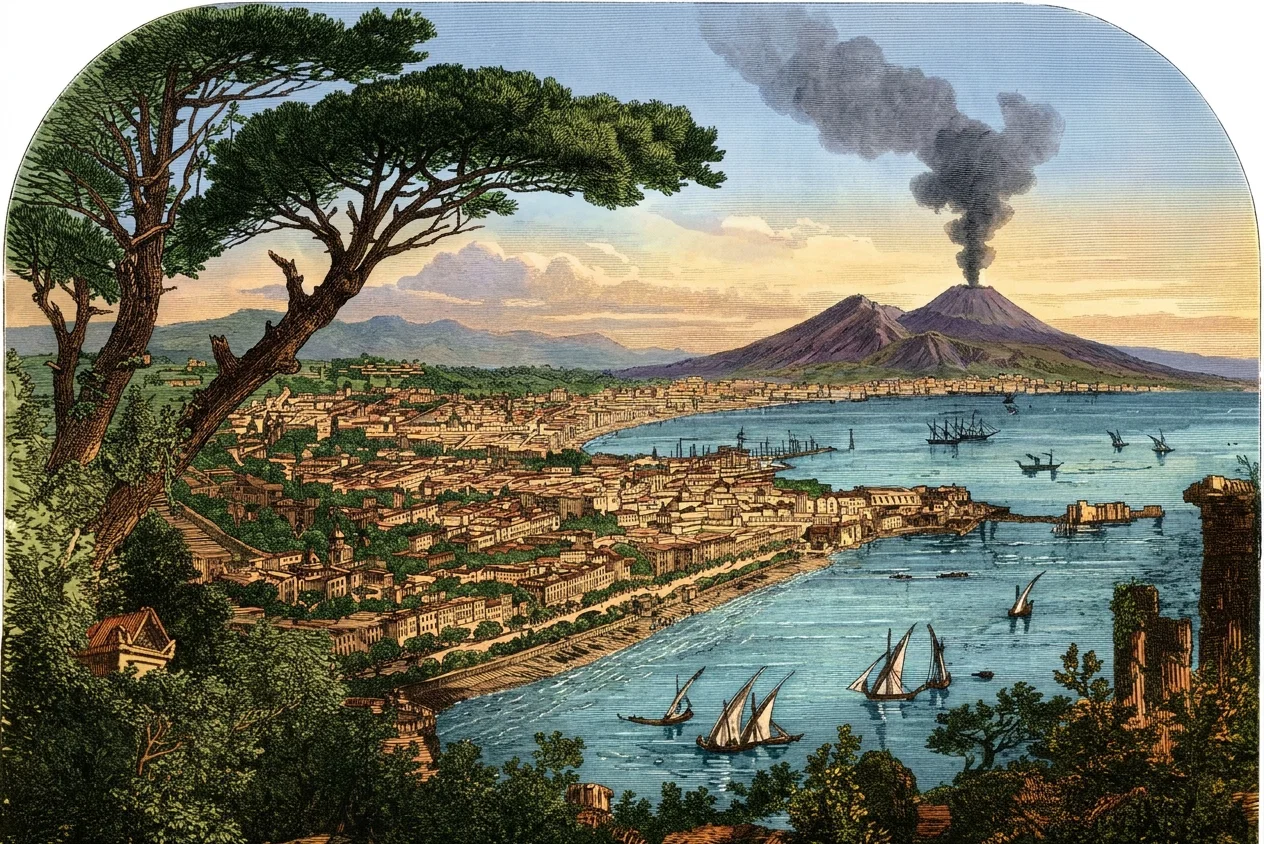
Vesuvius is eight miles from Naples, whose bay it overlooks, at the eastern extremity of a chain extending to the island of Ischia. It is believed that the whole gulf of Naples was once an immense crater, the northern end of a great rent in the earth’s crust, Ætna being the southern end and Stromboli about the middle.
At its base Vesuvius is thirty miles in circumference. Its height varies after its eruptions, but the average is about 4,000 feet. Its great crater is some 2,000 feet in diameter and about 500 feet deep.
It consists of two distinct parts. The north side is a lofty, semicircular cliff, called Monte Somma, which has a prehistoric crater. It is separated from the active volcano by a deep valley several hundred feet wide.
Where Spartacus Fought Claudius.
The Vesuvius of the ancients was a truncated cone with a base of eight or nine miles and a height of 4,000 feet. At its summit was a depressed plain, three miles in diameter. On this plain Spartacus, the gladiator, fought Claudius Pulcher.
There is no record of an eruption of Vesuvius prior to A.D. 79, altho the latter-day scientists have proved that it must have been active before that time. At the beginning of the Christian era the sides of Vesuvius were covered with fields and vines and its crater was overgrown with wild grapes.
It is certain that the people living near it at that time had not the slightest idea that it was an active volcano; for the writings of Pliny the Younger and Tacitus show that it gave warning for thirteen years before the great eruption. There were a series of earthquakes and tremendous seismic disturbances.
Buried Herculaneum and Pompeii.
The great historic eruption took place in August. The steam was condensed and poured down in torrents of rain, making the lava dust a pasty substance that poured down the mountain-side, and buried Herculaneum, at the west base; Pompeii, on the southeast side; Stabiæ, on the south side, and Castellamare, which was beyond Stabiæ. These cities were inundated and forgotten, so that centuries after, when the remains were dug up, moderns could gain a perfect insight into the manners and customs of the time of the great eruption.
For centuries Vesuvius was quiet. People who lived about it forgot that it had once buried cities and killed thousands. Again did vines cover the crater, and its sides were cultivated fields. There had been six months of earthquakes, but these were not accepted as a warning.
Eighteen Thousand Lives Lost.
Vesuvius burst forth in mighty fury on Dec. 16, 1631, suddenly and unexpectedly. It continued until February, 1632. There was a tremendous flow of lava, mingled with water, resulting from the melting of the snow and mud. Torre Annunziata, Torre del Greco, Resina, and Portia were almost wholly destroyed, and it is estimated that 18,000 people lost their lives. There was another eruption in 1660, but only ashes and steam, which formed mud torrents, came forth.
THE CITY AND BAY OF NAPLES, WITH VESUVIUS IN THE DISTANCE.
One of the very grand eruptions occurred in 1779. Huge stones were projected several thousand feet into the air in a cloud of white vapor, with large masses of molten rock. Huge streams of lava poured down the mountain-side, carrying death and destruction.
Vesuvius was quiet for a few years, but in 1794 it burst forth again. Torre del Greco was again destroyed by lava, which flowed down in a fiery stream nearly a quarter of a mile wide at its base and fifteen feet thick.
The outbreak which began in October, 1822, lasted nearly a month, rupturing the top of the cone and making a crater three miles in circumference and 1,000 feet deep. From that time Vesuvius has never been wholly quiet.
In 1841 Ferdinand II. established an observatory on the volcano for the purpose of giving warning of probable eruptions. When the eruption of May, 1855, came, the people had fled in time. The cone was again rent asunder, and the flow of lava continued for twenty-seven days, destroying miles of cultivated fields and many houses.
In 1858 there was another eruption, when lava poured from the crater. But it was slow-moving, progressing only a few inches a day.
The eruption of 1861 was violent for seven hours, and Torre del Greco was overwhelmed for the third time. The intense cold, which rapidly cooled the lava, was of immense advantage in protecting property.
Two Huge Rivers of Lava.
In the middle of November, 1867, a cone seventy feet in diameter, which had been forming in the crater during the preceding two years, poured forth a great amount of lava. Besides the main stream from the great crater there was a flow from an outside orifice twenty feet in diameter, which formed a stream twenty-five feet wide. The two streams poured down the mountain-side in a fiery torrent. Above the crater was a great cloud of white vapor, into which were projected huge stones with a mighty roar. This eruption continued until June, 1868.
The eruption of 1872 was preceded by slight premonitory symptoms. Early in 1871 the seismograph became unquiet and Professor Palmieri prophesied an outburst, which gradually increased in intensity until April 24, 1872. Two days later there was a rent in the cone 1,000 feet wide. Molten rocks, lava, and ashes gushed forth from the crater. Two fiery torrents rushed down the mountain on either side of the observatory, joining at the base with a third stream. In the words of Professor Palmieri, the volcano “sweated fire.”
Air White with Crystals.
The atmosphere was white with crystals. The streams of lava gave forth dense clouds of steam and formed miniature volcanoes as they sped downward. The earth trembled and heaved like the ocean in a storm. There was vivid lightning from the intense electrical excitement, and a heavy downpour of rain. The streets of13Naples were covered inches deep with a black sand. The flow of lava was three-fifths of a mile wide.
There have been other eruptions since that time which have done more or less damage, but none has been of great importance.