PLAGUES OF PALESTINE

5%

Pacific Press Publishing Company · Oakland, California · Oct 13, 1898

FromSigns of the Times, Vol. 24, No. 41.

Read the full edition

PLAGUES OF PALESTINE.

It is a well-conceded fact that the moral and physical habits of the people of a nation shape the prevailing diseases of that nation. In our own country, where there is so much rush and worry, with consequent lowered vitality we see dyspepsia, neurosis, and consumption the leading types of disease. In England, as a rule, the people worry less, work fewer hours, but with a marked convivial proclivity, regularly eating five times a day or more, and hence rheumatic and gouty diatheses prevail.
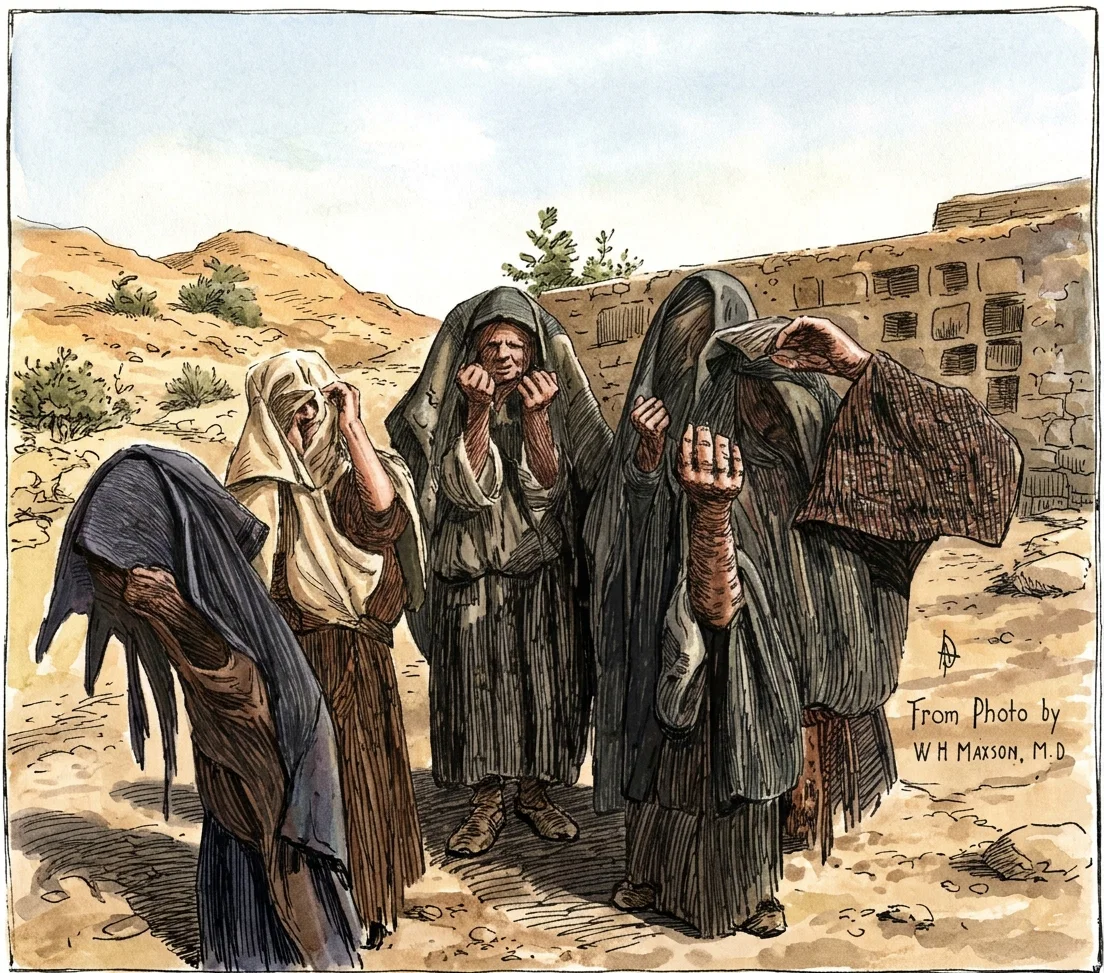
A GROUP OF LEPERS IN PALESTINE.
In Egypt and Palestine, where there is little worry and food comparatively scarce except in its simplest forms, we look in vain for a case of dyspepsia, consumption, or rheumatism; and yet these people, above every other people, seemingly, are cursed with a moral and physical depravity, and their diseases rank accordingly. Partial or complete blindness and leprosy prevail in these countries. No doubt the intense heat and light during the larger portion of the year, and the filthy habits of the people, figure incidentally in perpetuating these diseases.
But to the Bible student, in the light of the Gospel, disease is but the outward or bodily manifestation of sin; and essentially and primarily these two prevailing diseases of the once “Holy Land” are due to the curse resting upon it and its people; for “sin is transgression,” and “when it is finished, it bringeth forth death.” People with red and swollen eyes, purulent conjunctivitis, ulcerations of cornea, eyelids everted, meet the tourist everywhere. Of adult natives about one in ten have some form of visual disease.
It can be truly said that that country and that people have been blessed with the light of heaven. Manifestation after manifestation have been given it, and its glory made visible in a material sense as in no other country; and should it be thought incredible that blindness should follow as one of her prevailing diseases? The experience of Saul of Tarsus before Damascus would more than suggest the thought.
We are naturally very slow to admit that the Spirit-filled life of which Jesus Christ is an exponent, would elevate the body out of all its diseases. To thus believe is to admit that the rejection of divine light would bring physical darkness, disease, and death. May there not be food then in the thought that blindness and leprosy, which are the prevailing diseases of that country, are more than incidentally related to the special curses resting upon that people for rejecting the light of truth?
While diseases of the vision and organs of vision are amenable to treatment to an encouraging degree, leprosy has indeed been a plague for which there has been but little relief. Statistics indicate that leprosy has been slightly on the increase. It is estimated that there are at present more than two million lepers scattered over the world, mainly in the hot countries.
If the leper ever had a home, Palestine, from Mosaic times to the present, has been that home, having a larger per cent per capita than any other country. But the fact is the leper in Palestine never had a home. There are homes for fevers and houses for smallpox, but no house for the leper, and only meager family ties, no social friends, no easy-chairs or downy beds; but, instead, he is a wanderer, an outcast, inhabiting deserted tombs, legislated against in olden times, morally ostracized, with the thought that the curse of God especially rested upon all so afflicted; for, indeed, could they not see the decree written on their outward parts by the finger of God, “dying, thou shalt die;” and then it took but a little Phariseeism to take the next step and teach that they were individually and personally responsible for being thus.
In the days of Israel’s glory there were laws regulating the leper’s sphere, which were far more strenuous than at the present day. They were consigned to the caves and regions of deserted sepulchers, and in a section little frequented. In the vicinity of Jerusalem they were confined to the hill of death on the south, in the midst of which was the burning gehenna, where the refuse of the city was consumed—for, indeed, were not they the refuse of humanity, disconsolate in their anguish, living on months and years, dying many deaths in their living? Were the unfortunate to stray beyond the limits prescribed and appear on the thoroughfares leading out of the city, they were cursed and stoned by Pharisee, Sadducee, and Gentile alike. If a stranger came within their territory, he would turn and flee at the weird, shrill cry, “Unclean, unclean.”
The relations of the leper to the rest of humanity have materially changed since those times. They are now allowed the full range of the country, even to the gates and walls of the city. Whether the galling Roman yoke or the imperial sway of the Turkish power has tended to bridge the chasm between the common folk and the leper, or whether the commonwealth of Israel has deteriorated by natural causes until they see some kindred ties, can not be ascertained; but certain it is that the leper in Palestine at the present time has all the privileges of the poor without the city, and the tourists find them in all the thoroughfares begging for subsistence.
The road leading from St. Steven’s Gate to Gethsemane, over which our Saviour carried the sins of the world on the eventful night of His betrayal, is teeming with lepers, most of them sitting in the road, throwing dust in the air, and mourning in the vain effort to elicit sympathy from the passers-by. Their plea is for mercy and money, only asking a mite, and thankful when they receive it. We should judge that many of them eat their crust of bread and drink their cruse of water and sleep by the roadside, thus eking out a miserable existence without shelter.
By common consent or modesty most of them wear a covering of black cloth if they can afford it. If not, they have simply a pieced-up threadbare mantle, covering the body from head to foot, and only showing the disfigured face or hands in asking for money.
Many of the lepers of Palestine, so far as we were able to judge, marry and raise offspring, some of whom never show the leprosy and are admitted into the usual relations of city life.
There are several forms of leprosy, named according to some characteristic feature or color of the lesion. One form affects the skin and mucous surfaces mainly, another the nerves, while another and the worst form slowly amputates the joints; but it is all leprosy and from the same source. The milder forms are amenable to treatment. In fact, some are self-limiting, and the lepers are again received into society.
In the time of Titus the cry of “unclean” and the display of the leprous hand would put to flight a whole cohort of Roman soldiers. To-day there is such a time-honored aversion that perhaps not one in ten of the many tourists could be hired to touch a leper. Afraid of contagion, the majority draw their robes about them and pass by on the other side. Only a few would confess to a feeling of humanity in the presence of this living death, and yearn to show the great principle of brotherhood in a touch or a kindly word.
It is generally admitted that to live with them in their filth would transmit the disease in course of time.
A most vivid picture of a band of lepers was obtained by a rare circumstance. While returning from a visit to Hebron, as we stopped to water the horses, a band of lepers approached the carriage in quest of money. Their first act was to put out the hand, with a twanging request from faces hidden behind their mantle, but as our company was slow to respond to their appeals, they gradually drew aside their mantles until all the horrors of their person were disclosed. At that opportune moment, with kodak in hand, the button was pressed,and we have a feeble tracing of the ravages of that disease. (See illustration.)
One woman with swollen cheeks, nose and upper lip destroyed, had also the fingers of one hand missing; another, with hands and feet largely gone; another, with throat and lower jaw missing, breathing through a protruding trachea; while another had lost nose, cheek, and side of the face until the floor of the brain was in plain view. Words can not describe the horrors of such a living death. We tossed them their money and they mantled their woes. We passed on profoundly impressed with sympathy for the sufferers; and yet they suffer comparatively little pain, for in the very nature of the disease, like sin, it destroys the sensibility before it destroys the tissue. If the loving Father wanted to give an object lesson to His children of what a living death is, how well indeed a band of lepers tells the story!
After Paul had been smitten and had miraculously received his sight, he saw the vileness of that living death, and exclaimed with fervor, “Who shall deliver me from the body of this death?” and immediately he saw the remedy and was healed.
Sin is as blighting and disfiguring to the image of God in man as is leprosy to the body. The one is the counterpart of the other, the one leprosy within, the other, leprosy without. Let us hope that thousands will see in the lepers the epistle which God has been writing in their flesh, lo, these thousands of years, and, like Paul, get a keen sense of the soul leprosy and be healed. Then will the leper, as the illustrator, and the sinner, as the one illustrated, not have lived in vain.
W. H. MAXSON, M.D.