“The wicked flee when no man pursueth,” wrote Solomon. This natural terror in the human heart which is occasioned by not knowing the Saviour of sinners and Shepherd of Israel, is everywhere prevalent among the natives of the South Pacific. Even the inhabitants of Eastern Polynesia, who have long enjoyed much light, will shudder at the thought of incurring the ill-will of the goblin Tupapau. Children are frightened into obedience by the threat of his vengeance; and from earliest infancy the demon which is thought to stalk about in darkness, and to whom tradition attributes many strange and dreadful deeds, is held in mingled feelings of fear and reverence.
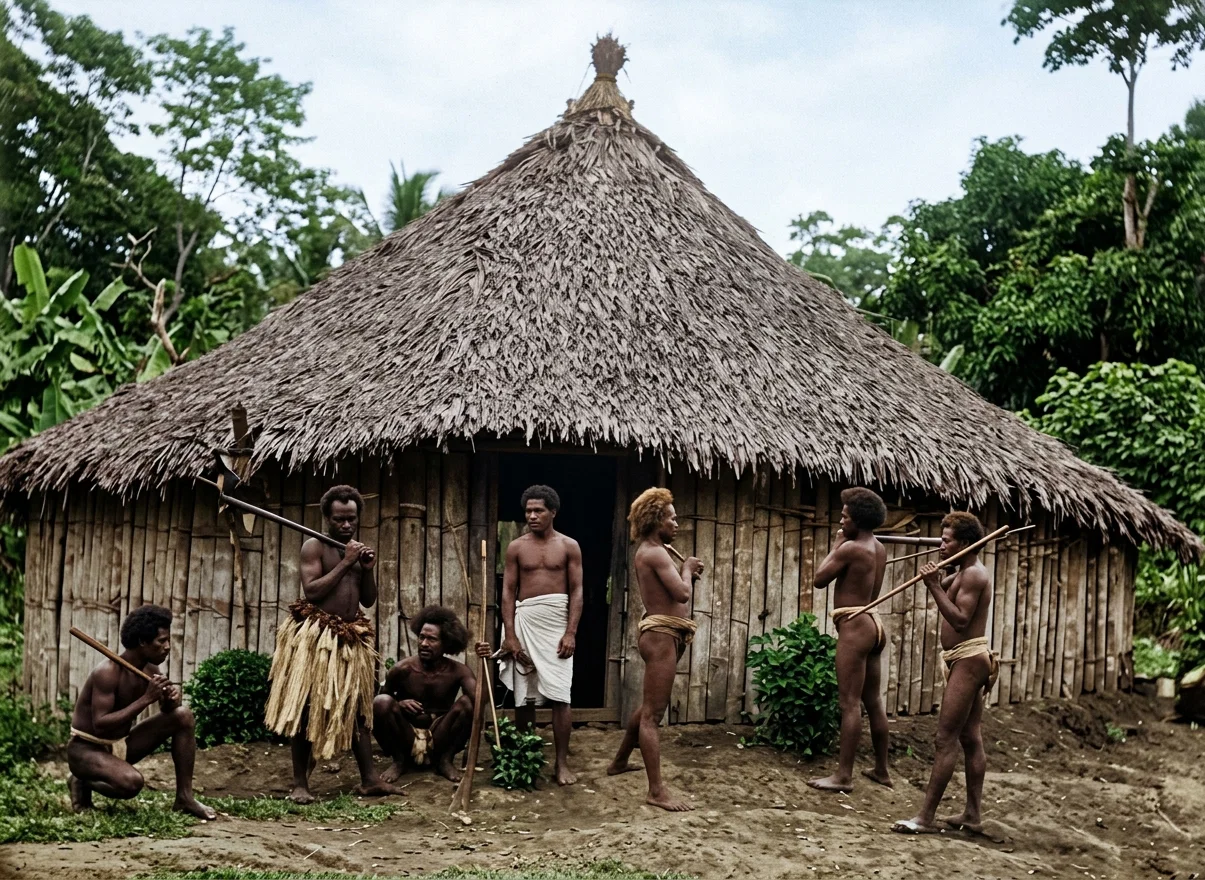
DEVIL-WORSHIPERS, of the New Hebrides. Idols, war clubs, and pigs are their most precious belongings. Yet, with their nakedness and ignorance, some precious jewels have been found among these people by John G. Paton and other faithful missionaries. Much of the territory is still unworked.
We found that there is still a considerable amount of superstition attached to the marai, or place of heathen sacrifice, in the minds of the natives of the Society Islands. For a person to cut wood on one of these marais, or to be so daring as to eat food in the rocky inclosure, would be looked upon as a sacrilegious act, that would be apt to bring swift punishment from the demon of the place, who, tho old and decrepit, is still supposed to punish such wilful deeds of presumption. While one day upon a marai, I noticed a native boy who was following us about, and, having a pocketful of raisins, I ate some and offered him some if he would eat them on the spot. Rather hesitatingly he took the raisins, but would not eat until at a safe distance from the enchanted ground. Brother Cady cut some wood and ate food upon a marai, and when warned by the natives of how such presumption was punished by a dreadful disease, he called their attention to the chickens and crabs which went about all the day long eating upon the marai without harm. “But have you never seen,” said they, “the girl down here with a crooked mouth, who became so by daring to eat in this place?” Brother Cady thereupon told them that as Christ was stronger than Satan, they need not fear the dragon so long as they dwelt under the shadow of the Almighty.
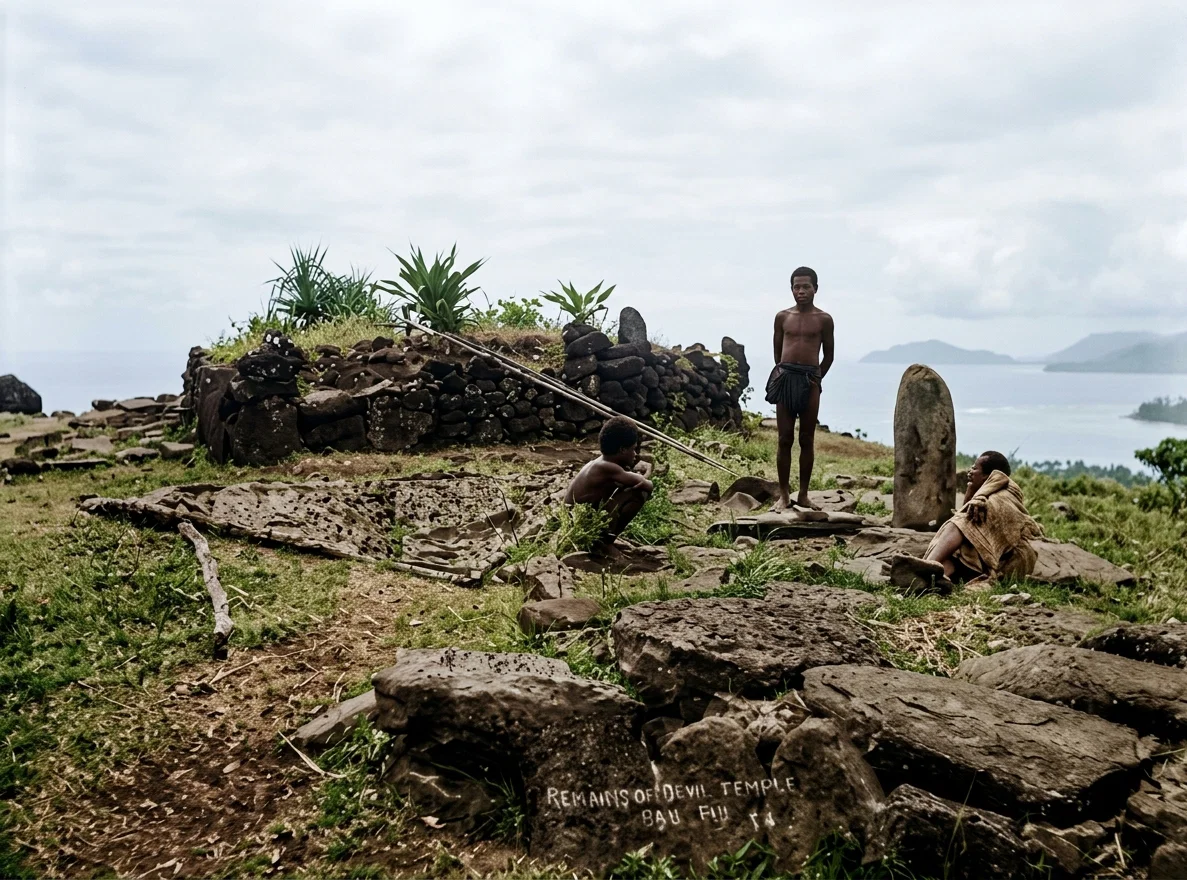
RUINS OF A DEVIL TEMPLE, or marai, of Bau, Fiji. Bau is a small island which was the center of native rule during the days of heathenism. This devil temple was accordingly the most important one in Fiji. Christian missionaries were not permitted to teach upon this island previous to 1854. In April of that year the big drum-beats called the people together to this temple to a cannibal feast for the last time of which we have record. Such events were common occurrences previously. The ruins of the temple testify to the power of the Gospel. This marai much resembles in appearance those of the Society Islands, tho generally they are more overgrown with trees and shrubbery.
Demon-worship was supreme 100 years ago throughout all the Pacific islands. Priests and sacrifices, offerings and ceremonies, all were connected with the wicked system of worship, where human sacrifices were offered to pacify the blood-thirsty spirits of devils. This dreadful system of wickedness is still in vogue throughout many of the islands, and groups to the west and northwest of Fiji. Cannibalism is connected with the false system of worship. So thoroughly has Satan deceived this people that darkness appears as light and light darkness.
While they are such devout devotees of Satan, let us see how their master treats them, and what recompense in the way of temporal enjoyment is theirs. The following quotation is from the Rev. Joseph Annand, who lived for several years on the Island of Faté of the New Hebrides. At the time of writing he was in company with a colaborer. “We met one man who had thirty-five wives and had eaten sixty-seven human beings. We slept in a low grass house about forty feet long and eight feet high, with a door two and a half feet high. Just outside the door was a gutter of filth, ankle deep. We had coconut mats to sleep on. The oven was open near us, and in consequence we could not eat some of the food cooked there. We had a shelf on the wall two and one-half feet high by as many wide, for two of us to sleep on, and thin mats to cover us. The mosquitoes and fleas can not be imagined. Each leg of our bedstead shelf had a pig tied to it, which tugged so that we feared a great fall. An old woman who slept on the stove belabored the pigs in the night to keep them quiet. In the morning we were awakened by the crowing of a cock which was right beside us. The census of the dwelling for the night was, ‘Thirteen pigs, seven people, rats, and fowls.’ Four or five months later the enemies of our entertainers came down upon them and cooked and ate every person in the family.”—Islands of the Pacific.
Theirs is certainly a very cruel master, and wretched existence, so that Christian missionaries who go there and teach them the better way, are not only minding the Lord, but doing the poor natives a great favor. Many islands and districts are as yet wholly without Christian workers. E. C. CHAPMAN.