Having rested a while at Jacob’s well, we continued our journey southward, along the eastern slope of Mount Gerizim. For some distance our way lay through a narrow, long valley, with here and there a village perched on the spurs of the craggy hills rising on both sides. Here we more frequently met camel trains than in the hills of Samaria.
It is interesting to see a caravan stop for dinner or for the night. The camels are made to kneel down, when their load is removed, and they are allowed to feed on the fat of the land, which sometimes consists of nothing but a few dry weed stalks or prickly cactus leaves. When the camel is reloaded, he begins to grumble; and when all has been put in place and the men begin to tighten the ropes to make sure of the load, he increases his grumble to a roar, which can be heard over a mile. In his vigorous protest against tight-lacing, the camel shows good sense.
About six miles south of Nablus, we turned in at a village for the night, and secured lodging for ourselves and horses in a general store. This village, like the one in which we lodged the night before, was composed of mud huts. The hut in which we stopped was not high enough to admit of a scaffold; the roof was composed of earth supported by a few trees with all their branches on, laid across the building from wall to wall. The interior, about eighteen feet square, provided places for the horses, a grain bin, the store supplies, kitchen, and dining-place, and sleeping-room. The fire to prepare the evening meal was made of bundles of brush and weeds. The opening intended for a chimney was not always mindful of its function, so that our room was dark with smoke.
This condition of things prevails in these villages. But this has no visible effect on the complexion of the Arab, which has the appearance of smoked bacon.
My companion here purchased grain for his horses. After filling the measure, instead of leveling it off with a straight edge, the seller heaped it full, shook it down, pressed it together, and poured on more, and repeated the same process till no more would stay on, but would run over. This style of measuring has remained unchanged for at least eighteen centuries, as evinced by the words of Christ: “Give, and it shall be given unto you; good measure, pressed down, and shaken together, and running over.”
Next morning we resumed our journey at 4 o’clock, for it was twelve hours’ journey from our village to Jerusalem, and we desired to arrive before sunset, so as to have a good view of the city all the way as we approached it from the north. It was a bright moonlight morning, and the air was crisp with frost like an October morning in Michigan. The morning stillness was often broken by the loud shouting of Arabs, who had either been traveling all night or had started earlier than we. After half an hour’s ride through the narrow, long valley, we began to ascend exceedingly rough, stony ridges, sometimes mounting five or six hundred feet; our horses had to carefully calculate every step. At first we were afraid to trust ourselves on their back, and walked over the worst places; but we soon learned that with four legs they were surer footed than we with two.
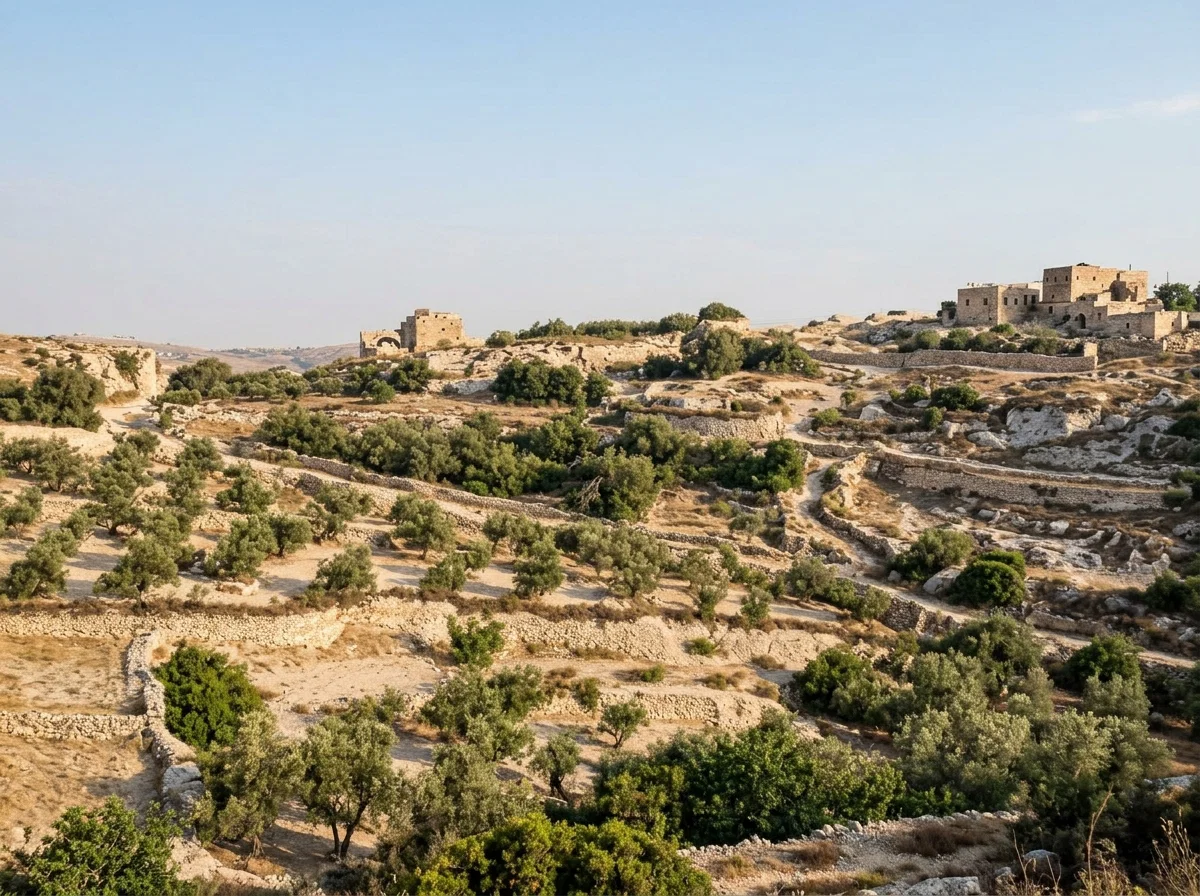
About six hours’ ride south of Nablus we passed near Shiloh, where the tabernacle was set up when Israel entered Canaan under Joshua, and where after the conquest the land was divided by lot. Shiloh is situated at quite an elevation, and is in conjunction with a fertile valley. During the time of the conquest of Canaan, it was a central point for Israel, and long afterwards was a significant place. It was at Shiloh that Eli, the high priest, officiated, and that the youthful Samuel served in the tabernacle. It was from here that the ark was taken to the battle and captured by the Philistines, and was never returned again to Shiloh. Here dwelt the prophet Ahijah, to whom the wife of Jeroboam came in disguise. But of Shiloh nothing is left but a wilderness of rocks and stones. Passing south from Shiloh, we traversed alternately small valleys, rocky ridges, and narrow ravines.
Occasionally we passed an olive grove, and patches of wheat. We say patches because very rarely a wheat field is seen. In many places the land is so stony that when the stones are collected, they occupy a large portion of the surface. Sometimes the patches of wheat between the stone walls were no larger than the average dwelling-room. When we passed through, the middle of January, the wheat had been sown and was nicely up.
In this land of lawlessness, the farmers have a hard time. When they free a place from stones, travelers leave the road and pass through the field, to avoid the numberless stones in the road; then the farmer makes a stone wall to keep the stragglers out; but the animals are so accustomed to climbing over stones that soon a breach is made in the wall by the animals climbing over it in order to have a little smooth road through the field. It seems strange that these ways which have been traversed for centuries should be so utterly neglected. With a little organized effort, how much inconvenience and time could be spared! But I suppose that till the end of time these orientals will go stumbling over the stones.
Between Shiloh and Jerusalem the country is more stony than any we had met on the journey from Galilee. But our horses were expert at picking the best route, so we left them to judge where to place their feet next, while we were occupied in scanning the country in all directions; for now we were nearing Jerusalem and the region of many places of interest. We had heard that the best view of Jerusalem from the distance is obtained from the north, so we constantly scanned the horizon to the south. When within four hours from the city, from a rocky height we gained our first view of Jerusalem. It was a splendid sight! Few inland cities can be so distinctly seen at such a distance. And just as distinctly could we see the Mount of Olives to the east of Jerusalem. At the same time, the Mediterranean and the mountains of Moab east of the Dead Sea were in view.
In a few minutes we arrived at Bethel, best remembered on account of Jacob’s dream in which he saw the ladder reaching to heaven, on which the angels were ascending and descending. Such a wilderness of stones! It was not difficult for Jacob to find one for a pillow; it would be more difficult to find a place to lay his head where there was no stone. On Jacob’s return from his long sojourn with Laban, he passed via Bethel, and here erected an altar, of which one is reminded by some altar-like stones hewn from the native rock. Bethel was doubtless doubly sacred to Jacob; for Abraham camped here when he first passed through Canaan.
After the revolt of the ten tribes at Shechem, Jeroboam set up one of his golden calves at Bethel, to keep Israel from going to Jerusalem to worship. Doubtless a suitable temple was10erected for the idol. It was here that Jeroboam’s arm was paralyzed when he extended it towards the prophet. To me it was an interesting fact that Jerusalem is plainly seen from the vicinity of Bethel. As Israel came from the north to worship at Bethel, they had a full view of the magnificent temple of Solomon at Jerusalem before their eyes, and were thus constantly reminded of their apostasy. After visiting Bethel, one can better appreciate the fitness of several expressions in the hymn “Nearer, my God, to Thee.” As at Shiloh, one is forcibly reminded of the desolating effects of sin, and how literally the Word of the Lord is accomplished. H. P. H.