“Heaven’s gate is closed to him who comes alone;
Save thou a soul and it shall save thine own.”
—Whittier.
“Is you my mama?” a bright-faced little fellow—hardly more than a baby—paused in his play with a group of other children to ask the question of a lady who rang the bell at the Home of the Friendless. So many of the children at the Home receive visits from those who wish to adopt them that little Genie is all the time looking for some “mama” to come and claim him. So day after day he repeats to each newcomer, with childish insistence, his pathetic query, “Is you my mama?”
Poor little Genie! How his question calls to mind the scores and hundreds of little waifs and strays who by their helplessness, if not in words, are asking for a mother’s care! Hardly a day passes but what one or more of them is left motherless by death or desertion in the city of Oakland alone; and it is estimated that there are six thousand homeless children in California, and from seventy to one hundred thousand in the United States. But for every homeless child there is somewhere a childless home, waiting for the light and love and blessing that a little one will bring to it. To place these homeless children in the childless homes, where they may be educated and trained for usefulness, is the work undertaken by the Home of the Friendless.
The enterprise was started about three years ago by a few interested persons in the Oakland S. D. A. Church, who felt that the Lord had laid upon them this burden; and the work increased so rapidly that a year later it was placed on a more permanent basis, with a broader field. It is yet in its infancy, but it has already provided homes for fifty-three children, and has as many more under observation.
It is necessary to have a temporary shelter for the children while arrangements are being made for conveying them to permanent homes. Several different houses have been rented and occupied successively, but soon outgrown, and at present the Home family, numbering twenty-one, occupies a thirteen-room house in Alameda, just across a branch of the bay from Oakland. The location is beautiful, the house comfortably furnished, the large yard furnishes ample room for the children’s playground, and altogether it seems that a more desirable place could hardly be found. Most of the children are for adoption, but a few half orphans are simply boarded and cared for in the Home.
But not until one visits the Home can he understand and appreciate the blessing it is to the children who are sheltered there. The present matron, Mrs. E. Dunn, has been in charge for over a year. That she is a true home-maker, and gives the children the genuine “mothering” for which their hearts long, is evidenced by the way they scramble to see who shall sit next to her at prayers, and beg for good-night kisses. One almost forgets the pitiful stories of the want and misery from which many of them have been rescued, as he sees how happy and light-hearted they are now.
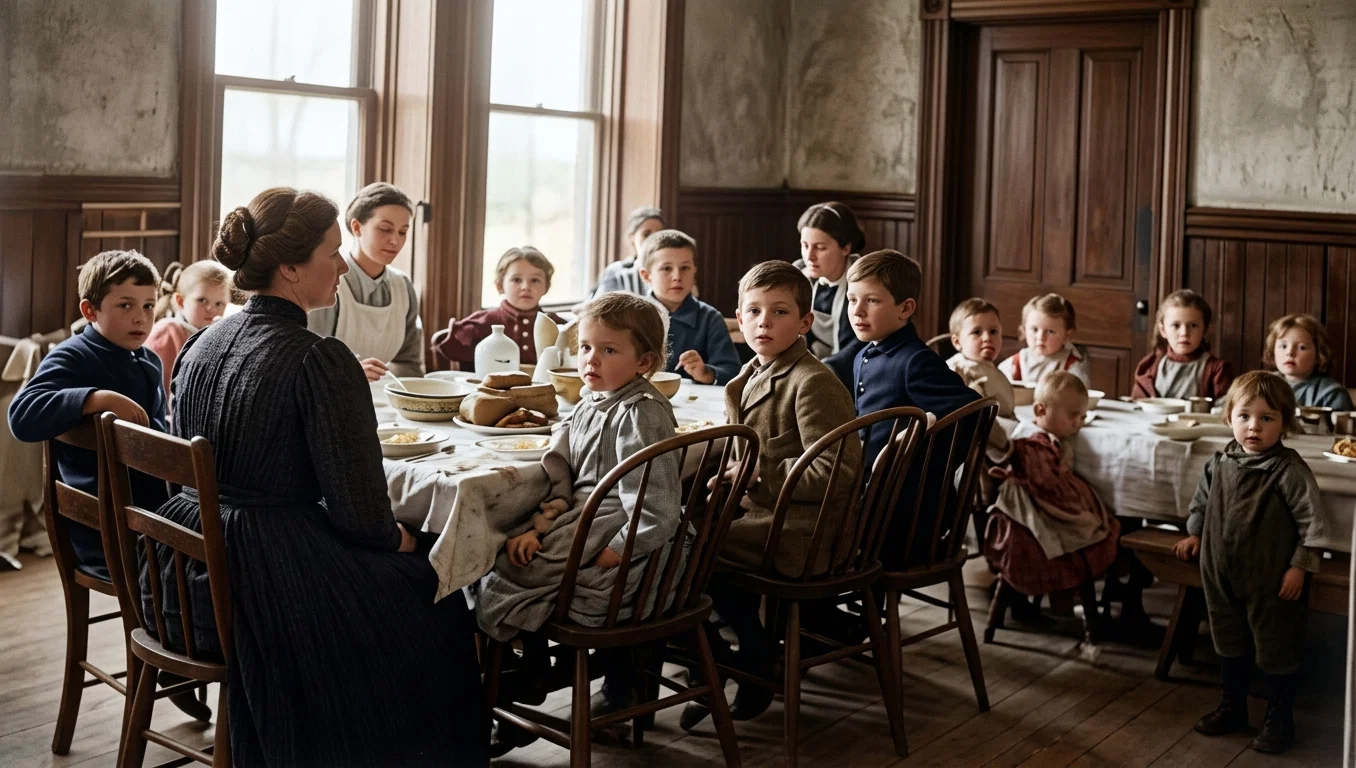
A Peep into the Dining-room.
Eight of the children, the oldest eleven years of age, attend school just across the street from the Home. Three others that have graduated from the nursery, but are still too young for school, play contentedly with their dolls. One little tot whose only recollections of home seem to be memories of whisky and police stations, follows the matron around, saying occasionally: “I love you. I like to stay here.”
The nursery is worthy of more than a passing notice. We found two large, sunny rooms devoted to the seven babies of the house, four of whom are still in long dresses, under the care of a sweet-faced nurse, Miss Ella Kemp, who has volunteered her services for a month. We feel sure the babies will have good care when we note her gentle ways and understand that she is there simply because she loves children. Surely, “love is the greatest thing in the world.” Just how she has managed to train them so that they all go to sleep at the same time and all wake up at once is a mystery we will not attempt to explain. One tiny little thing has been sick all its short life, but the others are as plump and happy-looking as anybody’s babies. All the children in the Home seem to be remarkably healthy.
The nursery babies are all boys except one. I am informed that as a general thing there are more calls for girls for adoption than boys, almost ten to one. But all adopted boys do not turn out bad. The great general W. T. Sherman, Vice-president Henry Wilson, the great explorer Henry M. Stanley, the renowned orator Bishop Simpson, the undaunted explorer John C. Fremont, and the great journalist and philanthropist G. W. Childs, were all homeless boys. All were reared by foster parents, the last named being a door-step waif, hence called Child or Childs, the name of the father of his country supplying the rest.
There seems to be an unwritten law about the Home that every one must be a helper and have the missionary spirit, and so the older children help with the ironing, make the beds, wipe the dishes, and feed the chickens; and the little ones feel it is a privilege to be allowed to sweep the walks and bring in the kindling-wood. A new church building is about to be erected in Alameda, and the children are anxious to help in the enterprise; so all who are10old enough to do so have planned to sell enough copies of the SIGNS to enable them to each give twenty-five cents.
Family prayers, morning and evening, form an interesting part of the program for the day at the Home. At the hour of evening worship the children are divided into two classes, and half an hour is usually spent in Bible study, but occasionally varied by a health talk. “Say, let’s keep right on with this. I’m ready to sit up all night an’ listen,” said one of the boys at the close of their study, which shows that it is anything but tiresome to them. Some time is then spent in singing, either to the accompaniment of the banjo or organ, just as the children prefer; and this exercise is also greatly enjoyed. The children all attend Sabbath-school regularly; and when it is noticed that they have better lessons than many others in the school, it speaks well for the faithfulness of their caretakers.
“The quality of mercy . . .
is twice bless’d;
It blesseth him that gives, and him that takes.”
And so this home is not more of a blessing to the children who are gathered into its loving embrace, than it is to the friends who have so generously made it a possibility. For you must know that the Home is supported entirely by voluntary contributions. Two collections are taken up each year in the churches in California, one in April and one in October, and the rest is donated by individuals. From the neat, cozy parlor, with its organ and tempting array of books, through the bedrooms, with their little “two-story beds,” the dining-room, whose low table and little chairs remind us of a kindergarten, to the storeroom, with its shelves filled to overflowing with well-made, comfortable garments, quilts, and gifts of fruit and other substantials, of which time and space forbid a detailed report, everywhere were evidences of the loving interest taken in “our orphans.”
The children throughout the State have taken a special delight in the work, and many daintily-embroidered bibs, also dolls, scrap-books, etc., witness to their patient hands and loving hearts. One little boy nine years old sent a quilt which he pieced himself, and he picked grapes to pay for the lining, so that it is entirely his own gift. When we saw all these tokens, it almost seemed to us the name “Home of the Friendless” is a misnomer, for surely the orphan children have no lack of warm, true-hearted friends, who are glad to have the privilege of caring for “Christ’s little ones.”