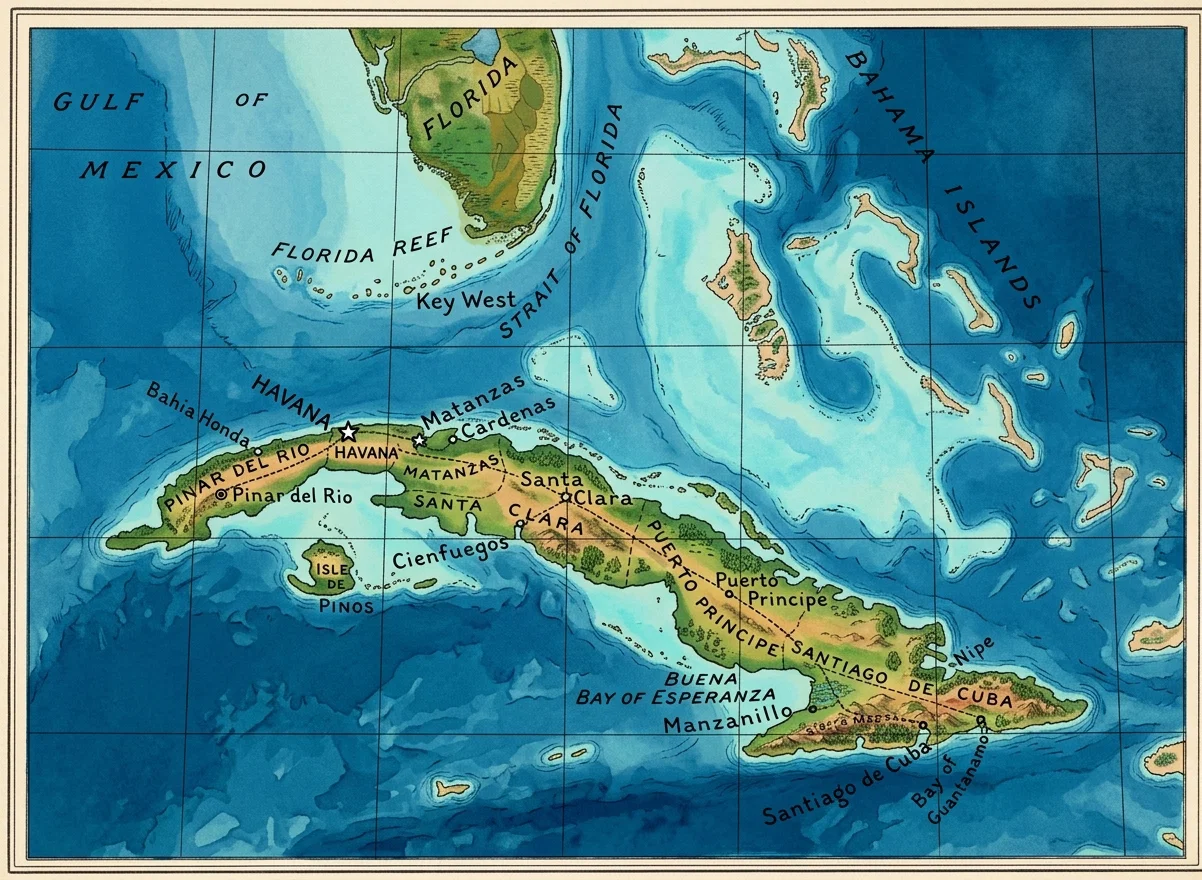
Cuba is about 760 miles in length, and the breadth at the narrowest part, near Havana, is from 30 to 36 miles; at the widest part, in the east, 125 miles. If Cuba was translated to the latitude of New York, and Cape Maisi, the eastern extremity, were laid down at Sandy Hook, Cape San Antonio, at the west, would be in the vicinity of Chicago. The distance from the northwest coast of Cuba to the Florida mainland is about that from New York to Albany, while our fleet at Key West is as near Havana as Poughkeepsie is to New York. The area of Cuba is 45,000 square miles, or about equal to that of Pennsylvania.
The eastern end of the island is the source of the mustering and march of the insurgents. From hence the raiders have proceeded with their long processions of cavalry through all the provinces, and Havana has seen the light of the flames that consume the substance of the island, in spite of the large Spanish army and the trench lines with detached forts at short intervals, known as “trochas,” drawn at various points across the island.
Cuba, in form a thin, irregular crescent, has a coast line of 2,200 miles, or of nearly 7,000 miles if all indentations are included. About half of the north coast is open, and an equal portion of the south, affording many fine harbors capable of easy defense. The country is in general mountainous, and this physical feature has enabled the insurgents to maintain their struggle against overwhelming odds in the way of numbers and military resources. The Cubitas Range, in Puerto Principe province, is the seat of whatever there is of the insurgent government. The mountains give the varieties of climate and products which make portions of Cuba remarkable.
The rivers are many rather than large. The lakes are few and mostly near the coast in proximity to the great marshes or everglades. The lowlands and rolling slopes worn from the mountain chains compose four-fifths of the area of Cuba, and the rich soil makes the productive capacity of incalculable value. Two crops of cereals are often obtained in the same year.
Considering its tropical position, the climate is mild. The seasons are divided into the dry and the rainy, the latter extending from May to November. Humidity averages over 80° at all seasons. The mean annual temperature at Havana is 78°; for the hottest month, 81°; coldest, 70°. January is the coldest month; August, the warmest. The dry season is delightful, and the hottest period is redeemed by refreshing ocean breezes. North winds prevail; the annual rainfall is forty inches, and hurricanes are not infrequent. The foliage is green at all seasons.
Rich ore deposits are known to exist. Copper occurs in the extreme eastern and western departments. Bituminous coal of fine quality is found in large quantities in many parts. Marble is abundant. Gold has been found. Iron ore making a super quality of steel is mined in the province of Santiago de Cuba.
The great wealth is in the agricultural products, the chief of which are sugar, tobacco, and coffee. The first sugar plantation was established in 1595, but the industry did not assume importance until the present century. In addition to heavy taxation, the trade has of late years suffered severely from beet-sugar competition. The war has practically ruined the crops for three years past. Tobacco is indigenous and its quality famous. Coffee does not hold an important place commercially. Maize, peppers, yams, and sweet potatoes are raised for home use. Almost all the tropical and sub-tropical fruits grow freely, as the pineapple, orange, plantain, banana, fig, and pomegranate. Coco, cassava, honey, and wax are produced for domestic consumption and export. The dense, uncleared forests—13,000,000 acres—abound in tropical and other valuable woods, including mahogany, ebony, cedar, and granadillo. There are over thirty species of palms, and the botanical catalog gives 3,350 indigenous flowering plants besides those introduced by Europeans.
CUBA.
The communications are poor, whether by road, rail, or boat. The roads, as a rule, are mere trails, almost impassable in the wet season. The government has built perhaps 175 miles of paved highway, the chief stretch being the sixty miles from Havana to Pinar del Rio. Outside the cities the universal passenger vehicle is the “volante,” a two-seated carriage, swung low by leather straps from the axle of two large wheels, with shafts fifteen feet long. The shaft horse is led by a postilion, whose horse is also harnessed to the carriage with traces. The conveyance is comfortable and safe. Merchandise, when not sent by rail, is usually transported in heavy carts drawn by oxen or mules.
The railway lines comprise about 1,000 miles of track, controlled by ten companies. In addition, sugar planters have built numerous narrow-gauge branches to connect their estates with the main lines. The land facilities for travel and transportation are far from satisfactory. There are frequent coastwise and foreign steamers connecting the coast towns. The telegraph system is under government control, and wires connect all the principal towns and villages. Telephonic communication is, as yet, confined to Havana and suburbs, and controlled by the government.
Each of the 6 provinces bears the same name as its chief city, and is divided into judicial districts. There are 112 cities and towns on the island. Havana, the capital and only city of any considerable size, has a fluctuating population commonly put at 200,000. Matanzas has 50,000; Puerto Principe, 40,000; Cienfuegos, 26,000; Cardenas, 20,505; Sagun la Grande, 14,000; Manzanillo, 9,036; Guantanamo, 9,000; while only one or two of the others reach 6,000.
[The religious condition of Cuba and the various forms of Protestant missionary effort among the Cubans are thus described by Rev. George Lester, in The Review of Missions.]
In Cuba flagrant desecration of the Sunday, gambling, brutal and degrading sports, and the exposure of indecent prints, are only the outward and visible signs of moral degeneracy, which is deep and widespread. A writer who is by no means unfavorable to the Roman Church has said, “Whether it be from want of rivals or merely from force of time, the Catholic Church in Cuba has fallen from its high estate.” It wants the wholesomeness which is essential to vigorous combat with worldliness and lust, and the “love” which endureth all things. It is the tool of the State, and its priesthood is a butt for the ribaldry of every scoffing wit. Its altars are served chiefly by foreigners; it is a rare thing for an educated Cuban to enter its ministry.
It is only a few years ago that liberty of worship was granted by the revised Spanish constitution.
Now, altho sympathy with evangelism is not yet forthcoming, toleration is the word of the written law. In a hundred ways which priestly ingenuity can devise, religious liberty may be interfered with, but the law professes to afford protection. Protestant teachers have only to toil on in the patience of hope and the labor of love, and the Cuban, who is indifferent to religion rather than averse to it, will come to know who are his true friends. Beginnings have already been made, of which the most successful was the work of Pastor A. J. Diaz, in Havana.
The Methodist Episcopal Church South has a station in Havana. The premises consist of a small hall and dwelling-house in Concordia, in the northwest quarter of the city, where the population is chiefly of the artisan class. The work has suffered many vicissitudes, and but for the grace and mercy of God, and the loyal devotion of a faithful few, would ere now have come to naught. In spite of many discouragements this mission church shows signs of life and hope, and is worthy of the support and sympathy of all who pray for the evangelization of Cuba.
The Jamaica Baptist Missionary Society has had a mission in Cienfuegos for several years. The results have not been encouraging, and it is not improbable that the station will have to10be abandoned.
The Presbyterians of Mexico have had one or two small missions in Cuba; and there is also an Episcopal mission in Matanzas.
A good work has been done by the distribution of the Scriptures and Gospel tracts. There is now but little that can be called persecution, altho considerable prejudice exists, and insult and petty annoyances have frequently to be endured. The priests are keenly sensitive, “doubting whereunto this thing may grow.” The well-known tactics to which the zealots of Rome resort in order to harass and hinder the evangelist are plied without mercy; but for all that, “a great door and effectual is opened” in Cuba for the preaching of a present, free, and full salvation.
What is done in the way of Protestant missions in Cuba should be done on a large and generous scale. Small hired halls in out-of-the-way places neither attract the Cuban, who is a lover of the spectacular, nor do they suggest to him the idea that these evangelists mean to stay. With every mission set up there should be arrangements for a cemetery—a strange suggestion to those who do not know Cuba, but to such as do, an adjunct regarded as important to success in this island as are schools in India and dispensaries in China. As far as possible, Cubans should be employed as missionaries to their countrymen. There is a strong sentiment of fellowship in the Cuban mind; there are patriotic ambitions in which no foreigner can fully share. And in all labor and underlying all plans of service there must needs be a strong, fervent, and triumphant expectation of success. Protestantism, not as a mere theological negation, but as a spiritual energy, is, under God, equal to the splendid task of saving Cuba.—Missionary Review.