THE BOYHOOD OF JESUS

9%

Pacific Press Publishing Company · Oakland, California · Sep 15, 1898

FromSigns of the Times, Vol. 24, No. 37.

Read the full edition

THE BOYHOOD OF JESUS.

But one effort is made in the sacred record of Christ’s life to lift the veil from His childhood experience. Had there been anything in that part of His life specially needful for us, we may rest assured that it would have been forthcoming. We are indeed informed that the Child grew, waxed strong in spirit, was filled with wisdom, and that the grace of God was upon Him. Luke 2:40.
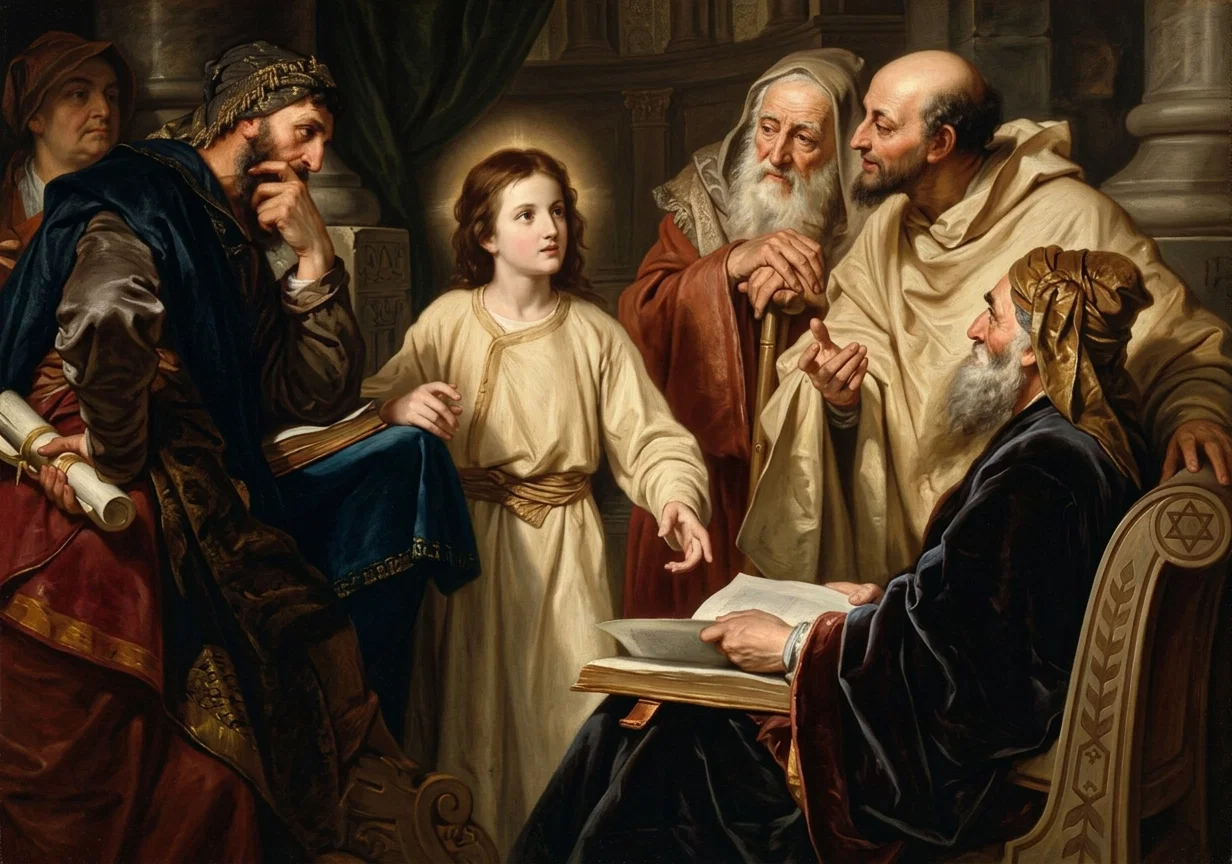
JESUS IN THE MIDST OF THE DOCTORS.
From this we may gather that under the gentle nurture of a loving mother, He met childhood’s restraints and admonitions with unruffled patience; that He was ever truthful with exactness; and that His love was so full and unvarying as to make Him a joy and delight to all around Him.
Apocryphal writings, however, are full of the strangest and most frivolous statements of these boyhood days; as, for instance, that when at play with other boys, in order to show His superiority over them, He made living beasts and birds from the clay with which they played; pulled short boards to the requisite length; struck dead with a curse boys who offended Him; and even destroyed the property of some poor man as tho for mischief, so that when the owner manifested consternation and grief at his loss, he might be pleasantly relieved by a miraculous restoration of the property.
It is good that reliable testimony has omitted such things from the youthful life of our Lord, since such an account seriously related would so violate our sense of propriety, and shock our moral ideas in such a way as to detract from the dignity to which He is entitled as the Son of Jehovah. The very silence of inspiration concerning this part of Christ’s life is, therefore, a most eloquent tribute to the dignity of His childhood. It is indeed a volume of instruction upon the divine power that led Him to pass so many years in obscurity, in human flesh, without a single flash of splendor, or of undue exaltation.
The Jewish Talmud recognized every boy among the Hebrews who had completed his twelfth year, as a “son of the law,” and as such, required him to observe the annual feasts held in Jerusalem. He must also at that time begin to learn some trade and also to acquire a knowledge of the Scriptures.
Jesus, therefore, at the age of twelve accompanied His parents to Jerusalem in order to celebrate the Passover. Joseph having fulfilled the requirements of the feast week, the parents prepared to return with the caravan on their way to Nazareth. Away from the holy city, and the deep religious emotion of the preceding days, visiting, music, and mirth were made to enliven the tediousness of the journey. Absorbed in the pleasures of the day, the parents of Jesus reached the place of the first night’s encampment before discovering that their holy Charge was not in the company. Seeking for Him without success, the parents became alarmed, and nothing was now left for them to do but to return to Jerusalem, which they did the following day, probably with a deep sense of self-reproach at their own unfaithfulness toward their Charge. But neither on that day nor the following night could they get any trace of their lost Child. On the third day, however, they came upon Him in one of the schools of the rabbis, which were held in the temple courts. Here, before the teachingrabbi, who was seated in his chair of learning, and others standing about, Jesus was found both hearing and asking questions of the doctors. Luke 2:43-46.
As the parents listened for a moment to the wisdom with which Jesus astonished the rabbis, they, too, were amazed. Joseph did not speak; and it is not likely that Mary said much until Jesus had gone with her apart. Her burdened heart then found utterance in the words, “Son, why hast Thou thus dealt with us? behold! Thy father and I have sought Thee sorrowing,” or, as the phrase will bear, “with aching hearts.” Probably never before had He done that which demanded such chiding. She really did not know how to account for His present conduct, and was astonished at His seeming neglect of her comfort.
His touching reply, so innocently given, must have started a singular train of thought in Mary’s mind: “How is it that ye sought Me? wist ye not that I must be about My Father’s business?” The parents did not understand the solemn import of these divinely-uttered words. Mary had said to Him, “Thy father” hath sought Thee. His reply was that even then He was doing His Father’s work. “Wist ye not,”—did ye not know whose Son I am—you who were favored before my birth in the flesh, by information from heaven’s messenger, relative to My mission? Have you forgotten so soon? You have called Joseph My father; I acknowledge My only Father, He in whose house I now am.
But, altho Jesus had in these words revealed that even at that tender age He knew whence He was, and why He came to earth, yet He quietly returned to Nazareth with Joseph and Mary, to be subject to family discipline for eighteen long years more, before He could enter directly upon that work to which He had given Himself. What divine patience was here shown! what emptying of self, even in private life! Such cheerful, prompt yielding to circumstances, while possessing a full consciousness of divine power and heavenly heritage, is just as much a part of His life-work and example for men, as His public ministry and His patient death upon the cross. Jesus of Nazareth was just as fully the Son of God as Jesus of Gethsemane and the cross, and His steps are as worthy of following in one case as in the other. He was about His Father’s business in one situation as well as in the other. May we all learn the true lesson of Christian service from the early years of Jesus, as well as from the latter part of His life. JOHN ORR.