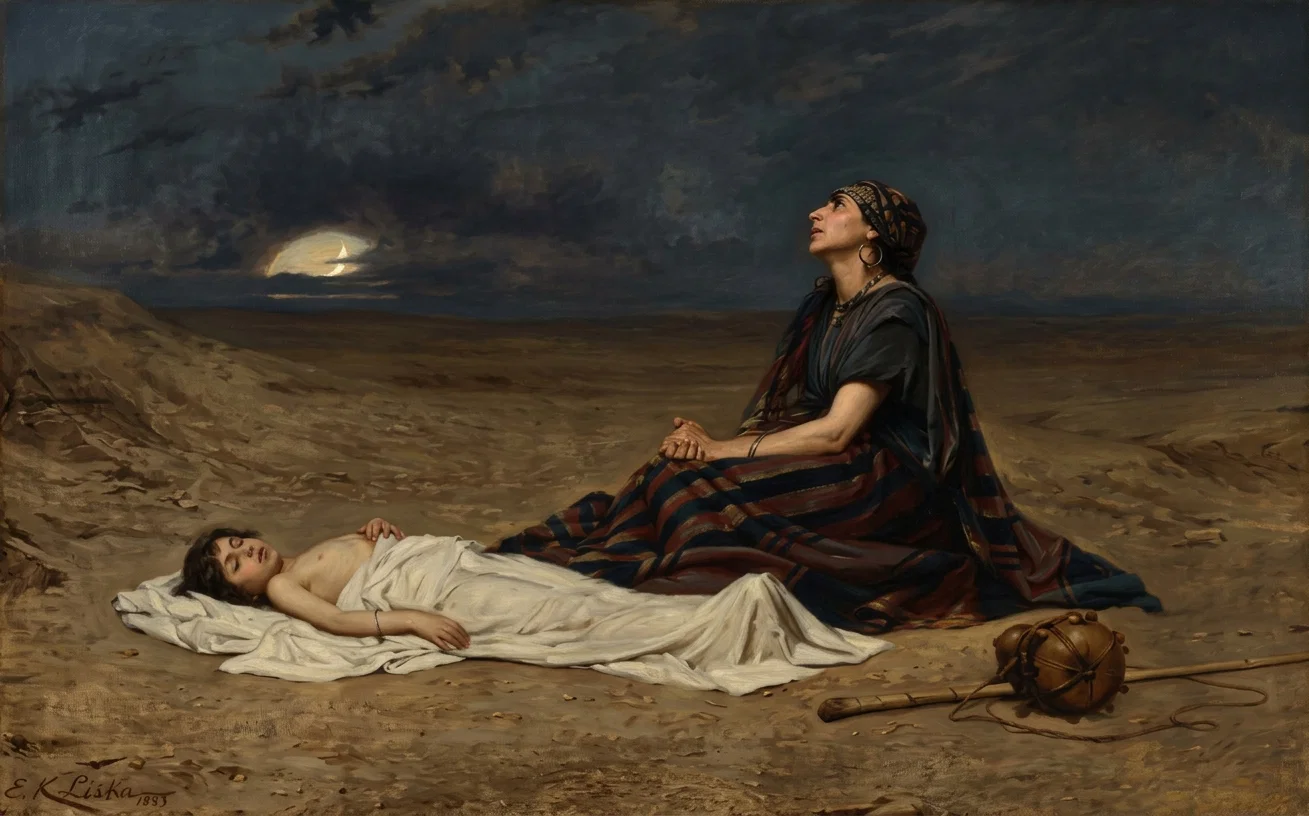
It is hardly possible to confine the results of unbelief to the one in whose breast it has been permitted to find lodgment. The story of Hagar, the Egyptian slave girl, well illustrates how one is made to suffer for the sin of unbelief in another. Her history would not have been so imperishably written as it is, had she not been made the innocent victim of another’s distrust of the fulfilment of God’s Word.
HAGAR AND ISHMAEL.
In attempting to establish with Abraham His everlasting covenant, God promised that patriarch and his seed after him all the land of Canaan for an inheritance, when as yet he had no child. Gen. 13:14-16; Acts 7:4, 5. In process of time, the Lord appeared again to the patriarch, telling him to give no place to fear, but trust that his reward would be sure. Not being able to see how a satisfactory reward could be rendered him, so long as he was childless, inasmuch as the promise before given contemplated an heir, Abraham questioned the Lord regarding the matter, and desired to know what would be considered a fulfilment of that promise. The Lord then told him that he should positively have an heir,—a son of his own flesh and bone. Gen. 15:1-5.
This seemed to set Abraham’s fears at rest for a time, and he joyfully responded, “Amen;” that is, Lord, this thing is now sure to me, and I confide in and trust to Thy word. Verse 6. But before long an anxious desire on the part of the patriarch to hasten the fulfilment of the promise led him to adopt a suggestion offered by Sarah his wife, which was this: She, concluding that it was impossible for her to become the mother of a child, suggested that it would be a fulfilment of the promise should Abraham’s heir be born of another woman. So Hagar, Sarah’s slave girl, was chosen as the vehicle through whom to keep the promise of God from failing. Gen. 16:1-3.
But little did they foresee the result to follow! How short-sighted indeed is finite man, when he attempts to fathom the mind of the Infinite, or essays to carry out a decree of Jehovah through human strength or passion. “Without Me ye can do nothing,” is an eternal edict of Heaven, which it was not possible for even Abraham to break through. A son was indeed born as the result of this clandestine arrangement but was not recognized by God as a son of Abraham, in the line of the promise. Gen. 22:2; Rom. 9:7, 8.
Abraham was disappointed with the result in several ways: First of all, the act brought friction and sorrow to the household of the patriarch. Sarah herself found cause for complaint; for her maid, hitherto tractable and respectful to her mistress, afterward made light of her. Gen. 16:4. This was more than Sarah could endure, and so she oppressed the victim of her own mistaken zeal, until the poor slave girl was driven from the bosom of the family. Deprived of home and counsel at a critical period, and for no fault of her own, the heart-wounded Hagar wandered in the desert, to find comfort only in the visit and comforting words of a messenger direct from the throne of God.
Upon the advice of the angel, Hagar smothered her grief, and returned to her mistress, to suffer whatever fell to her lot. The treatment she then received could not fail to leave its impress upon her child, born soon after, who, according to the angel’s prediction, became a “wild man,” with his hand against every2one, and the hands of all against him. Gen. 16:5-12.
A few years after this unfortunate affair, God renewed His promise to Abraham, telling him that his seed should be perpetuated, and become favored above all other people. At the same time it was revealed to the patriarch that his aged wife Sarah should be the mother of the child of promise. The statement seemed incredulous to both Abraham and Sarah, and the latter even laughed at such an idea. Genesis, chapters 17, 18. Nevertheless, the word of the Lord proved true, even as it ever had, and ever will, and Isaac became the son of their old age,—the child of promise, miraculously begotten, and born out of due time.
But the fulfilment of this absolute promise of God in the face of unbelief, did not soften the feelings of Sarah toward the one whom she counted a rival in the field of promise. The day when her own son was weaned, while all were merry at the lordly feast given by Abraham, Sarah detected Hagar’s boy laughing at Isaac, and her feelings were so much wrought up over the matter that she determined to have the bondwoman and her son expelled from the household. Gen. 21:9, 10.
Notwithstanding this demand very much grieved Abraham, who loved Ishmael as his son (Gen. 21:11; 17:18), yet upon receiving a comforting message from God, he complied with the demand, and the bondwoman, with her son, was sent away into the wilderness, with only a small supply of bread and a bottle of water. In that tropical climate, the water was soon gone, and the child became exhausted. The mother sat beside him for a time in the deepest despair, but soon resolved to carry him to the shade of a shrub, from which she removed far enough away so as not to see the death struggles of her child. In this situation she poured out her grief in strong crying and tears.
Again, however, the ministering angel from heaven came to render the very service necessary to relieve her difficulty. In answer to the cries of the child for drink, he pointed out a well of water, from which the mother drew a supply for the revival of the child, and so his life was spared.
It is cheering to know that in after years Abraham became absolutely trustful, so much so that he cheerfully obeyed the mandate to sacrifice the “son of promise,” believing that God was able to raise him even from the dead (Heb. 11:19), and so he obtained the title of “Friend of God.” The great lesson to be drawn from this history is threefold: First, that when God makes a promise we may rest upon it, and patiently wait for its fulfilment; second, that when we undertake to hasten God’s time, and lay our own plans by which to secure the promise, we are quite sure to enter the path of sin; and, third, that when we become the innocent victims of others’ displeasure, even though they may assume to be acting in the fear of Heaven, we can afford to wait upon God, and let Him minister to our necessities, which He will be sure to do if we quietly give Him the opportunity. JOHN ORR.