Samaria to Shechem

6%

Pacific Press Publishing Company · Oakland, Cal. · Sep 8, 1898

FromSigns of the Times, Vol. 24, No. 36.

Read the full edition

Samaria to Shechem

JOTTINGS FROM PALESTINE. No. 9.

Samaria to Shechem.
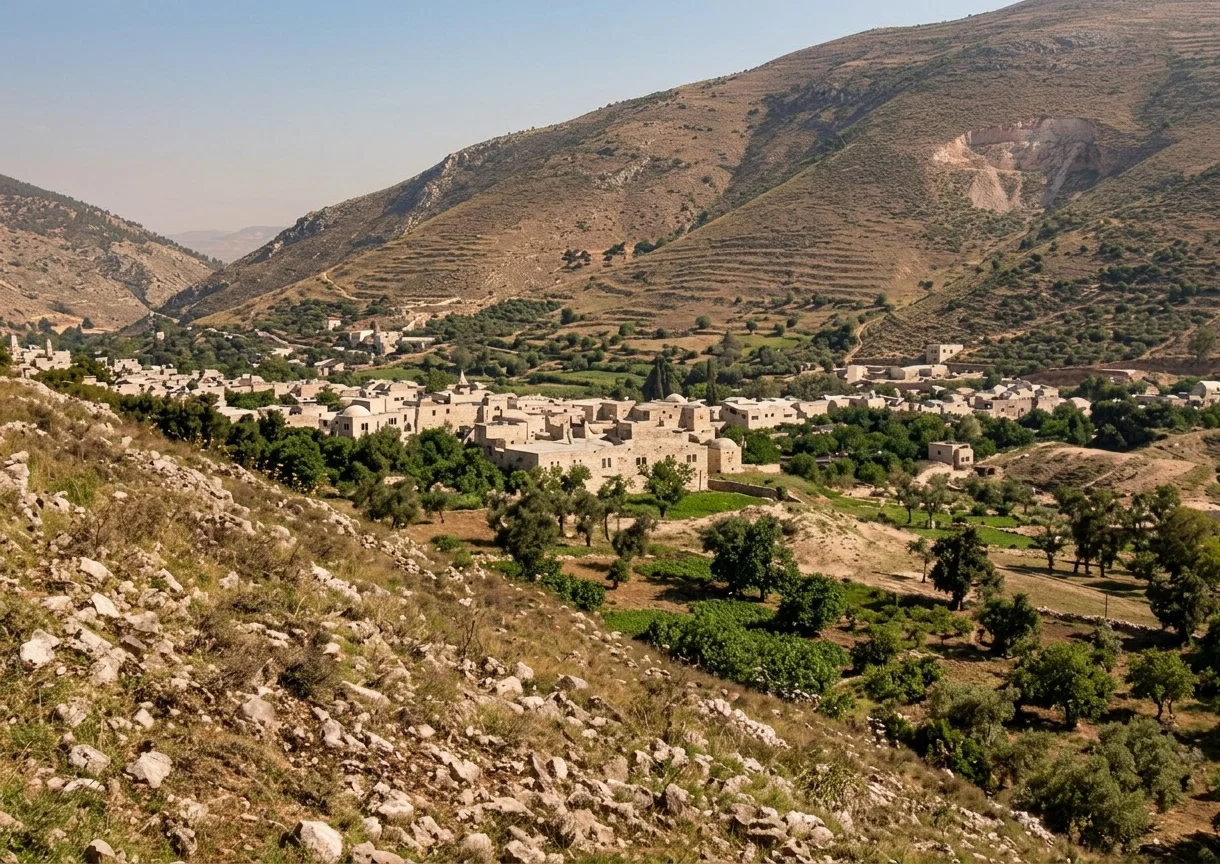
From the hill of Samaria we went six miles southwest, to Nablus, or the Shechem of the Old Testament. Most of the way the road leads through valleys; as we near Shechem, we strike the carriage road leading from Shechem to Joppa, the first of the kind we have seen all the way from Nazareth. In ancient times, when kings passed back and forth through this country with chariots, there must have been good roads; for, as illustrated in the account of Jehu, they sometimes drove “furiously.”
Along this road from Shechem to Joppa is a telegraph wire. As we near the town, there are more signs of life,—men working on the road, groups of women going to market, carrying their load on the head, and long strings of camels,—the freight trains of the Orient. Olive and fig trees are quite abundant in this region; water is plenty; and here and there we see an old dilapidated mill driven by water.
Shechem occupies a central point in the history of Israel. It was the first place in Canaan visited by Abraham; it was to Shechem that Jacob came on parting with Laban; here he bought a parcel of ground; it was here that his sons afterwards fed their flocks, when Joseph was sent to visit them; after the conquest of Canaan, Joshua assembled Israel here—six tribes towards Mount Gerizim to pronounce the blessings, and six tribes towards Mount Ebal to pronounce the curses; before his death, Joshua again assembled all Israel here for parting admonitions; and it was here that the national assembly was held when the ten tribes revolted from Rehoboam.
Shechem sits on a saddle between Mounts Ebal and Gerizim, on the watershed between the Jordan and the Mediterranean. Its present population is 20,000, all Arabic except one thousand Christians and two hundred Samaritans. The brisk trade which here centers from Joppa and the country east of the Jordan gives its market a lively character.
The town has but one long main street, through which we pass from west to east. This street is the main market, and hence was crowded with all sorts of wares, camels, and donkeys, so that it was difficult to squeeze through. In these cities there is no attempt at making a sidewalk; often, the whole street from wall to wall is jammed full. As a rule artisans of all sorts have their shops, which often consist of nothing but a nook under an arch, opening to the street; and usually those of like craft are grouped together. Whenever we meet camels, it is a time to give all our attention to our horses; in the country, we take a side path in the field, and give the camel the whole road; but here in these narrow streets the problem is a vexing one, for a horse prefers to keep his distance from a camel, tho the camel always marches along in solemn indifference.
Shechem is of special interest as having been the seat of the Samaritan worship. The Samaritans were a mixed race, an amalgamation of heathen from Babylon and vicinity, with a few of the poorer Israelites whom the Assyrians did not think worth carrying off. While outwardly adopting the first five books of Moses, and many features of the religion of the Jews, they retain their heathenism; and, as revealed in the New Testament, there was great enmity between them and the Jews. The Samaritans had a temple on Mount Gerizim, southeast of Shechem; but only a few stones now remain to mark its place.
SHECHEM, BETWEEN EBAL AND GERIZIM.
Of the Samaritan race, only 200 survive; these are in Shechem, where they have a distinct quarter of the town, and a synagog for their worship; they keep the feasts of the law of Moses, but offer sacrifices only once in a year,—at the Passover. Three times a year,—at the Feast of Tabernacles, the Feast of Weeks, and the Feast of Unleavened Bread,—they make pilgrimages to the summit of Mount Gerizim, to the spot where their temple stood. As in the days of Christ, they still hold this mountain as sacred. Their high priest claims to be a descendant of Aaron; he is supported by the tithes of his people. The race of Samaritans is gradually becoming extinct; in their numbers there are more men than women, and the Jews and others will not intermarry with them. They still look for the coming of the Messiah, expecting that He will appear about 6,000 years after creation. It is claimed that they still hold that the Samaritans only will enter Paradise.
Shechem is also a center for missionary operations. Latins, Greeks, and Protestants operate here; they maintain several institutions of charity and education; but the work done is mostly among Christians; it is claimed by those that have been here many years that the ground is very hard.
On emerging from the crowded street we had a clear view of Mounts Ebal and Gerizim, which are respectively 3,077 and 2,848 feet high. The foot of Gerizim is green with verdure; but Ebal is barren from the base. It is believed that the gathering of Israel under Joshua for pronouncing the blessings and the curses took place a short distance east of Shechem. From the summit of Mount Ebal the view is extensive; one can see the hills of Samaria, the Mediterranean, the site of Cæsarea in clear weather, Mount Carmel, the hills of Galilee, Mount Hermon, and a long range of hills east of the Jordan extending to the Dead Sea. The view from Gerizim is nearly as extensive.
But of the many things of interest about Shechem, Ebal, and Gerizim, nothing is so attractive as Jacob’s well, rendered immortal by the conversation of Jesus with the woman of Samaria. John 4. This woman came from Sychar, half a hour’s walk northeast of Shechem, at the foot of Mount Ebal. There is still a small village here. Jacob’s well is southeast of Shechem, near the center of the valley, between Gerizim and Ebal; its mouth is now about ten feet below the surface of the ground; we descend to it by steps through the ruins of a small chapel which the Crusaders built over the well. It is in possession of the Russian Church, and inclosed by a wall; a priest lives here to guard the well and to admit visitors.
The mouth of the well is covered by a large stone, having an oval opening about two by three feet. The priest lighted a candle, and with a long cord lowered it slowly to the bottom, showing all parts of the well; it is round, seventy and one-half feet in diameter, and about seventy-five feet deep. It is walled with hewn stones; and, tho so deep, has no water. Without doubt it was at this identical spot that the Saviour sat to rest at noon, and had that remarkableconversation about the water of life. We, too, are wearied with the journey and feel like resting awhile, to meditate upon the scene which here took place, and the grand truths here uttered.
Sychar, about fifteen minutes distant, is in plain view from the well; also the summit of Gerizim, where stood the Samaritan temple, to which the woman referred when she said, “Our fathers worshiped in this mountain; and ye say, that in Jerusalem is the place where men ought to worship.” Jacob’s well is in the parcel of ground which Jacob bought when he returned from Laban, and which he gave to Joseph. When Israel left Egypt, they brought the bones of Joseph with them, and buried them in this parcel. About 110 paces from Jacob’s well is a monument of modern construction, called Joseph’s tomb, which is believed to mark the place where he was buried. The valley opening to the east of Jacob’s well is fertile, but is now indifferently cultivated. The whole scene forcibly reminds one of how literally the curses pronounced from Mount Ebal have been fulfilled. H. P. H.