WHEN a man has been in this country a week, he feels that he could easily write a book. After he has been here a year or two, he has serious doubts about being able to write anything that would be worth reading. At first everything is new and strange—a world of wonders; but the novelty soon passes away, and most things seem commonplace enough.
That which makes the most deep and lasting impression on his mind probably is the sight of men and women engaged in labor which in our country is done only by domestic animals and machinery. Doubtless there are more tons of freight moved in Tokyo in one day by man-power than by horse-power. And it is no uncommon sight to see women engaged in the dray business. Nothing arouses one’s sympathy so much as the sight of a poor woman with a babe on her back, pulling like an ox at a heavy load. This many do all day long, for from five to ten cents. Much light outdoor work is performed by women, such as pulling weeds from the parks and gardens, delivering light packages, etc., for which they receive from three to five cents a day. Women’s wages rarely exceed ten cents a day even among those who are artisans. In all cases they board themselves. House-maids receive fifty cents a month and board.
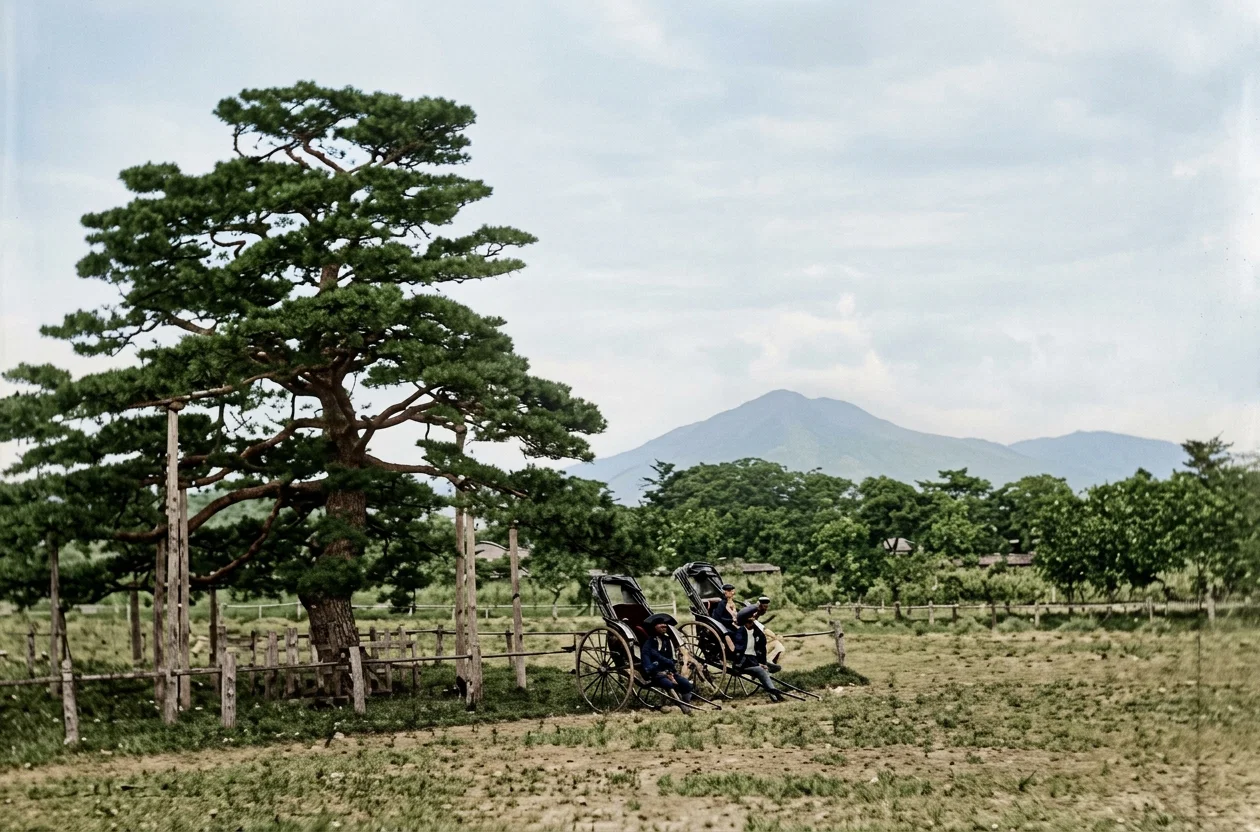
In passing through the streets you can see goods being transported in many different ways. The poorest people use a pole, from the ends of which the goods are suspended as the Chinese vegetable pedlers of San Francisco carry their burdens. Others who are not so poor use hand carts, of which there are many varieties, each adapted to the business of its owner. The milk carts, the street-sprinkling carts, express carts, mail carts, vegetable carts, pedler’s carts, are drawn by men—in fact, all light hauling is done by men, women, and boys, and much of the heavy hauling also. In heavy hauling men use a kind of harness by which they pull; and often two men work together so as to assist each other up steep places. Oftentimes there is to all appearance but little difference between the size of their loads and those of the horse carts in the same street. The jinrikisha—a little top buggy drawn by man—is the cab of the East. The men who draw them are the aristocrats among the draymen. There are more than forty thousand of them in this city alone. There is a horse-car line extending through this city from north to south. Those who do not patronize this, except the nobility and the11very rich, either travel by foot or jinrikisha. Their charges are very reasonable to their own countrymen; but they, like most others with whom you have to deal, seem to think that foreigners have plenty of money, and it is their duty to get as much of it as possible. Unless you have a clear understanding when you engage them, at the end of your journey you will have to pay two prices or have trouble with them. The newcomer gets “squeezed” on every hand until he has learned their ways, or has a friend to protect him. There are a few dealers who do not take advantage of foreigners’ ignorance, but the great majority do not scruple to take all they can get. With all the advantage of having a Japanese friend with us, we have several times discovered that we had been for months paying twice the value of some things of common consumption. These things are not to be wondered at, however, for these people recognize no such moral standard as that furnished by Christianity, and yet in so-called Christian countries lying and cheating are not uncommon practises.
The Jinrikisha.
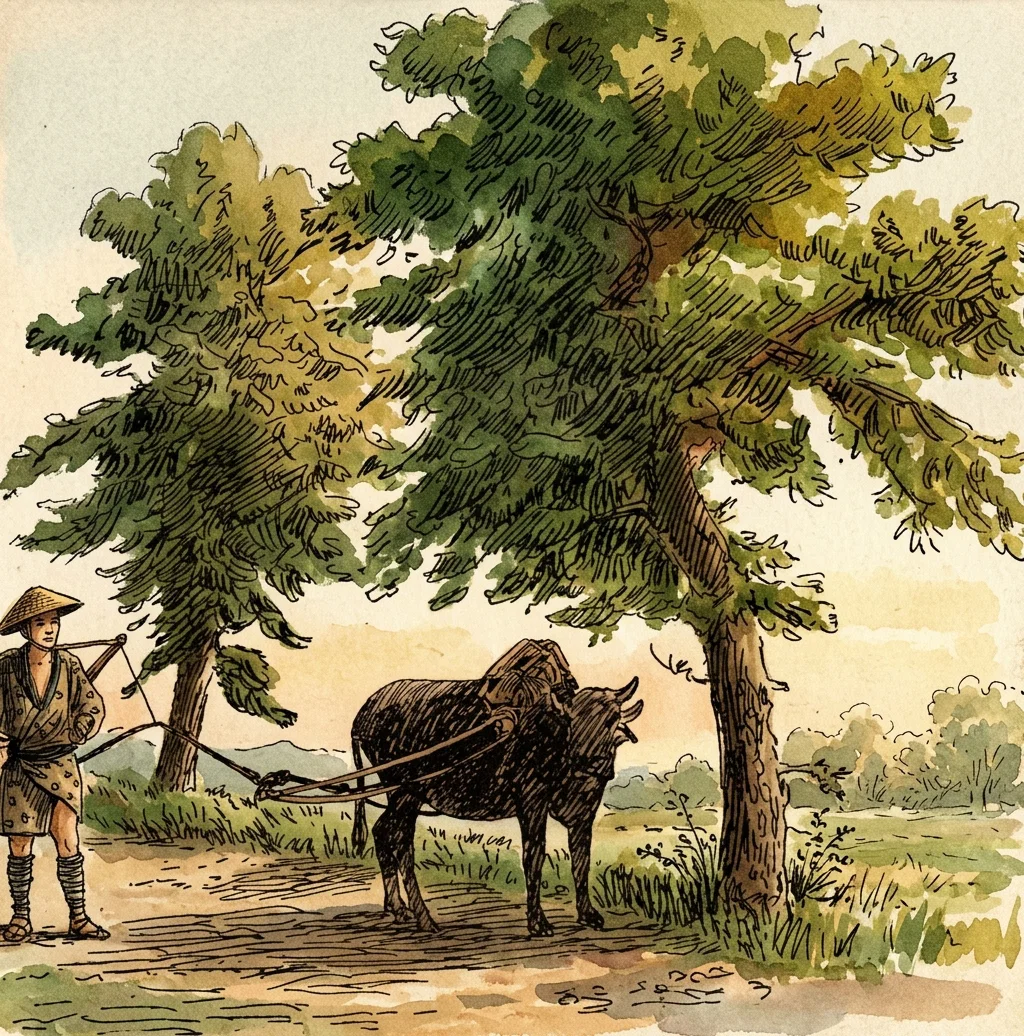
Ox and Cart.
There is as great difference among jinrikisha men as there is among horses—some are slow and short-winded, while others are fast and enduring during. A good one can travel thirty or forty miles a day and be ready to repeat it the next day. For short distances he can travel six miles an hour without undue exertion. Like pugilists, baseball and football players, and professional cyclists, jinrikisha men usually die young, pneumonia and heart disease being the prevailing causes of death.
Everything in this country seems to have been cast in small molds. It is a well-known fact that the people of Japan are much below the average in stature. So the dogs, chickens, horses, and cattle are not as large as such things are at home. Dogs, chickens, and children have the freedom of the streets. In the central portions of the city there are no such things as back yards, consequently there are no other places than the streets to go for outdoor exercise. Being very narrow, one would think that playing in the streets would be accompanied with great danger. Not so. No one ever gets run over. Neither do vehicles stop for anything to get out of the way. The jinrikisha man or teamster calls out, “Hai [Hi], hai,” short and quick, when all scamper to one side.
I have often heard it said that the poorer a man is the larger family he has and the greater number of dogs he keeps. This saying will apply well to this country, for in some parts of the city the dogs seem to well nigh have possession. I do not know but that the first part of the saying will apply also, for Japanese families are, as far as I am acquainted, of good size. How they ever live on the small earnings of the father is difficult to understand. But they not only live, but the father and oftentimes the mother indulge in the use of tobacco. Tobacco-using among men is almost a universal habit, the cigarette being the favorite form in which it is taken. A large per cent. of the women and boys also indulge in the smoking habit. The women usually smoke pipes without any effort at concealment.
The Japanese are great lovers of pets. Besides dogs and cats, many kinds of birds are kept, and it is a rare thing to find a house without its cages of birds and pots of flowers. There are great numbers of wild birds in the city,—crows, hawks, swallows, sparrows, and ducks. In the winter it is no uncommon thing to see flocks of ducks floating on the canals right in the heart of the city. No one being permitted to molest them, they seem to be wholly indifferent to passers-by. It is just so with the crows. They alight in the streets and in the door-yards, apparently without fear of molestation, to pick morsels of food which their keen eyes have discovered. The hawks are more shy. They do not seem to have so much confidence in man, and as their food consists largely of smaller birds, there is no necessity of their coming so near the surface. They may be seen flying around or perched on the tall trees. The most sociable of all is the swallow. Since the shops are mostly constructed with the whole front open to the streets, the swallows come in and build their nests wherever they think best. They and the people seem to be on the best of terms.
The small boy in this country seems to have had better training than his contemporary of other lands, or it may be that he is naturally of a gentler and kinder disposition.
While there is much in the habits of this people to be lamented, there is much to commend. People who love birds and flowers can not be wholly bad. God grant that they may soon learn to love Him who made the birds and the flowers.