WOMAN’S LOT IN AFRICA

6%

Pacific Press Publishing Company · Oakland, California · Aug 25, 1898

FromSigns of the Times, Vol. 24, No. 33.

Read the full edition

WOMAN’S LOT IN AFRICA.

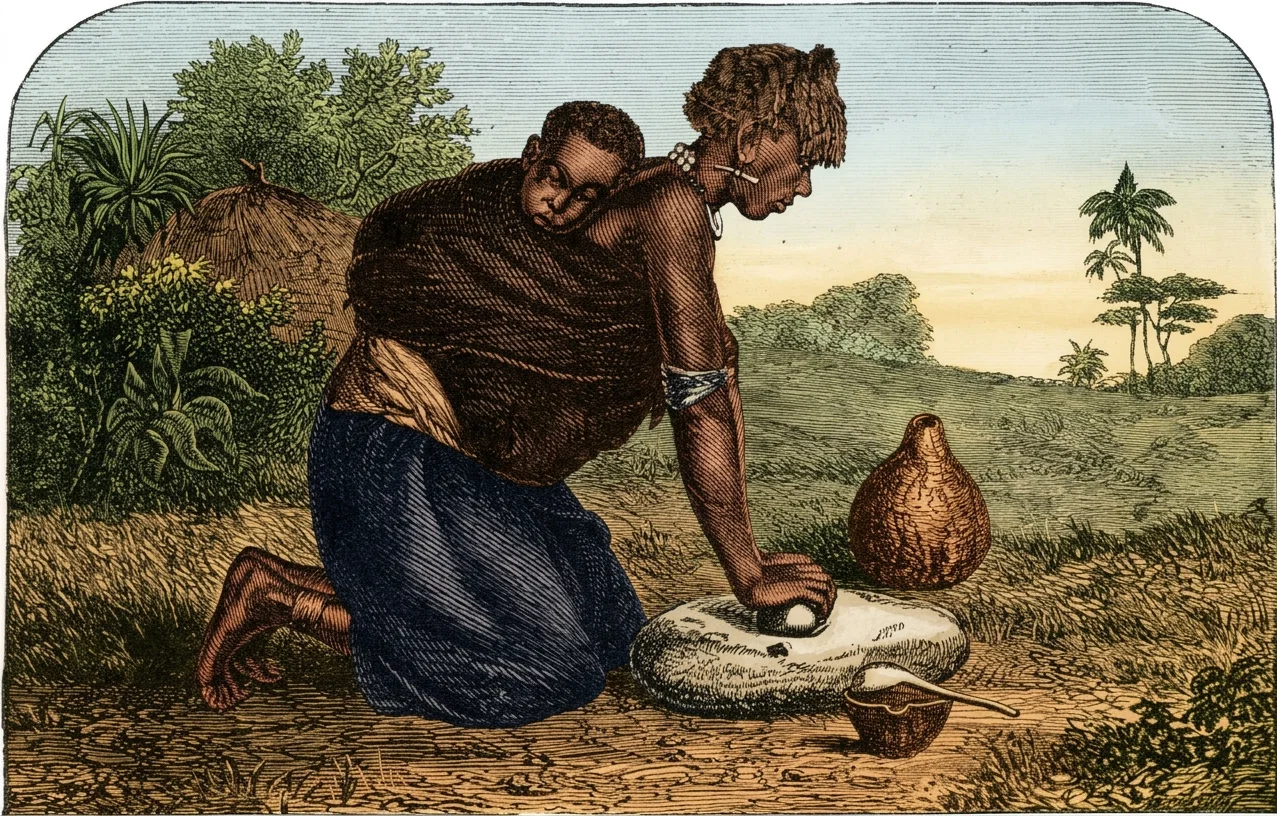
A WOMAN MAKING BREAD IN AFRICA.
The temporal penalties of sin seem to bear most heavily on woman. Everywhere and always heathenism means for her degradation and humiliation, altho it takes different forms in India, China, Turkey, and Africa.
Her lot in Africa is, perhaps, not so hard as in some other heathen lands. The soil is more productive and the population less dense than in China and India. As a consequence the struggle for the necessities of life is less sharp and pangs of hunger are less often felt than in parts of Asia. Then, too, woman is not in Africa confined like a prisoner for life in a zenana or harem, but has the fullest liberty to go about, and can and does come to hear the Gospel as freely as the men. But in other respects her lot is a hard one and ought to appeal powerfully to the sympathies of her sisters in Christian lands.
Point a native of Gaboon or the Ogowe to his right hand and ask what he calls it. He answers, “That is the ‘man hand.’”
“And what is the other?”
“This,” pointing to his left, “is the ‘woman hand.’”
“Why are they so named?”
“Because,” he explains, “this is the stronger and better hand and arm, and is therefore the man hand. The other is inferior in strength and efficiency, and hence is the woman.”
Here we have embodied in an idiom of the language the African estimate of woman’s worth.
At meal-time a plate of the best of everything is placed on the rude table, and the man of the house sits down and eats in solitary grandeur. He may invite any male friend to eat with him, in some cases even his boys; but never his wife.
She may wait till he has eaten, or she may take a plate of food and eat apart; but while her lord and master is dining, she may expect to be called at any moment, in imperious tones, to bring him this and to do that. No matter how hungry or tired she may be, she must drop everything and obey at once, or she is wanting in respect to her husband. The arrogant tone and manner in which his commands are often uttered show a deliberate purpose to emphasize and render yet more galling her menial position.
Take a very common sight in Africa: On a forest path you meet a family returning home from the plantation. In advance stalks the man, a great, stalwart fellow, carrying a light gun that weighs five or six pounds. Next come the women, usually much smaller and feebler, every one of them panting and staggering under the loads they carry. On their backs, supported by grass ropes passing over their foreheads, are bushel baskets full of plantains or cassava roots and heaped until there is nearly a bushel on top, and, perhaps, an additional burden in each hand, till they look like pack mules rather than women. You say to the man, “Why do you make your wives carry such heavy loads?” In surprise he answers, “Why, they are my women.” “I know they are,” you reply; “but why don’t you carry the basket for that poor woman and let her carry your gun?” “Me! Why, I’m a man! It is the work of the women to carry the loads.”
And so women are the burden-bearers, and they age rapidly under it.
But it is in the marriage customs of Africa that woman’s degradation is most marked. Betrothed when a mere child, she grows up bound to a man who is certainly ten or fifteen and perhaps forty years her senior. She may dislike him, even hate him, it makes little difference. She is taken from her home at the age of eight or ten, and goes to live in the family of her future husband, where her mother-in-law teaches her that her great duty in life is to obey her husband, and the great business of life is to serve him. Here she begins at once to cook his food and to wait on him, and as soon as he chooses, she becomes his wife without any further ceremony. If she fails to show her husband due respect, if his abuse and imperious demands cause her to lose her temper (for she still has one, and a tongue too), then he beats her. You remonstrate, “Stranger, why do you beat this woman?” “She’s my wife.” “Yes; but why abuse her?” “She did not obey me.” “But why do you expect more deference from her than you show to her?” “Did I not,” he replies, “pay for her more than two hundred dollars, the wages of years of work? She’s mine.”
There you have the story. Greed prompted her father to sell her, and he tries to satisfy his parental instincts by calling it marriage. Selfishness prompts her husband to oppress her, to take advantage of her weakness, to make her his slave, his drudge.—Gospel in All Lands.