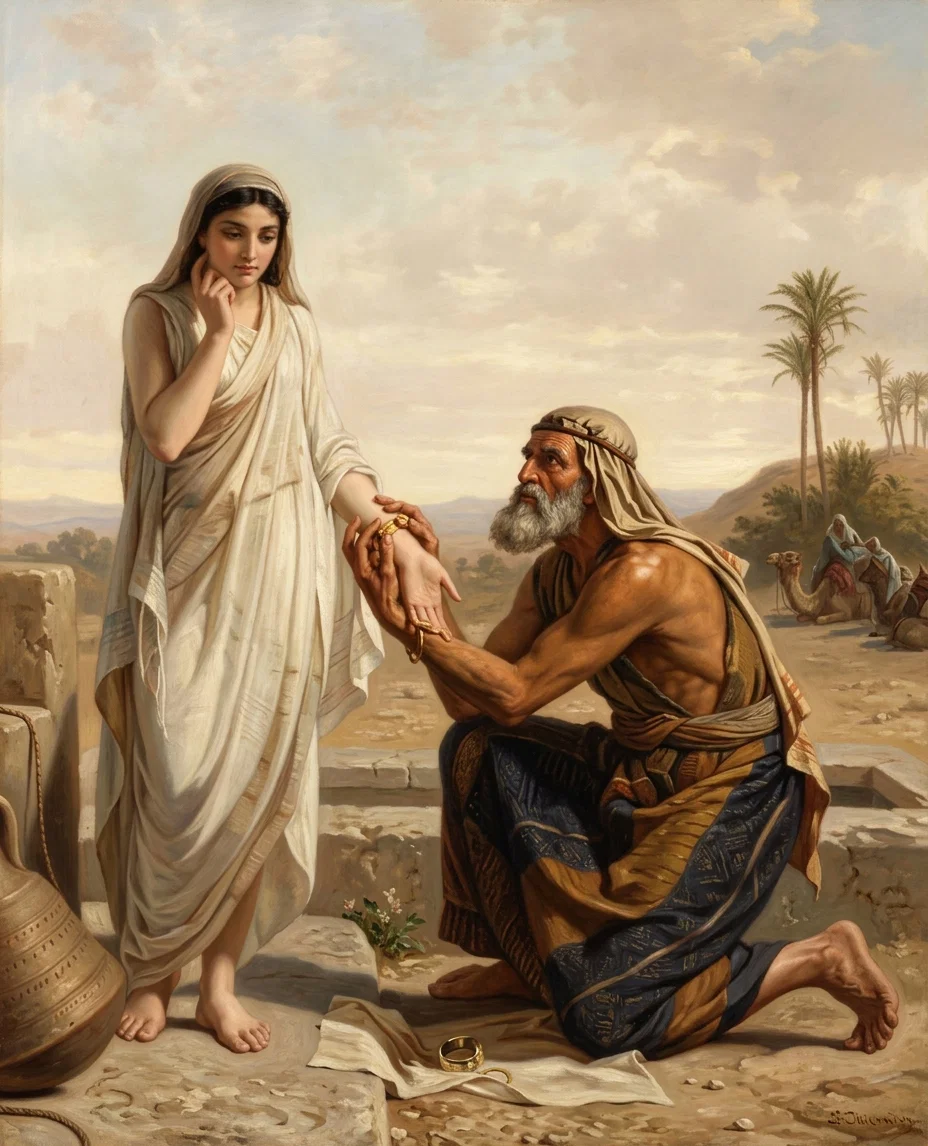
“The man took a golden ring of half a shekel weight, and two bracelets for her hands of ten shekels weight of gold; and said, Whose daughter art thou?” Gen. 24:22, 23, R.V.
“Now the Lord had said unto Abram, Get thee out of thy country, and from thy kindred, and from thy father’s house, unto a land that I will show thee.” Gen. 12:1. Abram (afterward named Abraham) “was called the friend of God” (James 2:23); therefore he made no special plea of attachment to “home and native land,” but “went out, not knowing whither he went” (Heb. 11:8). Abraham could not be a friend of God and a friend of the world—not even of kindred and country—at the same time. “Know ye not that the friendship of the world is enmity with God? whosoever therefore will be a friend of the world is the enemy of God.” James 4:4.
Abraham never returned to his native land. Even when there was a famine in the land to which God called him, he did not conclude that he had made a mistake in going there, or that his mission there was at an end. No, he went on still farther from the land from which he had come out, and sojourned temporarily in the land of Egypt. Abraham, the friend of God, was a pilgrim and a sojourner wherever he went, and dwelt in tents, indicating that he was not attached to any particular spot even in the land which he and his offspring were to occupy. If he ever sang—
“My country, ’tis of thee,” etc.,
it was with reference to the antitypical land of promise; “for he looked for a city which hath foundations, whose builder and maker is God.” Heb. 11:10.
Isaac, the son of Abraham, was a child of promise. The promises made to Abraham because of his faith were to him and to his seed (Rom. 4:13), and this seed was Christ (Gal. 3:16). Abraham had another son, Ishmael, by a bondwoman, but the seed was to come through Isaac, who was the son of Abraham’s wife, a freewoman (Gal. 4:22, 23; Rom. 9:6, 7). Isaac was the type of Christ, being a child of promise. He was submissive to his father’s will, even to being made ready for a burnt-offering; so when he was forty years old, his father made arrangements to get him a wife, and Isaac intrusted the matter entirely to him. “And Abraham said unto his eldest servant of his house, that ruled over all that he had, Put, I pray thee, thy hand under my thigh; and I will make thee swear by the Lord, the God of heaven, and the God of the earth, that thou shalt not take a wife unto my son of the daughters of the Canaanites, among whom I dwell; but thou shalt go unto my country, and to my kindred, and take a wife unto my son Isaac. And the servant said unto him, Peradventure the woman will not be willing to follow me unto this land; must I needs bring thy son again unto the land from whence thou camest? And Abraham said unto him, Beware thou that thou bring not my son thither again.”
We see that Abraham would not only not return himself to the land from which God had called him, but he would not allow his son to return, even to bring a wife away. Abraham was not slack in the matter of his son’s marriage; he had made it a subject of communion with God. This is evident from the fact that he told the servant that God would send His angel before him. It may be asked why he would send to a country to which he would not allow his son to go, and take from there a wife for his son. Two reasons seem obvious: (1) Abraham was endued with the spirit of prophecy (Gen. 20:7), and knew that the Canaanites would be eventually destroyed because of their wickedness ; therefore if Isaac were married amongst them, and his posterity were to live in close companionship and relationship with them, they would of necessity be cut off with the Canaanites. (2) Abraham trusted that there might be one in the land whence he had been called whom the Lord knew would yield to the good influences of his family (Gen. 18:19), and it would be a blessing to her to bring her away from her home surroundings. Besides this, Abraham was not lacking in knowledge of the evil results of marriage with those whose influence would tend to lead one away from fidelity to the God of heaven,—a knowledge too often2 (498)unheeded in our time, “as it was in the days of Noah,” and in the experience of Lot.
The test in Isaac’s case was, Would one be found willing to leave her country and her kindred, as Abraham had done, to become the wife of Abraham’s son, the child of promise? To find such an one was the important mission with which the God-fearing steward of Abraham’s household was intrusted, and laid under the obligation of a solemn oath. But if one could not be found willing to risk the journey with a strange man, and wedlock with one whom she never had seen, then the servant would be released from his obligation.
The servant (Eliezer) took ten camels and an abundant outfit, and went into Mesopotamia, unto the city of Nahor, Abraham’s brother. Stopping by a well outside the city, he again committed his cause to the Lord, saying: “Behold, I stand here by the well of water; and the daughters of the men of the city come out here to draw water; and let it come to pass, that the damsel to whom I shall say, Let down thy pitcher, I pray thee, that I may drink; and she shall say, Drink, and I will give thy camels drink also; let the same be she that Thou hast appointed for Thy servant Isaac; and thereby shall I know that Thou hast showed kindness unto my master.” Verses 13, 14.
The prayer was promptly answered, for “before he had done speaking” the damsel was at the well who did as he had said. And she proved to be Rebekah, “the daughter of Bethuel the son of Milcah, which she bare unto Nahor,” and was therefore the daughter of Isaac’s cousin. Eliezer was much encouraged by the manifest answer to his prayer, and humbly returned thanks to God. Upon receiving some costly presents, Rebekah ran home to show them to her family and tell them about the strangers at the well. Her brother Laban, attracted by the display of wealth, ran to the well and with much ado bade the servant of Abraham and his companions welcome to the hospitality of his father’s house. The characteristic selfishness manifested by Laban in his dealings with Jacob in after years is a fair indication that his show of friendship on this occasion was actuated by the prospect of gain rather than kindness of heart.
When Eliezer had made known his errand and requested an answer, her father and brother replied: “The thing proceedeth from the Lord; we can not speak unto thee bad or good. Behold, Rebekah is before thee, take her, and go, and let her be thy master’s son’s wife, as the Lord has spoken.” Then again the pious servant of Abraham bowed himself to the earth and thanked God for His kind providence. The hospitality of Rebekah’s family was well repaid, for besides the jewels and raiment that were given to Rebekah, Eliezer “gave also to her brother and to her mother precious things.”
When it came to the point of departing, the matter of Rebekah’s going was left entirely to her own choice, and she said, “I will go.” So, receiving the parting blessing from the family, she took her nurse and went with Abraham’s servant and his men. On arriving at Abraham’s camp, the servant made report of his mission, and Rebekah became Isaac’s wife.
The question is sometimes raised, If Abraham would not return to a country whence God had called him out, nor would allow his son Isaac to return thither, how could Jacob return there? The answer is in one word—apostasy. It was Jacob’s treachery toward Esau that caused him to flee from Canaan and take refuge in the land whence Abraham had been called, in order to escape his brother’s vengeance. And in after years, when Jacob’s posterity had been delivered from Egyptian bondage, and again planted in the land of Canaan, and had lapsed into dire apostasy, they were also carried as captives to the country whence Abraham had been called.
Now what is the lesson?—When God calls one from the world into His service, there can be no legitimate excuse for a return. A departure from God, if not repented of, must inevitably lead back to the former condition. Being “unequally yoked together with unbelievers” will surely endanger a covenant relation with God. Neither Abraham nor Isaac, altho enduring trials of faith, ever had to pass through Jacob’s trouble, or to labor as a servant in the land whence God’s representative had been called to freedom. All these humiliating experiences of Jacob and his posterity were the consequences of apostasy, and “whatsoever things were written aforetime were written for our learning, that we through patience and comfort of the Scriptures might have hope.” Rom. 15:4. W. N. G.