CONVERSING WITH CHRIST

8%

Pacific Press Publishing Company · Oakland, California · Jul 21, 1898

FromSigns of the Times, Vol. 24, No. 29.

Read the full edition

CONVERSING WITH CHRIST.

“Did not our heart burn within us, while He talked with us by the way, and while He opened to us the Scriptures?” Luke 24:32.
Reader, go back nearly nineteen centuries to that wonderful land of Judea, at the time when the “Desire of all Nations” walked upon earth a man. But He spake as never man before had spoken. He wrought works such as man never before had wrought. He revealed an unselfishness, a love for humanity, a gentleness, a tenderness, a mercifulness of disposition, such as had never before been seen. Surely He was the long-promised Messiah, the King to sit upon the throne of David.
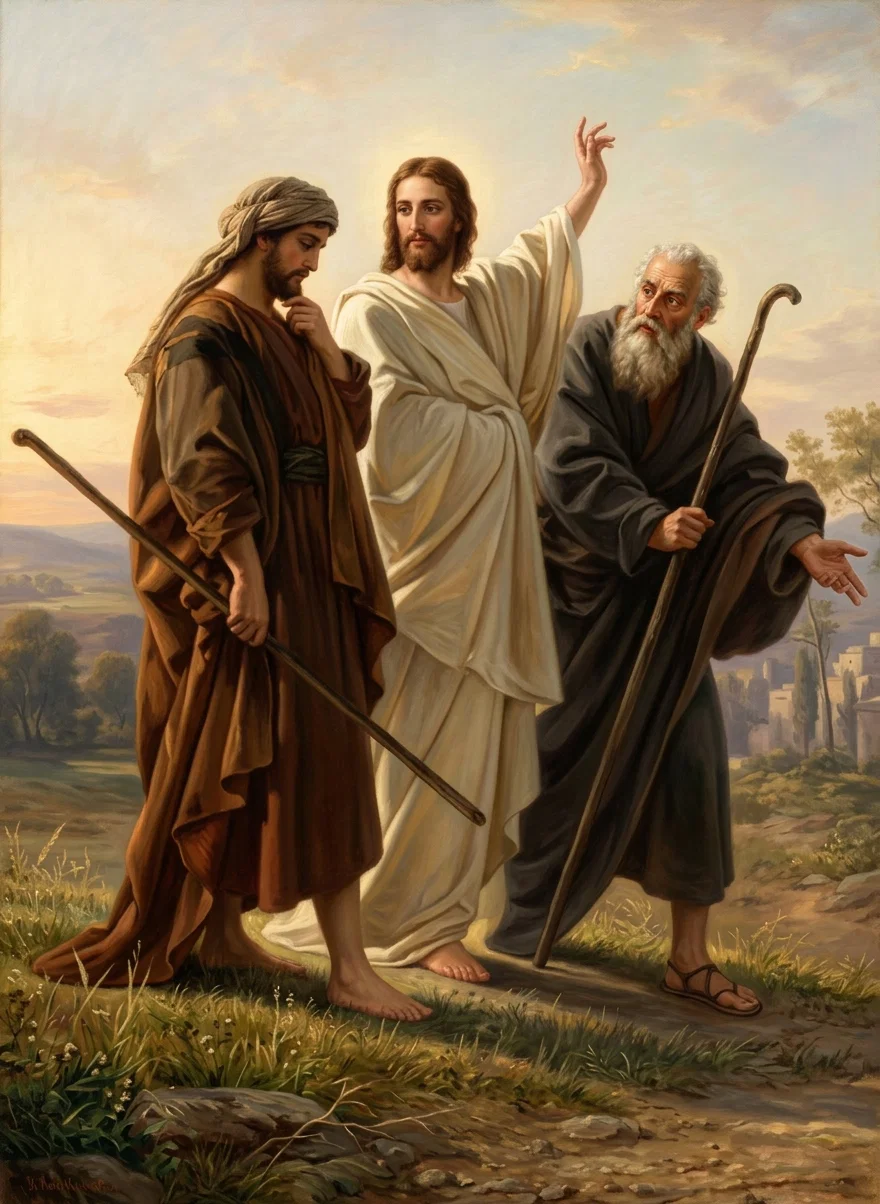
JESUS AND THE DISCIPLES ON THE WAY TO EMMAUS.
AND all this was true. He was the Messiah; He was the King. But He was now even the divinely appointed Man, Example, Sacrifice. But this a people wrongly educated could not see. They wanted a temporal king, triumphant over the hated Roman power. They wanted a temporal kingdom, rivaling in court splendor the glory and magnificence of Solomon’s reign. The disciples of Jesus believed Him to be the king, and earthly Jerusalem His capital city, and Mount Zion His throne; and each of the twelve, at least, wanted the highest place in that kingdom.
POOR men; they were doomed to disappointment. They could not believe, much less realize, that entrance to that kingdom , both as king and subjects, was by the way of the cross. He had said: “If any man will come after Me, let him deny himself, and take up his cross daily, and follow Me,” and “whosoever will be chief among you, let him be your servant; even as the Son of man came not to be ministered unto, but to minister, and to give His life a ransom for many.” This and much more they had heard of the lowly way, and the crucifixion; but eyes blinded with national prejudices could not see; ears stopped by selfish schemes could not hear. Their imagined ideas of the splendor of Christ’s reign eclipsed all else, and they passed blindly on to disappointment, the lessons given to save them from it unheeded. Thus it was till the arrest and passive submission of Jesus came. Even then they hoped He would assert His power and conquer His enemies, until the rebuff of Peter and His announcement that He must drink the cup. Then “all forsook Him and fled,” and He was left to tread the winepress of humiliation, of anguish, of suffering, alone.
NONE, save perhaps the disciples who looked for Christ to come in 1843 and 1844, can appreciate the disappointment of the disciples in 31. They saw their Lord taken captive; returning and following again, they saw Him humiliated, beaten, scourged, mocked, falsely condemned to die, stretched upon the cruel cross, yielding up his life as a malefactor, laid in the grave. Disconsolate and disheartened, they were despairingly mourning over that which was their salvation. Two of them go from Jerusalem to Emmaus, a distance of seven and one-half miles. On the way a Stranger overtakes them. He asks the sorrowful men the subject of their conversation. They tell Him of Jesus, and of their blighted hopes: “We trusted that it had been He which should have redeemed Israel; and beside all this, to-day is the third day since these things were done.” Their minds were as dull to comprehend the Scriptures as their eyes were to discern the form of the Master by their side.
But He does not leave them in stupidity and sorrow. He turns their thoughts to the only source of comfort and strength, the Scriptures of truth. The Stranger knew naught of the “higher criticism,” tho He did of higher thought, higher life, higher hopes. “From Moses and from all the prophets, He interpreted to them in all the Scriptures the things concerning Himself.” He went with them to Emmaus, talking as they went. They urged Him to tarry. He ate with them; blessed andbrake their bread; and, more blessed than all, opened their blind eyes so that they recognized Him. And then He vanished.
BUT He left them not in despair. Hope reigned in their hearts once more. It gave them a message to those in Jerusalem. They rose that same hour and started on their return. The Master is risen. They say to themselves, “Did not our hearts burn within us, while He talked with us by the way, and while He opened to us the Scriptures?” They find the other disciples saying, “The Lord is risen indeed, and hath appeared unto Simon.” Together they rejoice, and again with burning hearts the two tell of the journey with the Master, and His opening of the Scriptures.
DEAR soul, Christ is risen indeed. He is a living Saviour, a living Teacher. He left an unchangeable message to all His disciples: “Lo; I am with you alway, even unto the end of the age.” He comes to you in various strange and mysterious providences. He walks by your side, striving to help you when you are cast down. He would by His blessed Spirit of truth open to your mind and heart the Scriptures, the Word of life, if you are longing to know them, that you may do them. He will tarry with you to break and bless to you the bread of life if you really desire Him. No path He calls upon you to tread will be trackless of His stone-bruised feet. No trial so fierce but that its thorns have pierced Him. In the mightiest storms He has stood unsheltered and alone. He pities all; He would help all. He wishes to talk with you, to help you, to make truth plain to you, as truly as He did to the disciples at Emmaus, nineteen centuries ago. Will you let Him?
“Talk with us, Lord; Thyself reveal While here o’er earth we rove; Speak to our hearts, and let us feel The kindlings of Thy love.
“With Thee conversing we forget All time and toil and care. Labor is rest and pain is sweet If Thou, my God, art here.”
X.