FARMING IN JAPAN

6%

Pacific Press Publishing Company · Oakland, California · Jul 21, 1898

FromSigns of the Times, Vol. 24, No. 29.

Read the full edition

FARMING IN JAPAN.

Farming in this country is conducted under very different conditions and in a manner very unlike that in America. The chief reason for this is that the leading products of the two countries are different. Vegetables and the common grains are cultivated in a way similar to American methods, save that grain is planted in drills and cultivated with the hoe, as we do root plants.
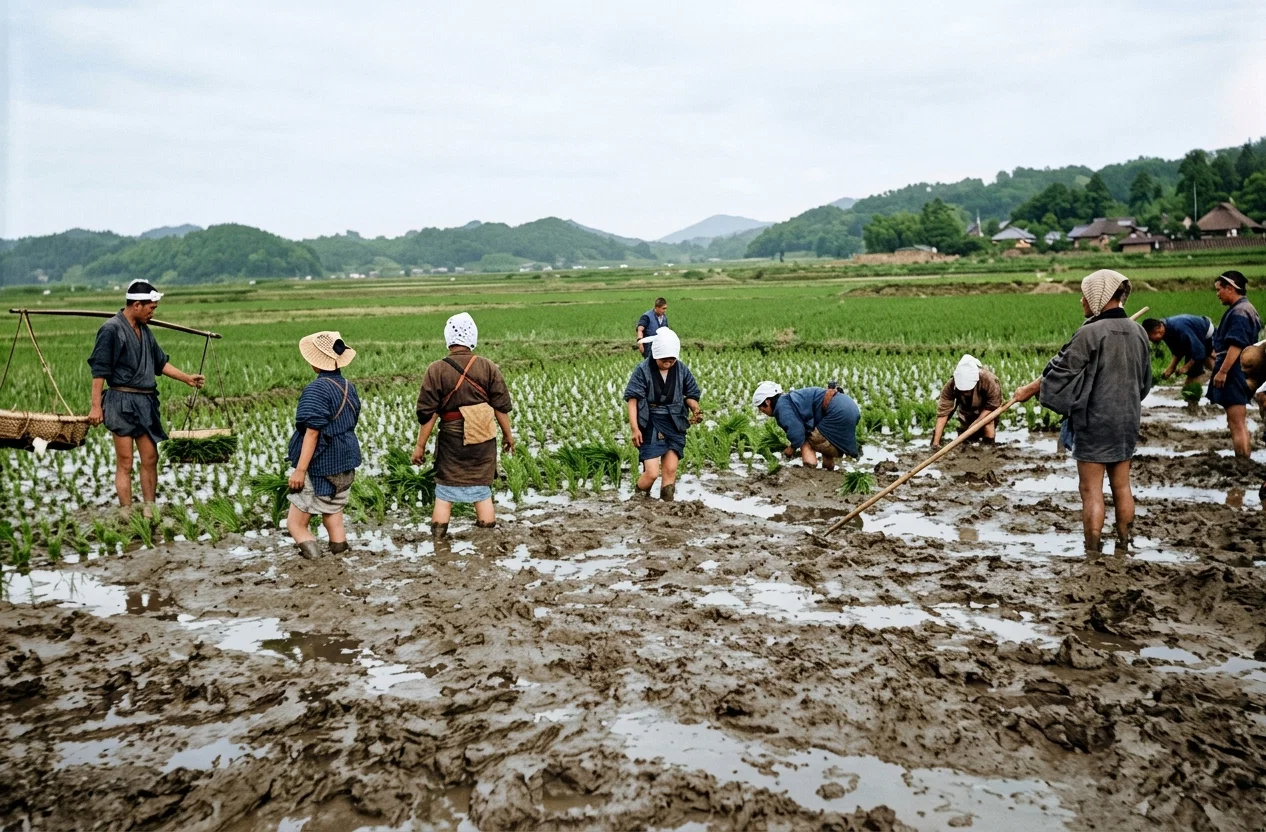
The principal food crop is rice, to which all lands are devoted that can be flooded with water. Rice is a marsh grass that will not thrive without an abundance of water. The fields are divided into sections a few rods square by means of levees. Each section is graded to a perfect level. The soil is then stirred to the depth of one foot or more with spades, or a kind of mattock with a blade very much like a spade. Water is then turned in, and the loose soil is worked into the consistency of thick gravel by men and women, with rakes, who wade around in this mud from morning till night, week in and week out. This is the work of preparing the ground for planting.
The rice plants are propagated in beds very much as we produce cabbage plants. About the middle of June the work of transplanting begins and usually continues about two weeks. The plants are about six inches tall, and are set about four or five inches apart in drills separated eight or ten inches in this soft mud. This is the farmer’s busiest season, and every member of the family who is able to assist must lend a hand, except one to care for the smaller children. This duty usually falls to the grandmother.
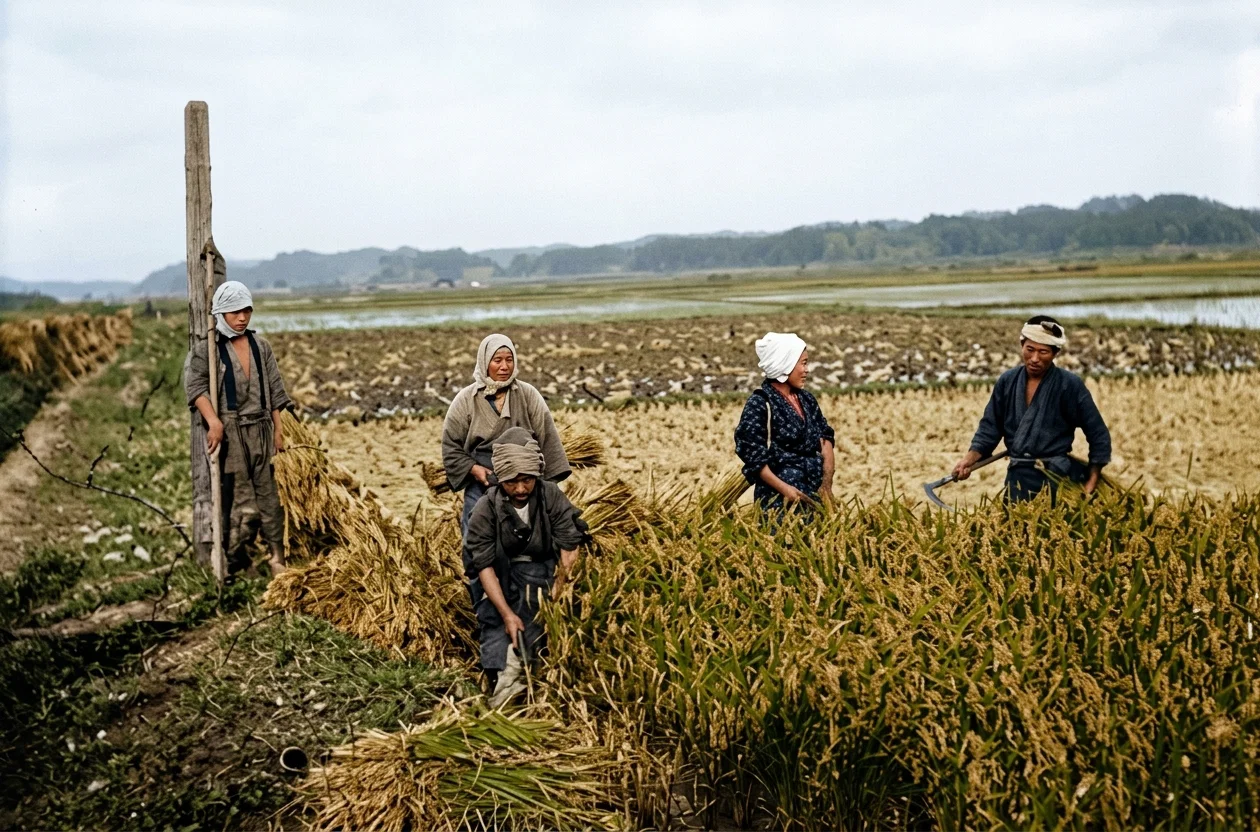
After the rice is planted, there is but little further to do to it except to keep the surface well under water until harvest-time. At the time of harvest, which is about November 1, men go into the paddies with reap hook in hand and proceed to gather in the crop. The ground is frequently as soft as it was when the crop was planted. In that case a piece of straw matting is thrown down on the mud to receive the grain, which is carried out usually by women assistants, and spread in the levee.
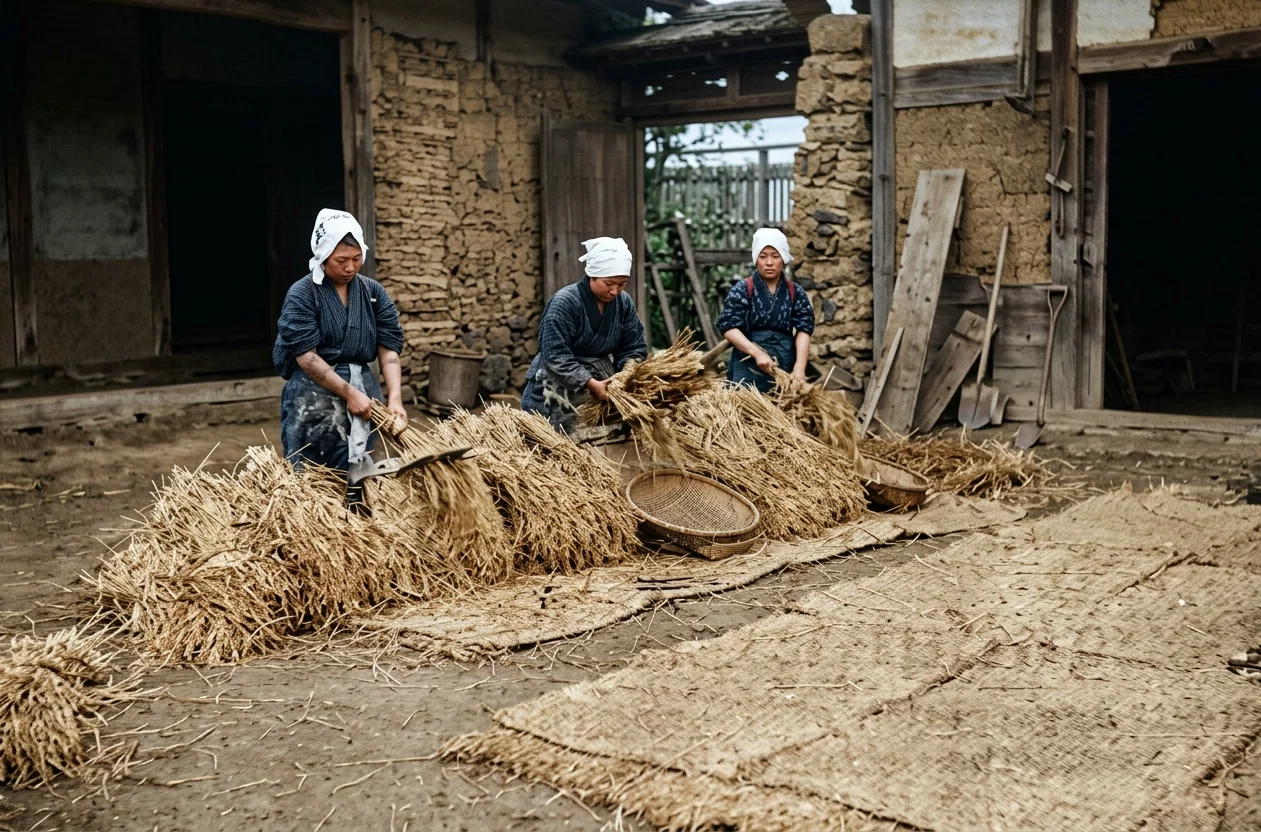
As far as I have observed, the threshing is done chiefly by women and girls, who draw the grain end of the sheaves through an instrument similar to a hackle. The winnowing is done by tossing the grain up, for the wind to blow the chaff away. When sufficiently cleaned, it is put up in straw bags containing nearly one hundred pounds each, when it is ready for the market.
TRANSPLANTING RICE.
TRANSPLANTING RICE.
GATHERING RICE.
GATHERING RICE.
Every farmer endeavors to have two pieces of land—one for rice and another of upland for vegetables and other grains; otherwise he would have difficulty in finding employment during the growing season.
After the rice crop has been harvested, many farmers, especially tenant farmers, drain their rice fields and cultivate a crop of winter vegetables. If tenants should not do so, they would have great difficulty in supporting their families, for the landlord takes his rental out of the rice crop, amounting to from three-fourths to seven-eighths of the whole. Under favorable circumstances the tenant farmer realizes about two hundred yen for his year’s labor, which is equivalent to one hundred dollars of our money. Out of this must be taken house rent, seed, and fertilizers before allowance can be made for food and clothing for his family.
Certainly the condition of the Japanese farmer is not one to be envied. And yet his condition is not considered the worst in the country. The lot of the common coolie is harder than that of the farmer. He works for forty sen a day, or less, at whatever he can get to do. Just think of a man working for twenty cents a day. That means that he pays rent, feeds and clothes his family, and sends his children to school on an income of seventy dollars a year. “How does he do it?” you ask. I do not know. His life to all appearances is without a ray of hope for any improvement in his condition. It is a constant battle for existence; yet he appears to be happy and contented. This seeming happiness is chiefly artificial, the result of education, or I would better say of training. You never see the least manifestation of grief among any Japanese except small children. It is very difficult to ascertain their true feelings, or to get access to their inner selves. They are by no means a confidential people. At any rate, it is hard for foreigners to get into their confidence.
I have somewhat digressed from the subject I started out to write about, and will resume by considering other products of agriculture, the chief of which is tea and mulberry trees. The tea plant is an evergreen shrub that grows three or four feet high and is cultivated on uplands very much as vineyards are cultivated in California. The time of harvest is in the spring—the tea of commerce being the new leaves which are gathered and dried in a certain manner. The different kinds of tea depend on the condition of the leaf when gathered or in the difference of manipulation in the process of curing, mainly the former. Tea-farming is a much more agreeable occupation than rice farming; for wading almost up to the knees in mud for several months of the year would be to me a very disagreeable business.
The mulberry tree is cultivated for feeding silkworms. This industry during the last few years has increased very rapidly, and I understand is fairly profitable—more so than tea culture, which of late years has not been so remunerative as formerly.
The silkworms are kept and fed in a house constructed for that purpose, or if the business is small, in one room of the farmer’s residence. The mulberry trees are cut down as needed, and the leaves are stripped off and fed to the worms. The suckers that grow around the stump this year will be cut off next year, and so on. Consequently a mulberry orchard is not a thing of beauty, especially during the feeding season. This is a very pleasant business for old men, women, and children, to whom this work is usually allotted. The young and strong men of the family devote their time to other and more severe labor. When the cocoons are finished, they are sold to the manufacturer, who rolls off the silk and prepares it for the weaver.
THRESHING RICE.
THRESHING RICE.
Farms are as a rule very small when compared with American farms. The method of cultivating the soil is so primitive that it is impossible for a family to cultivate more than a few acres. Modern machinery is almost unknown. The mattock, the rake, and the hoe are the chief implements of agriculture. In my ramblings one day last summer I saw an Oliver plow, the only thing of the kind I have seen in the country, and it was not in use. The sight of it made me feel as if I had met an old friend.
Almost all kinds of vegetables are produced here in great abundance, but aside from oranges, strawberries, and persimmons, fruits are very scarce and inferior in quality. There is nothing here except the above mentioned that is worthy of being compared to California fruit. A few apples are brought down from the northern island which look nice but are inferior in quality and dear in price—the best ones selling for eighteen or twenty sen a pound (9 or 10 cents.) W. C. GRAINGER.
June 2, 1898.