Galilee and Southward

5%

Pacific Press Publishing Company · Oakland, California · Jul 14, 1898

FromSigns of the Times, Vol. 24, No. 28.

Read the full edition

Galilee and Southward

JOTTINGS FROM PALESTINE. NO. 6.

Galilee and Southward.

As we enter the hospice, our room has little attraction; Galilee acts like a magnet on the heart; we leave the building, walk down the garden, and spend the evening hours listening to the whisperings of the sea as it recounts the sweet stories of old. Soon the moon rises above the hills of the Gergesenes, on the opposite shore, enabling us to see the dim outlines of the land where the fierce men dwelt among the tombs. Should we ascend the hills just back of Tiberias in the morning, in a clear day we could not only distinctly see across to the shores of Gergesa, but from one end of the sea to the other.
As we stand on the shore, we hear the quacking of ducks, playing in the water a short distance out. As there are so few inhabitants about Galilee, water-fowls are plenty, and, as anciently, the sea is teeming with fish. At present, there are very few fishermen. There are also but few boats; these are kept at Tiberias, mostly for renting to tourists. To cross the lake from Tiberias, or to go to either end, requires from two and a half to three hours’ rowing.
As the sea lies so deep down among the mountains, its waters are tranquil except when the wind sweeps down from the mountains, when it becomes furious. Hence, storms are apt to rise very suddenly. The hospice garden wall was some distance from the water’s edge, and some ten feet high; yet the waves are sometimes high enough to reach the wall, and even to jump over it.
While we stand on the shore, we are joined by an Italian monk, who is stopping at the hospice for his health. He has been at a monastery in the vicinity of Capernaum; but that region is so infested with fever that he was obliged to leave it. Even Tiberias is considered a sickly place, specially in the hot season. As the Sea of Galilee lies so low, the heat is much greater here than on the shores of the Mediterranean.
In the morning, I hire a horse of an Arab to take me to Nazareth, a ride of six hours. Hesends along a servant, a young man, to bring the horse back. The January morning is cold and rainy, and the road quite muddy. The young man is barefoot, and has only thin cotton trousers on, about the thickness of an ordinary bed-sheet. With my winter underclothing and overcoat, I feel none too warm. Where the road permits, I trot my horse, and the young man runs along behind, making as good time as the horse without difficulty.
While ascending the mountain, we turn again and again to view the lake, which at every turn seems to reveal new beauties; and our heart is animated with the sentiment of the poet as he wrote:—
“O thou dear Galilee, we would linger by thee, Where the voice of our Lord stilled the tempest’s loud roar; And His servants are we, whom He comes now to see, As He stands in the morning on the shore.”
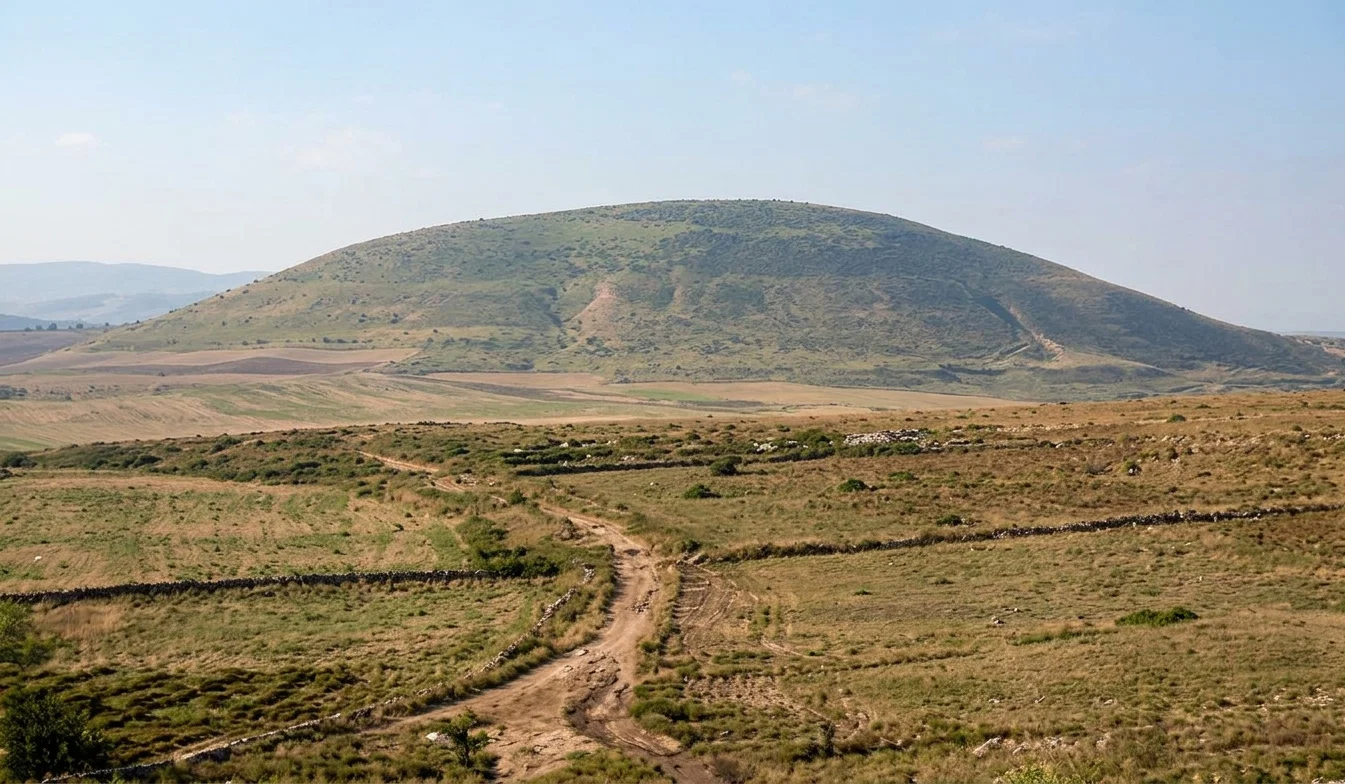
MOUNT TABOR AND A PORTION OF THE PLAIN OF JEZREEL.
We must now bid thee adieu; but thy fair picture will ever remain, and thy cherished memories be more sacred and tender! We now continue along the main route leading from the Sea of Galilee to Jerusalem. We again pass by the Mount of Beatitudes, from whose summit we can plainly see Safed, high, high up, over three thousand feet above the Sea of Galilee, but only four hours distant from it; it is thought by some that it was to this city that Jesus referred when in the sermon on this mount He said, “A city that is set on a hill can not be hid.”
We return to Nazareth by the same road over which we came; we gladly dismount, for six hours in an Arabic saddle is not like six hours in a modern railway car. Many tourists in Palestine go to the extra expense of obtaining European saddles, as they can ride in them much easier. On the way, we passed some caravans; for we crossed the caravan line leading from Carmel to Damascus. This was also the ancient route between Egypt and Damascus. All the way from Galilee to Nazareth, there are but few villages, and very few farmers working in the fields. In the days of Christ, this whole region was teeming with a dense population.
As we entered Nazareth, on passing Mary’s well, an Arab rode past us on a fiery steed in great style; then he continued just in front of us all the way to our hotel, displaying the fine qualities of his animal. Scarce had we dismounted when he was at hand to offer his animal for the next part of the journey. On investigation, we found him to be a reliable man, and his horses good; so we bargained with him to take us to Jerusalem, by way of Samaria and Nablous, a journey of three days. As he knew a few words of French, we were able to communicate what was necessary.
Having already visited Nazareth, we will spend no more time here, and arrange to leave at daylight next morning. Promptly as agreed, the Arab is here with his two horses, one for me and one for himself. Just back of the saddle is a large sack, with a pocket hanging down each side of the horse, to receive our luggage and provisions for the journey. In anticipation of this part of the journey, we have very little baggage, and thus avoid the expense of an extra horse. Our horses were full of life, and pranced about impatiently till we were off. Just as the sun sent forth its first heraldic rays above the hills of Gilead, we were coursing our way along the hills to the south of Nazareth.
In a short time we reached their limit, and began the rapid descent to the great plain of Jezreel. From these heights near Nazareth, the view is extensive and interesting. The whole plain of Jezreel spreads out before us; to the southwest and west stretches the Carmel range, with the place of Elijah’s sacrifice in plain view; to the east is Mount Tabor, and to the southeast little Hermon and the hills of Gilboa; to the south rise the mountains of Samaria, to which we are now to go, across the plain of Jezreel.
Looking out from these hills of Nazareth, one can readily see across the plain to the hills of Megiddo, not far from Elijah’s place of sacrifice; it is from these hills that the name of Armageddon is derived—the place where the final gathering of the armies of earth is to take place. Rev. 16:12–16. This has been the scene of some of the most noted conflicts in the history of Israel; here was the test between Elijah and the prophets of Baal; here Josiah met Pharaoh-necho and was slain; and it was here that the remarkable victory was gained by Deborah and Barak over Sisera with his nine hundred chariots of iron. It was an interesting fact to me to observe that from Mount Tabor, where Barak had assembled his ten thousand, one can see across the plain of Jezreel to the waters of Megiddo, where Sisera assembled his host. It is about six hours’ walk from Mount Tabor to Mount Megiddo.
We now descend the steep banks to the plain, going nearly straight south towards Jenin (the En-gannim of the Old Testament). Our way is over pasture lands and grain fields; part of the time along the single telegraph wire which runs from Nazareth to Nablous and Joppa. The plain of Jezreel is quite free from stones and very fertile, but poorly cultivated. Well tilled, it would support an immense population; but at the present, it is very thinly peopled. We have now come from the shores of Galilee to the plain of Jezreel in a ride of seven hours; our further journey must be left for the future.
H. P. H.
Basel, Switzerland.