The Sea of Galilee

5%

Pacific Press Publishing Company · Oakland, California · Jun 30, 1898

FromSigns of the Times, Vol. 24, No. 26.

Read the full edition

The Sea of Galilee

JOTTINGS FROM PALESTINE. No. 4.

The Sea of Galilee.
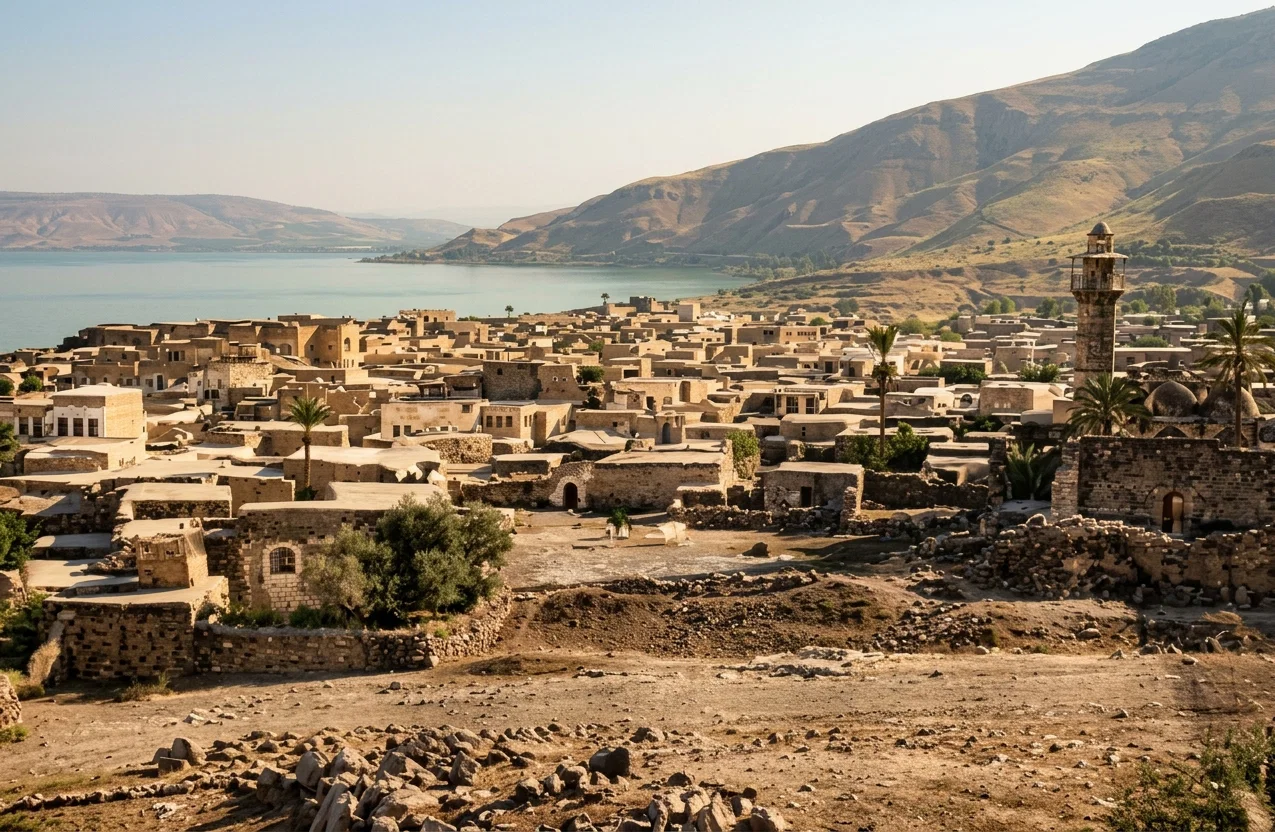
From the Mount of Beatitudes we descend southward, and in twenty minutes join our coach on the main road leading from Nazareth to Tiberias. This was doubtless the main route of travel between the Sea of Galilee and Jerusalem in the days of Christ; hence Jesus and His disciples must have oft wended their way over these hills and through these valleys.
As we descend, we have before us a fine panorama of the sea and surrounding hills. There being much soil and few stones in this vicinity, the roads are good, and per exception our horses can trot. From the beginning of the descent we have an excellent view of nearly the whole sea; how peaceful and quiet it lies, nestled among the mountains! Stripped of all its sacred memories, the scene is one of interest still by virtue of its natural beauties. This was an agreeable surprise to me; for the idea obtained from descriptions and pictures of the Sea of Galilee was far short of the reality.
The Sea of Galilee has a deep depression; the surface of the water is over 600 feet below the surface of the Mediterranean. Hence the valleys of the country round about, which are somewhat above the level of the Mediterranean, are highlands compared with the surface of the Sea of Galilee. So from the valley which we have just traversed at the foot of the Mount of Beatitudes we have a steep descent of nearly a thousand feet to the shore of the lake.
Our point of destination is Tiberias, the only place on the Sea of Galilee where travelers can find accommodations, except in monasteries at the ruins of Capernaum and other places. All along the descent we had a good view of Tiberias; it is compactly built, and surrounded by a wall, and is still classed by the Turkish Government as a fortified town; hence, as in ancient times, no buildings are allowed outside the walls, much to the inconvenience of modern builders.
As we drive through the narrow gate, at our left stands a new hotel finished; it is the first regular hotel put up in Tiberias. Heretofore, travelers were accommodated at the Catholic hospice. Most of our company go to the hospice; but our Jewish friend decides to find other quarters, so I accompany him. As we pass along the narrow, crooked street, we see a sign which looks as tho it had been painted with the end of the finger instead of a brush: “Hotel Tiberias.” We enter and find a few small, poorly-kept rooms, with hard beds, having soiled coverings; the only thing modern about the hotel is the price; so I here take leave of the Jewish professor and accept quarters with the rest of the company at the hospice. The monks in charge receive us kindly and furnish respectable rooms. As fleas are not my special enemies, I will leave it to others to tell what a terrible torment they are in Tiberias. The Arabs claim that the king of fleas holds court here.
Having deposited my baggage at the hospice, I hasten out to view the town, and for the first time walk the shores of Galilee. Tiberias having been built on the plan of a fortified town, the streets are narrow and crooked and filthy, and the buildings dilapidated. Most of the people I meet are Polish Jews, easily distinguishable by their black felt hats and long curly lock hanging down in front of the ear. I never saw a town composed of such pale, squalid-looking people. With neglected person, and ragged clothes, they look like a company of beggars; and, indeed, many belong to this category; for a large number of the Jews of Tiberias live on charity.
Next, I walk through the market, to see what are the prospects for a wholesome diet. Like people, like market. With the exception of oranges, most of the articles offered for sale are well calculated to make a well man sick.
Tiberias was built during the lifetime of Christ by Herod Antipas, the son of Herod the Great. It was Herod’s purpose to build a new and splendid capital, and, to court favor, he named it after the reigning Roman emperor, Tiberias. He began the city A.D. 16, and finished it about A.D. 22—but a short time before Christ entered upon His ministry. Hence, while Christ taught on the shores of Galilee, Tiberias was a bright new city. From this city, the Sea of Galilee was afterwards often called Tiberias. John 6:1. But the city was not at first popular with the Jews; the Graeco-Roman style of its architecture was an abomination to their conservatism; and when building the city, a burial-place was disturbed; for this cause many of the Jews could not be induced to live in Tiberias, as contact with a grave made them unclean seven days. As a result, the city was at first peopled mostly by strangers and unprincipled persons.
So far as the Bible record goes, Jesus did not visit Tiberias. Perhaps this was because of Herod’s attitude towards the work of God. He had imprisoned and beheaded John the Baptist; when Jesus heard of this, he departed into Galilee; and, later, according to the report of the Pharisees, Herod thought of taking the life of Christ. Luke 13:31. It was on this occasion that Jesus referred to Herod as a “fox.” Under these circumstances it is not surprising that Jesus should choose another part of the lake as the scene of His activity. He was mostly in the vicinity of Capernaum, at the north end of the sea, while Tiberias is on the west side, a little south of the center.
The city of Tiberias is but once mentioned in the Bible. John 6:23. Soon after the destruction of Jerusalem by the Romans, Tiberias became the chief seat of the Jewish nation; the Sanhedrin and school of the Talmud were located here, and in the beginning of the fourth century, the Jerusalem Talmud came into existence here. The Jews still hold Tiberias as one of the sacred places of Palestine; the present population, of about 4,000, is two-thirds Jewish. There are ten synagogs here; on the Sabbath, nearly all shops were closed, and the town was remarkably quiet.
In 1837, Tiberias was visited by a terrible earthquake, which destroyed nearly half the population. The ancient city was much more extensive than the modern, the ruins of the ancient walls extending far beyond the present town.Half an hour’s walk to the south of the town are several hot springs, one of them having a temperature of 143° Fahr. Quite extensive but poorly-kept baths are located here.
Besides Jews, the population is mostly Mohammedan, there being only a few Catholics and Protestants. The Free Church of Scotland has a fine hospital and mission buildings at the north end of town, on the shores of the lake. Between the buildings and the lake are fine gardens filled with tropical plants, and fig, olive, orange, cypress, and palm trees. From the verandas is a fine view of nearly the whole lake, and surrounding mountains. This garden furnishes an illustration of what the whole shore must have been in the time of Christ.
The Scotch hospital is well patronized by both Jews and Moslems, tho the former do their utmost to keep their members away. Open conversions are very few; but much is being accomplished in enlightening and lifting up the people, and illustrating the difference between Christianity and false religions.
Sea of Galilee and City of Tiberias.
Our first day on the shores of Gennesaret having passed, we will here close our account, and continue with our stroll on the morrow.
H. P. H.