INDEPENDENCE—LIBERTY

4%

Pacific Press Publishing Company · Oakland, California · Jun 30, 1898

FromSigns of the Times, Vol. 24, No. 26.

Read the full edition

INDEPENDENCE—LIBERTY

THERE are principles and symbols of principles. It is the principle itself which ought to be loved or hated, not the symbol of the principle.
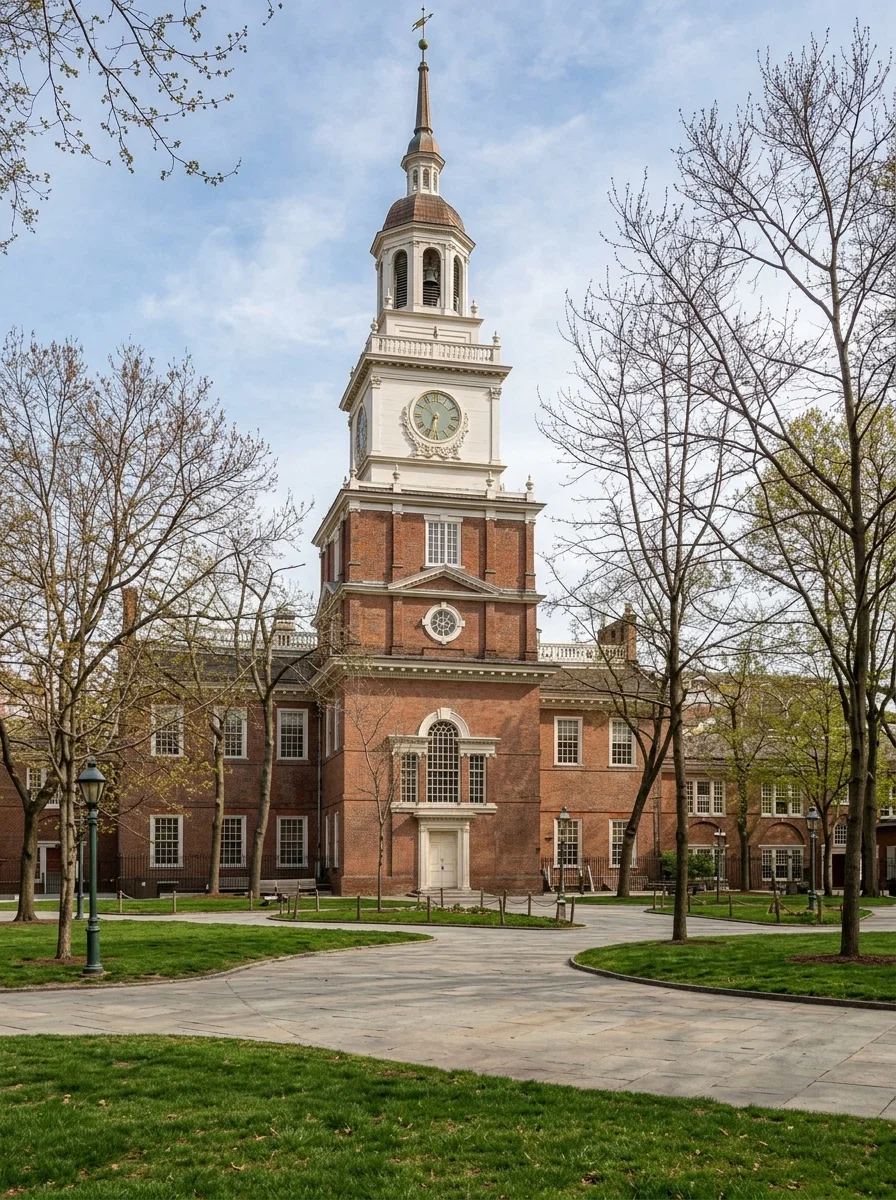
“Independence Hall,” Philadelphia, where the Declaration of Independence was signed July 4, 1776.
American Symbols.—Thus “Independence Hall”—the “Old State House” in Philadelphia—in itself is no more than many another building; but it stands for a principle, and that principle was at one time considered of vital worth to the people of this country. The flag of itself is no more than any other tri-colored cloth, but the principle of freedom for which it stands is of tremendous value. The old “Liberty Bell,” about which so much has been said, is worth no more of itself than so many pounds avoirdupois of bell-metal, but the principle of liberty for which it is supposed to stand is of infinite worth.
The great danger is that people get to worshiping the symbol and the thing symbolized is forgotten. Men will revere Independence Hall and Liberty Bell as sacred, when the principles they stand for are trampled underfoot. They will worship the flag, will speak of its trinity of colors, and liken them to the trinity of Deity; they will bow before “Old Glory” as it waves in the breeze as the aboriginal does before his idol, while the principles of liberty which in a measure gave birth to the flag are set aside as out of date, and the flag itself is used to foster tyranny and slavery.
The Lessons of History.—There are not wanting many lessons of this kind in history.
Here is one from the Book of God: As long as Israel was faithful to God, cherishing His holy law and His rich mercy in their hearts, the ark of God, containing the tables of that law, under the mercy-seat, was a symbol of God’s presence and their strength to withstand all foes. Before that ark Jordan’s rolling flood was stayed, and Israel passed through on dry ground. In its presence, while shouting victory by faith, the strong walls of Jericho crumbled to dust. But when Israel had forgotten the principles of pure righteousness, God’s presence in the life, for which that ark stood as symbol, they worshiped the ark as a sort of charm, or idol, or fetish, while they forgot God.
And when they went out against the Philistines to battle, they thought the presence of the ark would insure success, even tho it were borne by unrighteous priests. What was the result? Israel was defeated; the ark was taken by the enemy; and Israel’s true condition was written in the word “Ichabod,” “the glory is departed.” See Joshua 3:14–17; 6:1–5; 1 Sam. 4:3–22.

“Nehushtan.”

—Again, when poor sinning Israel were bitten by the fiery serpents of the wilderness, fit representation of sin, the Lord told Moses to make a serpent of brass, and place it upon a pole high enough so that all who desired to look upon it could behold and live. Many looked and were healed. They saw in the uplifted brazen serpent the symbol of God’s power and mercy and love. It was a symbol of the lifting up of Jesus Christ, through whom alone healing and virtue come to man. But centuries after, when Israel forgot God’s mercy and goodness, they worshiped the brazen serpent as tho there were virtue in it. But Hezekiah, true reformer that he was, in breaking down the high places and images of the licentious sun-worship, also “brake in pieces the brazen serpent that Moses had made; for unto those days the children of Israel did burn incense to it; and he [Hezekiah] called it Nehushtan,” that is, “a piece of brass.” See Num. 21:7–9; 2 Kings 18:4.
In how many nations and lands can we trace the images they now worship as having virtue or efficacy back to some good principle which the original image symbolized! But later generations forgot the principle and worshipedthe image; and the more the principle was forgotten, the more elaborately was the image worshiped, and the more sacredly was it regarded, till it became a proper symbol of persecution against all who did not agree with its worshipers.
Independence Hall, Liberty Bell, and the Old Flag stood for something in the days of 1876. They stood for two principles dear to the heart of every lover of humanity and liberty. The first of these is equality of man, embodied in the Declaration of Independence: “We hold these truths to be self-evident, that all men are created equal; that they are endowed by their Creator with certain inalienable rights; that among these are life, liberty, and the pursuit of happiness.” Equality of man was the basic principle of the grand document signed by the fathers of this country July 4, 1876, in the Old State House, Philadelphia. “To secure these rights governments are instituted among men, deriving their just powers from the consent of the governed.” Man yields no unalienable right in being a subject of true civil government. A just government protects him in these rights and secures them to him. Another principle is involved in the Declaration of Independence; but it was thought necessary especially to emphasize it in the First Amendment to the Constitution of the new nation; and that was the principle of religious liberty, the right to worship or not to worship, to believe or not to believe, to be wholly untrammeled in religious worship by human interference. Thus it is guarded in the Constitution: “Congress shall make no law respecting an establishment of religion, or prohibiting the free exercise thereof.” And later on in Amendment XIV: “No State shall make or enforce any law which shall abridge the privileges or immunities of citizens of the United States; nor shall any State deprive any person of life, liberty, or property without due process of law; nor deny to any person within its jurisdiction the equal protection of the laws.”
Christlike.—Both of these principles are Christian in their origin. Equality of man without and within the church is expressed in such scriptures as these: “God is no respecter of persons;” “God . . . hath made of one blood all nations of men for to dwell on all the face of the earth;” “For one is your Master, even Christ, and all ye are brethren.” And the second grand principle of religious or non-religious freedom is thus expressed by Jesus Christ and the apostle Paul: “If any man hear My words, and believe not, I judge him not; for I came not to judge the world, but to save the world.” “Knowing therefore the terror of the Lord, we persuade men.”
What the Founders Said.—That these principles were what these symbols stood for in 1776 the founders of the nation speak abundantly. See the sixteenth section of the Declaration of rights of Virginia, adopted June 12, 1776. The Presbytery of Hanover, Va., with the Baptists and Quakers, addressed a memorial in the same year to the General Assembly of Virginia, in which they say that they “are governed by the same sentiments which have inspired the United States of America,” and in which among many other good things they declare:—
Certain it is that every argument for civil liberty gains additional strength when applied to liberty in the concerns of religion; and there is no argument in favor of establishing the Christian religion but may be pleaded with equal propriety for establishing the tenets of Mohammed by those who believe the Alcoran; or, if this be not true, it is at least impossible for the magistrate to adjudge the right of preference among the various sects that profess the Christian faith without erecting a claim to infallibility, which would lead us back to the Church of Rome. . . .
The duty we owe to our Creator, and the manner of discharging it, can only be directed by reason and conviction, and is nowhere cognizable but at the tribunal of the universal Judge.
And the one who penned the Declaration of Independence said:—
Our civil rights have no dependence upon our religious opinions, more than our opinions in physics or geometry.—Thomas Jefferson.
Thus also spake Madison, Washington, and others. Thus also spake Congress in 1829, when misguided men thought it duty to endeavor to induce the government to ally itself with religion under the guise of a law closing post-offices and post-roads on Sunday.
On the reverse side of the great seal of the United States is the Latin motto, “Novus ordo seclorum,” “A new order of ages.” And so began in the United States a new order of ages in government. Every man was the peer of his fellow. Here was a “State without a king and a church without a pope.” Religion was free, to live or to die as its devotee willed. The government protected the man, not the religion. If worthy, if of God, the religion would stand of itself without the support of civil government. If unworthy, let it die. So the founders of this government considered, and so they expressed it in the charters of our liberty.
But “the new order of ages” is passing away, and the old order of the Dark Ages is reviving. He who has carefully read the history of the first five centuries of the Christian era may see Rome’s life being lived over again in this country. The religious element of the country, having lost the pentecostal power, is seeking affiliation with the State, and State aid to religious institutions. Not knowing the power of godliness, they are seeking the power of the civil arm. They are bringing strong pressure to bear upon politicians, municipal officers, State Legislatures, the national Congress, the State, District, and Federal Courts. All these institutions have bent under the pressure.
The fulcrum over which the strongest lifting has been done is the Sunday law in a hundred different phases. Judges in our State courts have yielded; the Supreme Court yielded in 1892 enough to declare this to be a Christian nation; Congress and Chief Executive yielded the same year in the closing of the World’s Fair on Sunday. Scores have been imprisoned in different States for the simple exercise of the unalienable rights vouchsafed of God to every human being, and supposed to have been secured by the Magna Charta of American liberty.
Just now there is a lull in the persecution. But honest and misguided souls are working through our young people’s societies, through law-and-order leagues, through so-called “Christian Citizenship,” through various organizations and federations, to secure what will finally culminate in the fullest union of Church and State in this country, and which will result in the utter ruin of both Church and State.
Now is the time for every lover of liberty to be alarmed and aroused. Now is the time for these religio-political reformers to examine anew the ground and motive of their work in the light of past history and in the blazing brightness of New Testament teaching. We can not afford to be mistaken. “Eternal vigilance is the price of liberty.” Already the flag, which should be a symbol of liberty existing, is made an instrument of tyranny in some parts of our land in compelling its worship in public schools. So is every principle of right becoming perverted.
It is the symbol and not the principle which is honored by the backslider in every true cause. It is the principle, the truth, God-given, which is honored by the true reformer in both Church and State.