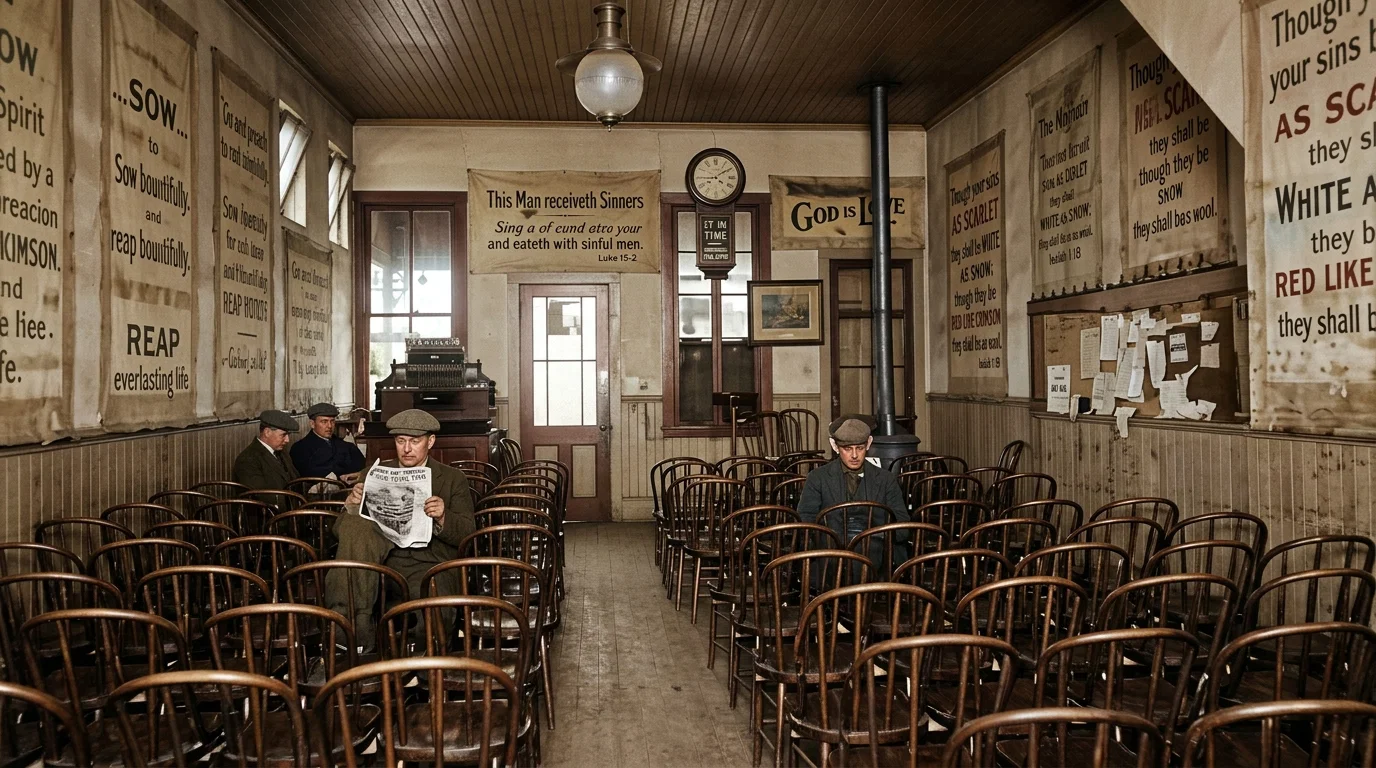
The superintendent and the helpers told me that things were quiet just now at the Mission, on account of the war. Twenty or more men who have been regular patrons, have enlisted in the army, and the bulletin-boards and war news are for many others greater attractions than are the free seats, wall texts, and Gospel talks at 641 Commercial Street.
Nevertheless, it seemed to the writer, as he stepped into the comfortable rooms of the Helping Hand Mission a few evenings ago, that the present attendance and interest are a long way from being quiet. But of course they are used to more stirring scenes. In the reading-room, which answers for reception room, parlor, office, and church, there were some ten or a dozen men. The illustration shows this room, looking in from the street. Two or three were reading magazines, and one was especially conspicuous, seeing he was perusing a copy of the SIGNS OF THE TIMES. Others were evidently meditating on the situation in general, or passing the hour scanning new faces that came in, while several, both inside and outside the door, were engaged in more or less animated discussion.
It was about 6 o’clock when I entered the place. This, you know, is supper hour, —5:30 to 7—and the very proper thing to do was to take supper with the men. One doesn’t have to have a full purse to get a meal here. The place was not designed that way, but is primarily for the man that is down on his luck. Still you would be surprised to see what an intelligent class of men patronize this branch of the institution—not alone those who must save the nickels, but many clerks and business men who have regular employment visit the place because of the vegetarian feature of the cooking.
You have to be your own waiter, that is, for the serving. You buy five cents worth of tickets at the office (you will not need more), step up to the counter, give your order from the bill of fare posted on the wall, hand over your tickets, and carry your meal to a seat at one of the eight or more long tables in the room. All dishes are a cent apiece, so you are not bothered making change: soup, potatoes, vegetable stew, plate of beans, cup of cereal coffee, sugar, small dish of nut butter, cup of milk, sauce, bread, etc., and they are liberal dishes, too, and the cooking is well done. Three to five cents a meal! I hardly see how the managers can serve so much for so little.
As the evening grew, the men gathered in slowly, until at 8 o’clock, time for the evening service, there were nearly forty in the chairs. For the reason before stated, the audience is less than half as large as it has been in the past. A song service preceded the preaching, and this seemed to be enjoyed by all. Friends from the San Francisco and Oakland churches are usually present to help in the singing.
The Gospel talks are given alternately by Brethren Richards and Dexter at present. This was Elder Dexter’s evening to speak. The sermon was listened to attentively as the speaker compared the power that is in the Gospel with various kinds of power in the world, together with the things to be gained. Men are not ashamed of power in worldly affairs. On the contrary, they glory in it. So how earnestly should we desire that power that is able to save us from sin and prepare us for endless life in the world to come! “I am not ashamed of the Gospel of Christ; for it is the power of God unto salvation to every one that believeth.”
At the close of the sermon a call was made for those who wanted this power to enable them to live better lives, and who desired prayers in their behalf, to raise their hands. Five hands went up. The men were invited to the front seats, and a short season of prayer followed, in which two of the men engaged. These also spoke to the audience of their desire to turn from Satan to God. One of them was a man who once knew the peace that comes from serving Christ, and who now rejoiced that he had been reclaimed. Three of the men were more or less under the influence of liquor. Poor fellows, they realized to some extent their sad condition, and that they needed help!
Many, yes, the larger share of those that thus come forward for prayers, go out from the Mission, and are seen no more by those who have labored for them. Truly it is a work of seed-sowing, pure and simple. Little chance here for man to take the glory to himself for the good that may be accomplished. God only and His blessed angels can water the seed and tend it and care for it in the after days. God alone in any event does this, but here few results are seen. But who will say it is not the noblest service. The day of judgment alone will reveal how many of God’s jewels have thus been reclaimed through the hands of His servants from among11the restless passers in and out at the Helping Hand Mission.
One is impressed that, for some of the men at least, the night’s proceedings grow in importance and weight as the hours grow larger. The closing of the meeting at 9:15 is the signal for the beginning of the last and probably the most interesting run of the day’s business. The last song means that the time has arrived when beds are available; and the clerk behind the wire screen of the office finds a plenty to do for an hour or two recording names, assigning numbers of beds, and giving out tickets and clothes locker keys.
But a stranger finds that at this point in the program all is not plain sailing. Down in the basement is a bath-room, and it is one of the unchangeable and unalterable laws that every man who did not sleep at this Mission “last night” must take a bath or find accommodations elsewhere. These words, “last night,” are the “open sesame” to some, and a chilling blast on the tender expectations of others; for there are a few people in this world that strenuously object to injuring their health by the use of soap and water. But the law is fixed. However, the most of them are willing and glad for the privilege, and welcome the spray, and the warm room, and clean towels, and clean night-shirt, and clean bed afterward. Just now the bath has only about fifteen patrons nightly. As some seventy beds are filled each night out of the total of 125, it will be seen by this how many are regular lodgers.
I must not neglect to speak of one very important room in the Mission buildings. This is the fumigator. It is on the top floor, and during the bathing process the one who has charge of this business makes frequent trips from bathroom to garret with loads of clothing in sacks, each sack containing the clothes of one man, who puts them therein as he prepares for the spray. Even hats and shoes frequently go into the sack, if the occasion seems to demand it. Arrived at the destination, the human elevator strings up each bundle by itself to a hook in the ceiling, and when all is ready, several pounds of sulphur are set burning, the room is fastened up tight, and the dire work goes on without let or hindrance for several hours. After all is over, the renovated garments are deposited by the beds of the owners. And all for ten cents!
A dime isn’t much, but there are lots of men who haven’t a cent in all their pockets. Some of these men were there the other night, and it was raining outside. They waited awhile, and when the right time came, which meant the sticking point of courage, they “braced up” to the window, told their story, and asked for a bed. Of course there are men who would abuse one’s hospitality, but the careful clerk tells them to sit down “over there” and he will “see” after a bit. “Over there” claims several, who wait patiently enough till the rush is over, when their stories receive investigation. If everything is “straight,” and they are willing to run the gauntlet downstairs, and to pay for the bed in work about the premises the next day, the case receives favorable consideration.
It is usually the same story, with a variation by each man,—no work, tho they have been trying a day, a week, or months, to get work. One fellow told me he was clean discouraged, hadn’t eaten anything all day, and had walked from some fifteen miles outside the city. He grew confidential, and related several chapters of his history; had graduated at a college, and his parents and sisters were well-to-do; he was ashamed of himself, but it was only partly his fault. Poor man, and poor men! Whisky had done it, and the devil had so benumbed his faculties and debased his manhood that well-nigh all aspiration and hope of anything better had been destroyed.
Others who remained in the room awhile did so because it was comfortable, and the scene had a peculiar interest. They can stay there if they wish until midnight, when the doors are locked. One man told me he had a room elsewhere. He had not much sympathy for the “no-work” men. He was a laboring man, and always found something to do, and believed the rest could if they wanted to work. I found out, however, that his occupation afforded him a better “show” than is afforded the man who is looking for “anything” to do, and is skilled perhaps at nothing in particular.
And so it goes, night after night, the same routine, many faces the same, but always something and some one new, ever the ebb and flow of the tide of needy men, aye, God only knows the depth of their need. You who have homes and enough to eat and enough to clothe your bodies, thank the Lord for His care for you, and remember the poor, and the outcasts, and the homeless ones.
I left an hour before midnight. The night clerk remained on duty until 2 in the morning.