The prophets were often permitted to view scenes of desolating destruction that were to spread over Jerusalem and Palestine. And quite as often were their minds led on by vision to behold the still greater desolations that would completely break the world down in the last days. A very clear illustration of this is found in Jeremiah, chapter four. In the first part of the chapter the prophet is addressing Israel and Jerusalem. And in the last part of the chapter he is dwelling upon the terrible last-day scenes. And the destruction of ancient Jerusalem is only a faint shadow of the rapidly-approaching time when the mountains tremble, the hills move lightly, and the “fruitful place” becomes “a wilderness, and all the cities thereof were broken down at the presence of the Lord, and by his fierce anger.” See Jer. 4:24–26.
One thing in particular that engages the prophet’s attention in a most wonderful manner is the “alarm of war” that is heard in the land amid these last-day scenes. His language5in both feeling and power is among the most thrilling utterances of all the inspired volume. He says:—
“My bowels, my bowels! I am pained at my very heart; my heart maketh a noise in me; I can not hold my peace, because thou hast heard, O my soul, the sound of the trumpet, the alarm of war. Destruction upon destruction is cried; for the whole land is spoiled; suddenly are my tents spoiled, and my curtains in a moment.” Jer. 4:19, 20.
The “sound of the trumpet and the alarm of war” are heard by the prophet. But it is no ordinary scene that is passing before his prophetic vision. What he beholds is so soul-stirring, so awful, and so filled up with “destruction upon destruction,” that he cries out, “I am pained at my very heart; my heart maketh a noise in me; I can not hold my peace, because thou hast heard, O my soul, the sound of the trumpet, the alarm of war.”
The trumpet is sounding among the nations, and the war cry is heard everywhere. Nations that have claimed to be standing for peace are being plunged into the awful maelstrom of strife. Superhuman agencies seem to have taken possession of men, and they have gone fairly wild in their unprecedented endeavors to prepare for human slaughter. From the small boy to the gray-haired man you will hear the situation discussed. Every one grows pale before the thought of this incoming tidal wave of war. Here and there all over the land you may hear a few warning voices against it. All are united in saying that even the contemplation of a modern battle is terrifying beyond description. Peace societies are formed, and kind-hearted and noble-souled men and women seek to raise a standard that will turn aside the threatened flow of blood; but all to no purpose. Everything is borne down before the swelling tide. War! war! is the cry. Even the minister, who claims to be a representative of the Prince of Peace, joins in swelling the battle din and call to arms.
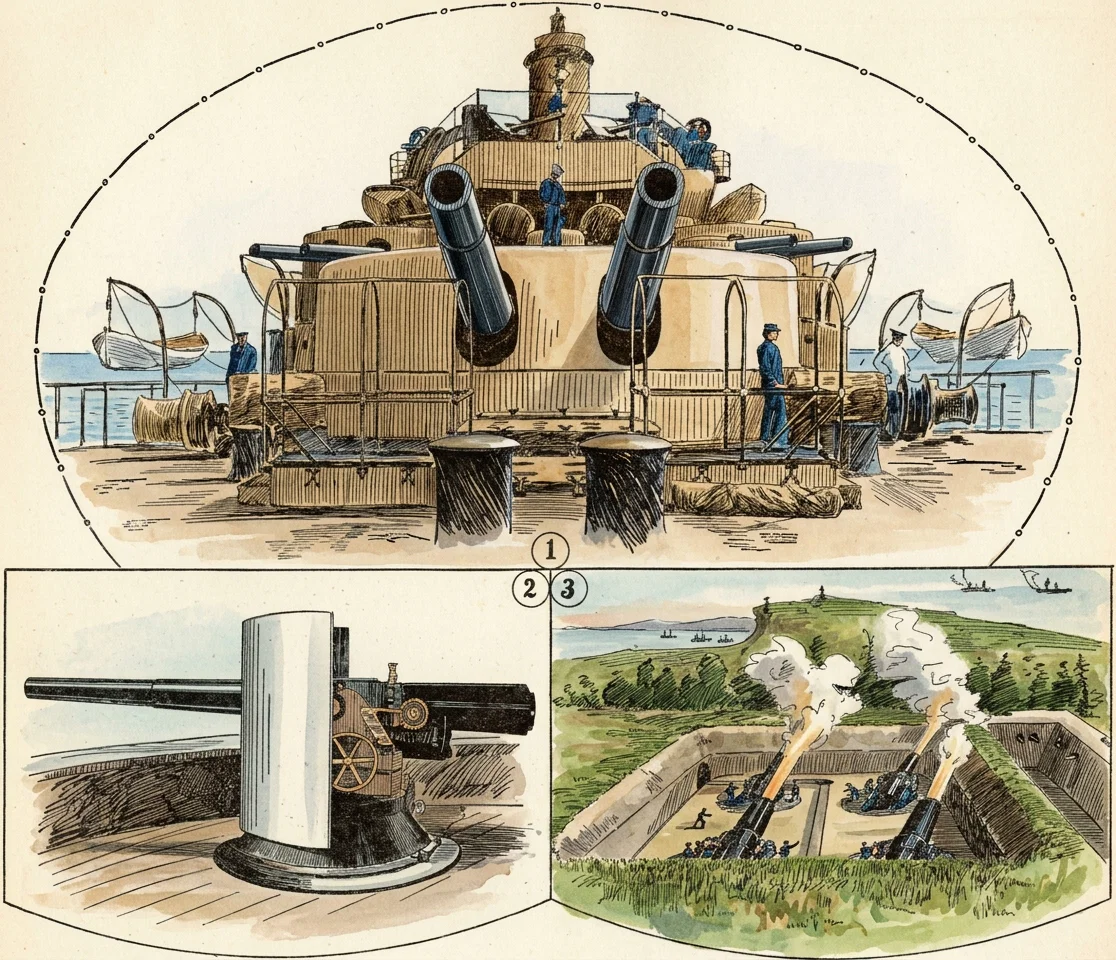
No. 1. The after part of the battle-ship Oregon, showing her aft revolving turret with two of her 13-inch guns protruding from the same. On either side may be seen one of her broad-side revolving turrets with two of her eight 8-inch guns projecting from each. Some of her small rapid-fire guns may be seen near the top of the cut. The 13-inch guns use a charge of 550 lbs. of powder and throw a shell weighing 1,100 pounds, with a velocity of 2,100 feet, or nearly half a mile, per second. The 8-inch guns use 115 pounds of powder and throw a 250-pound shell with a velocity of 2,080 feet per second. The forward part of the Oregon has the same heavy guns, while her secondary rapid-fire battery, of twenty 6-pounders, six 1-pounders, and four Gatling guns, can shoot out a regular hailstorm of steel. No. 2. A 4-inch rapid-fire gun, with revolving shield, such as is used on the men-of-war. It uses a charge of from 12 to 14 pounds of powder, and throws a 33-pound shell with a velocity of 2,000 feet per second. At the muzzle its projectile would pierce 10 inches of wrought iron. It is fired with such rapidity that in the ordinary range, 5 balls may be kept in the air flying toward the mark. Thirty-six years ago the iron-clad Monitor pounded the sides of the Merrimac for over half a day with her two 11-inch smooth-bore guns. And, altho the Merrimac had only 4-inch iron armor, yet no shot perforated her during the whole fight. This 4-inch gun would have made a veritable pepper box out of her in short order. No. 3. A section of a battery at the entrance to New York harbor. Ships may pass and repass this battery without being seen by the men within; neither would those on board the ship get any idea of a battery being there from any outward appearance. The mortars are down behind great earthworks, and within these earthworks are massive walls with an intervening space so as to protect them from a charge from the enemy's infantry if they should succeed in landing. As shown in the engraving, some machine guns are so arranged in the diagonally opposite corners of this outer space that they could mow men down as fast as they could rush in. The harbor is all carefully mapped off in squares, and an officer on a prominence a mile or so away from the battery, by means of his range-finder and chart can tell what square the enemy's ship is occupying. He telegraphs this to the officer in charge of the mortar battery, and he immediately gives his pieces the proper elevation and fires them, either one, two, three, or on up to sixteen at a time, just as he likes. They have the matter so accurately figured out, and the men have become so skilled in their work, that a shot from one of these mortars can be dropped down on the space of a vessel's deck anywhere within a radius of five miles, the plan of a mortar being, of course, to throw a shell high into the air and let it fall on its target, bursting as it strikes. The shells thrown by the mortars shown in our cut weigh 1,000 pounds and are charged with 100 pounds of a high explosive. They would make short work of any hostile war ship that came within their range.
Why is all this? What does it all mean? We have been told of a millennium of peace. But instead of peace the whole world is gathering for such a war that all the battles of all the legions in all the past would seem but little more than child’s play beside it.
The frowning after-part of the battle-ship Oregon, shown in our accompanying cut, most would have been sufficient, previous to fifty or sixty years ago, to have completely unnerved the navies and armies of the world. A few batteries of the little four-inch guns shown on this page, if accompanied by their skilled manipulators, would have enabled the Corsican of a hundred years ago to have marched in triumph from country to country, laying all the world under tribute at his feet. While a battery or two of the modern mortars, favorably placed at the entrance to a harbor, could have made the authoritative demand that all who enter this port must first secure our permission or else lie beneath the wave.
And only to think that a short twenty-five years in the closing part of the nineteenth century is able to produce these marvelous machines of war! It seems incredible! But here it lies before us, and we are compelled to believe it. The dizzy spheres into which the imaginary stories of our nursery days carried us are outdone by the wonderful realities of to-day. And so can there be any doubt that Jeremiah had a wonderful and most intensely realistic view of these times? Nothing short of the modern engines of war could have called forth such vivid language. Such a flame of intense expressions would not burst forth from a vision of a few thousand men stabbing each other with swords and spears. But modern rapid-fire and machine guns, the great high-power cannon and bursting torpedo, are belching forth their “destruction upon destruction” when the ancient seer is caused to say, “I am pained at my very heart; my heart maketh a noise in me; I can not hold my peace, because thou hast heard, O my soul, the sound of the trumpet, the alarm of war.”
The last days are here; and not simply by the “alarm of war” that is heard all over the world, but by multiplied signs on every hand, the Lord is seeking to press this great truth home on every heart. If we discern and receive the truth for our time, divine power will shield us from every evil that confronts this age. Satan is seeking by every means to destroy men, but the Father above is speaking to your heart and conscience, and by the most touching appeals is bidding you enter that haven where we may rest in eternal safety. You hear the voice of God speaking through His Word, and your soul is stirred to respond to a Father’s invitation and love. You must soon decide. What will you do? T.