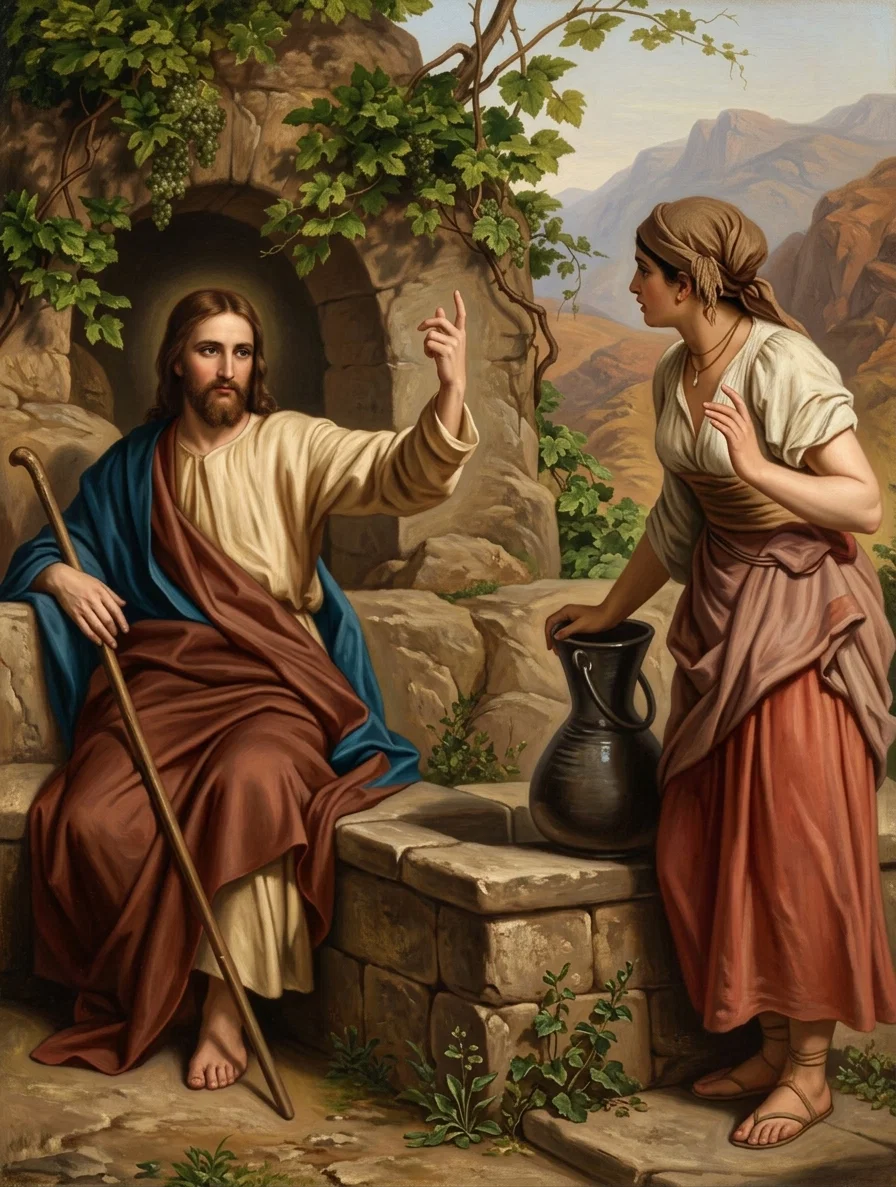
JESUS AT JACOB'S WELL. “Whosoever drinketh of the water that I shall give him shall never thirst; but the water that I shall give him shall be in him a well of water springing up into everlasting life.” John 4:14.
Among the beautiful incidents of Jesus’ life on earth is that of His meeting with the woman of Samaria. The record is found in John 4:3–42. The incident is the special one of a journey which our Lord took with His disciples from Judea to Galilee.
As they came to Sychar, Jesus, wearied with the journey, seated Himself on the curbing of Jacob’s well. His disciples left Him there, and went into the city to buy food. While they were away, there came to the well a Samaritan woman to draw water. We quote only so much of the record as is germane to the lessons we wish to draw from it.
Jesus first spoke to the woman: “Give Me to drink.”
“Then saith the woman of Samaria unto Him, How is it that Thou, being a Jew, askest drink of me, which am a woman of Samaria? for the Jews have no dealings with the Samaritans.”
“Jesus answered and said unto her, If thou knewest the gift of God, and who it is that saith to thee, Give Me to drink; thou wouldest have asked of Him, and He would have given thee living water.”
“The woman saith unto Him, Sir, Thou hast nothing to draw with, and the well is deep; from whence then hast Thou that living water? Art Thou greater than our father Jacob, which gave us the well, and drank thereof himself, and his children, and his cattle?”
“Jesus answered and said unto her, Whosoever drinketh of this water shall thirst again; but whosoever drinketh of the water that I shall give him shall never thirst; but the water that I shall give him shall be in him a well of water springing up into everlasting life.”
“The woman saith unto Him, Sir, give me this water, that I thirst not, neither come hither to draw.”
“Jesus saith unto her, Go, call thy husband, and come hither.”
“The woman answered and said, I have no husband. Jesus said unto her, Thou hast well said, I have no husband; for thou hast had five husbands; and he whom thou now hast is not thy husband; in that saidst thou truly.”
“The woman saith unto him, Sir, I perceive that Thou art a prophet. Our fathers worshiped in this mountain; and ye say, that in Jerusalem is the place where men ought to worship.”
“Jesus saith unto her, Woman, believe Me, the hour cometh, when ye shall neither in this mountain, nor yet at Jerusalem, worship the Father. Ye worship ye know not what; we know what we worship; for salvation is of the Jews. But the hour cometh, and now is, when the true worshipers shall worship the Father in spirit and in truth; for the Father seeketh such to worship Him. God is a Spirit; and they that worship Him must worship Him in spirit and in truth.”
“The woman saith unto Him, I know that Messias cometh, which is called Christ; when He is come, He will tell us all things.”
“Jesus saith unto her, I that speak unto thee am He.”
“No Respecter of Persons.”—Over and over again the Bible tells us that God is “no respecter of persons.” Jesus came to represent God to the world. In this same chapter He tells us, “My meat is to do the will of Him that sent Me, and to finish His work.” And again: “I came . . . not to do Mine own will, but the will of Him that sent Me.” “He that hath seen Me hath seen the Father. . . . The words that I speak unto you I speak not of Myself; but the Father that dwelleth in Me, He doeth the works.” God loved the world. Jesus represented that love. God loved all the people of the world, by loving each one in the world. Therefore Jesus could not live.2within the narrow prejudices of His own countrymen, the Jews. They hated the Samaritans, who, no doubt, in their mixed worship, were in many things despicable, low, and unworthy. They called the Samaritans “dogs,” and believed that they were no better than demoniacs.
But Jesus knew they were sinners. He needed not that any should testify to Him of man; for He knew what was in man. He came to seek and to save the lost. It mattered not to Him what nationality they were, He gave Himself for them, and longed to save them. Each and all were the purchase of His blood. He did not argue about nationality or race with the woman or the disciples. His business was to save. And so in a wonderfully wise manner He opened the heart of the woman by appealing to her kindness, and showing that He was interested in her welfare and salvation.
What would He do, dear reader, were He here to-day? Would He reject the African, because the poor man had been a slave? Would He despise the Chinese? Would He call for vengeance on the Spaniards?—No; His great heart of love and pity would go out to all men, and His arms were open wide to receive them. “Come unto Me, all ye [Jews, Samaritans, Romans, Pharisees, publicans, Spaniards, Chinese, English, American, white or black] that labor and are heavy-laden, and I will give you rest.” O, for a heart like Christ’s, to love all men and women, irrespective of race or nation!
Not a Seeker after Prosperity.—Jesus did not seek the great crowds; the multitudes sought Him; for “there went virtue out of Him and healed them all.” He came to save. He “preached the righteousness of God in the great congregation;” He taught the lone, immoral woman by Jacob’s well; and He became so interested in the latter work that He forgot His weariness and hunger. What a lesson is here for the servant of Christ! How few there are who would have paused to tell the sweet story of salvation; but Jesus found a soul in need, and His work then was to supply that need. Every needy soul sent us whom we can help by word or otherwise is an opportunity given us of God to co-operate with Him.
The Wonderful Teacher.—Here is an example of Christ’s teaching. He ever lifted the mind from some earthly thing with which His hearers were familiar, to the great heights of God. It is the sower and his seed, the fisherman with his net, the merchant seeking goodly pearls; the woman and her leaven, the vine and its branches. In our lesson it is water from the well. The woman knew of this water, knew of the constancy of the flow of the water. From that earthly water Jesus lifted her mind to the great Fountain of life, which satisfies soul-thirst. How many times Satan endeavored to get the woman to lose the lesson by stirring her up to argue these questions with a Jew! Jesus does not argue. By one question He shows that her manner of life is known, and then reveals to her the great divine remedy, the water of life.
He is the Fountain to-day, as truly as then. Whosoever drinks of the water which He gives, never thirsts for the earthly, human pools of sin and selfishness. He quaffs of the life of God. Christ will give it as freely to us; for “He is no respecter of persons.”
The Clear Revelation.—With the honest doubt of the woman, Jesus has all patience. He knows how slowly light sifts through the sluggish brains, darkened and hardened by sin. Closer and closer He presses home the truth upon the heart, till at last she mentions the expected Messiah. Then our blessed Lord, knowing her sincerity, declares, “I that speak unto thee am He,” I am the Christ. Not so did He reveal His mission and work to the Pharisee, or the doctor, or the scribe. They would not trust Him or would betray His confidence. But to the simple heart, how clear the revelation came! Humbled by a sense of her own sins, she readily accepted the Saviour, and brought the people to hear Him. So, sinner, will the blessed Christ of God reveal Himself as a Saviour to you. “The meek will He teach His way.” “The secret of the Lord is with them that fear Him; and He will show them His covenant.” Open your hearts; come unto Him as unto a little child. He will place to the parched lips of your souls the water of life. He will teach to you the simple, saving truth.
There are other lessons,—the true manner of worship, the place of worship, the missionary work of the woman,—you will find them in almost every verse. But these which have been suggested are lessons most precious to both saint and sinner. X.