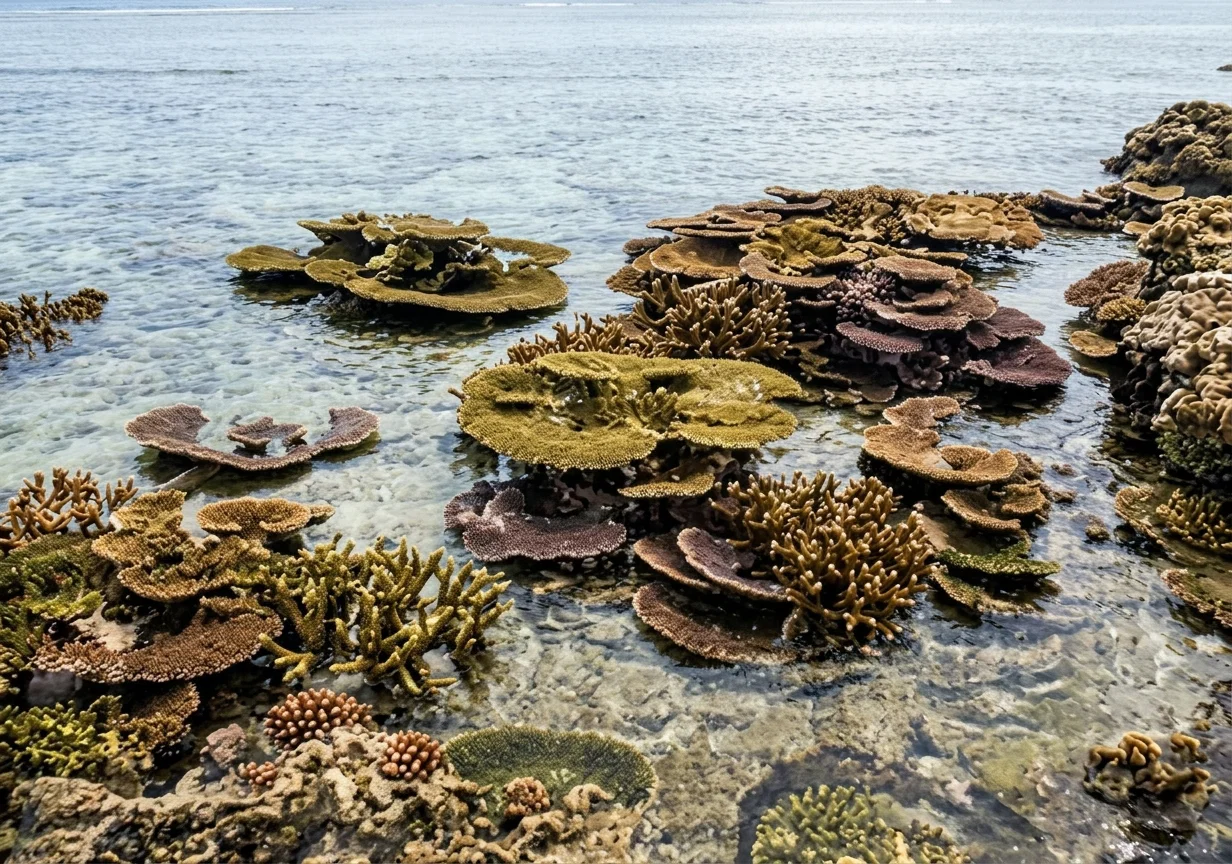
In the warm waters of the central Pacific lie several groups of low coral islands; indeed, the ocean in many parts is fairly speckled with the product of the persevering little workmen who build with their skeletons beautiful specimens of coral architecture for our admiration, and also construct mighty islands, and reefs innumerable, in which are stored millions of tons of lime. Many of the low islands are shaped somewhat like a horseshoe with a lagoon inclosed; others are but reefs of irregular form, upon which drift and dirt have accumulated sufficient to maintain a meager growth of vegetation.
The Tuamotu Islands of the French possessions of Eastern Polynesia rank first in importance among the groups of the lagoon-encircling islands of the Pacific. Their principal wealth lies in the pearl-fishing industry of the surrounding coasts. Large quantities of these valuable shells are annually gathered by divers in the Tuamotus, and shipped to Europe. The population of the group is less than 5,000.
The term Micronesia has often been applied to the region of the Pacific which embraces the Gilbert, Marshall, Caroline, and Ladrone Islands. These four groups are mostly of the low coral order, and are inhabited by a mixed race that are supposed to be derived from both Papuan and Polynesian blood. The Gilbert Islands have fallen under the protection of England, while Germany was awarded by the arbitration of the pope the Marshall Islands, with their 15,000 natives. The less fortunate Caroline and Ladrone Islands fell, by “right11of discovery and gift of the pope” under the cruel rule of Spain, which has destroyed many of the natives, driven off their Christian missionaries, and enforced the papal religion. The fall of Spain in the Philippines will no doubt mean equal freedom for these groups which lie between Hawaii and Manila. Is not this the providential opening of a door that was closed to Gospel workers? We believe so.
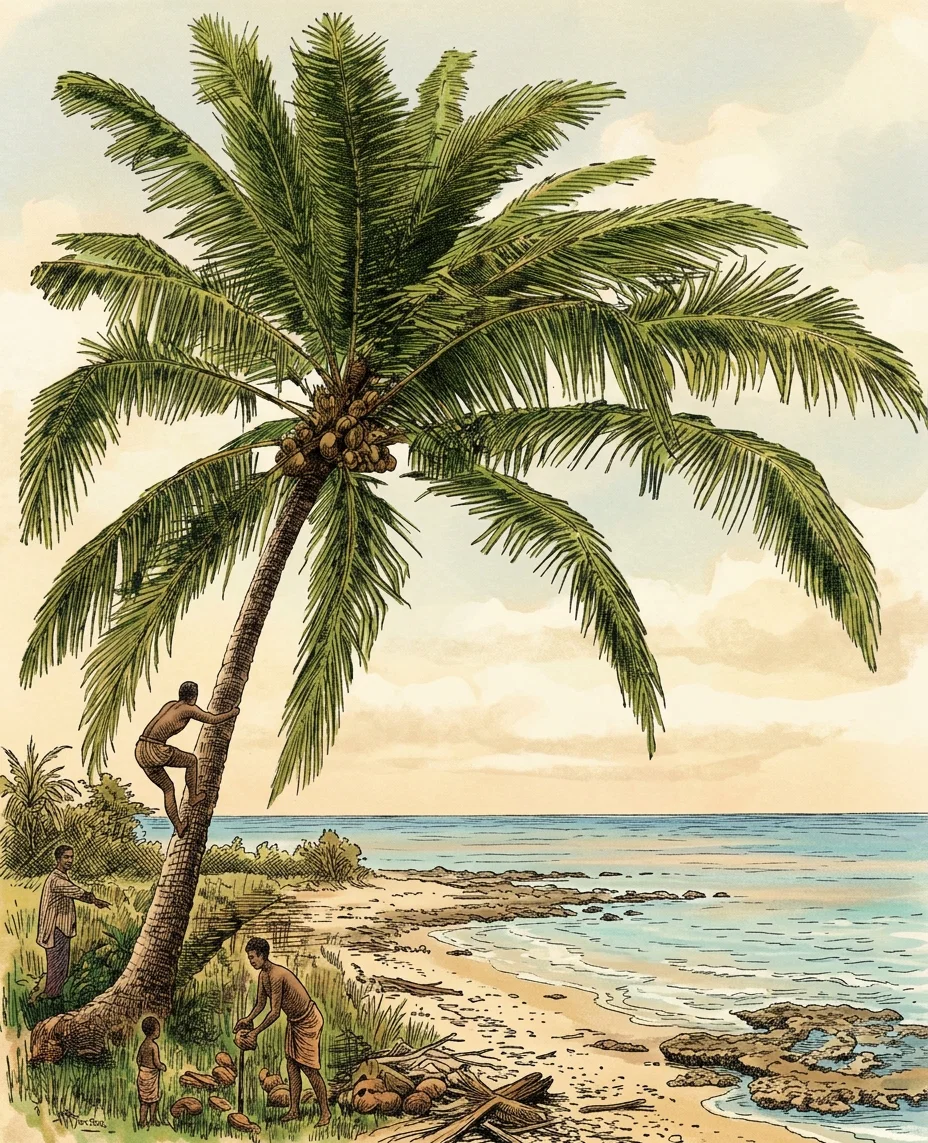
The most elevated point of land in the Gilbert group is not more than twenty feet above the level of the sea, and there are but a few inches of soil spread over the coral foundation of the islands, from which the trees of the group maintain an existence. The coconut and pandanus palm are about the only trees found upon this class of islands, and, aside from the fruit of these, the natives have little variety to tempt their appetites, with the exception of the taro, which is carefully cultivated in many places. The lagoons which open out to the sea furnish a very fine region for the native fishermen to obtain in quiet their oft-desired meal of fish. About these lagoons is the favorite region for the cultivation of taro.
With hands and feet accustomed to the rough bark, the natives are able to ascend the coconut trees like monkeys. The nuts are husked on the sharp end of a stick or iron which is driven into the ground.
Glimpse of a coral garden of the great deep. A snap shot at low tide.
Tho the Gilbert Islands are comparatively unattractive regions, there is no place in Micronesia or Polynesia where the shores are more densely populated than those of the above-named groups. The island of Taputeouea, of the Gilbert Archipelago, is thirty miles long, and it is doubtful if there is a spear of grass upon the whole island; it is also destitute of all underbrush. The coconuts and pandanus are scattered thinly over the island, and aside from those and the taro there is nothing upon which an animal can subsist; yet this island contained at last reports a population estimated at seven or eight thousand. These places have been a favorite haunt for the slave-dealer and labor vessel, and the natives have accordingly endured their share of suffering from these wicked men, who have removed large numbers of the people to various islands and distant countries. There are several hundred of these islanders living upon Tahiti, who congregate in villages by themselves by the seashore, and depend mostly upon fishing for a livelihood. Their language much resembles the Tahitian, and most of their habits are similar to those of the natives of the southern groups of Polynesia. The Gilbert islanders are prone to pierce holes in their ears, which are enlarged until the lobe of the ear is sometimes stretched down nearly to the shoulder. They are accustomed to run naked upon their native shores, and are, like most of the other islanders, given up to evil, tho they are not an especially treacherous or blood-thirsty race. They are lazy, and indisposed to hand labor, and if the stomach be full, are satisfied to live in the most primitive style under a hut of coconut limbs.
It is estimated that the total population of the Gilbert group amounts to about 25,000 natives, which is nearly half that of the region known as Micronesia.
“The Marshall islanders boldly go 300 and even 500 miles to other groups, guiding themselves by the stars. Captain Gillett, of the Morning Star, once found a company of these natives in a canoe beating their way home 300 miles against a head wind, and gave them a compass, and taught them how to direct their course by it; but one of them pointed to an old man with a great shaggy head of hair, and said, ‘His head all same compass.’”
“The religion of the Micronesians, if it may be called a religion, is spiritism. They have no idols, no temples, no priests. They do obeisance to certain trees, rocks, or coral slabs, into which they suppose spirits have entered; and they are very particular in the care of the bodies of their deceased friends, whose spirits they will conciliate. With this view the Gilbert islanders formerly kept the dead bodies of their people, anointed with oil and covered with mats, many weeks, and sometimes over a year, and after they were decayed away, carried their skulls as charms—a custom that illustrated the unclean and revolting horrors of nearly all pagan religions.”—Islands of the Pacific, p. 320.
The natives of Micronesia, Tuamotu, and other low islands of Polynesia, have some of them received help from the missionaries, tho the vast majority of them are a needy and degraded class to-day. The American and Hawaiian board of foreign missions has put forth many a noble effort for the evangelization of these natives. The Rev. H. Bingham lived for seventeen years upon one of these desolate islands of the Gilbert group, where there was naught to break the monotony of isolation but the yell of the savages and the roar of the waves. As a result of this consecrated labor, the Gilbert islanders now have the Bible in their own tongue, and it is to be hoped that many of them will shine as bright stars in Mr. Bingham’s crown, through all eternity. Upon other islands of Micronesia similar devotion was exhibited by missionary pioneers.
The London Missionary Society’s fine vessel, the John Williams, regularly calls at the various stations of that society among the isolated coral islands of the South Pacific. There remains much yet to be done for these poor souls.