THE TESTIMONY OF HISTORY TO THE TRUTH OF THE WORDS OF JESUS.
By X
Among the prosperous, busy towns of teeming Galilee nineteen centuries ago was Capernaum. Here it was that our Lord made His earthly home for a little while, and it is therefore called in the Gospel (Matt. 9:1) “His own city.” This one fact alone would make it of interest.
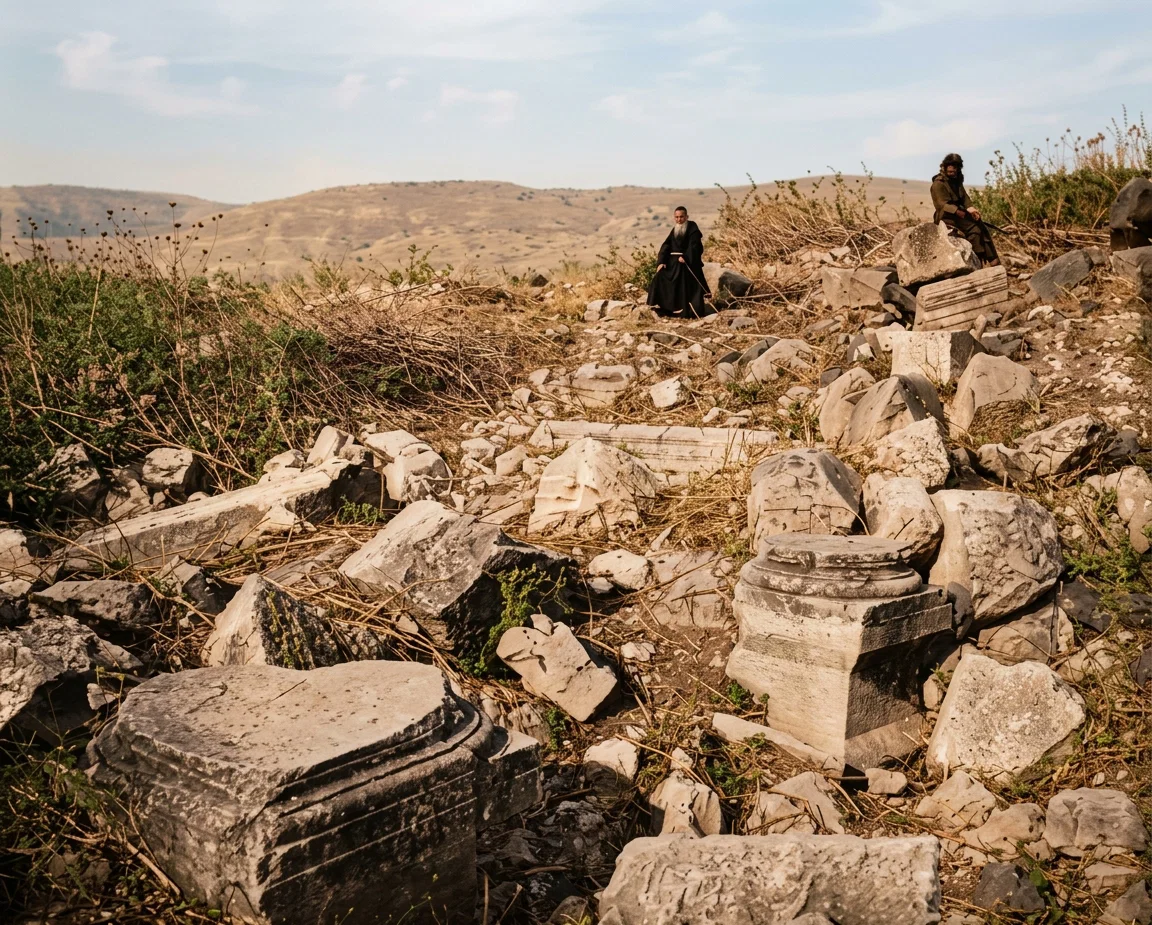
RUINS OF CAPERNAUM.
“And thou, Capernaum, which art exalted unto heaven, shalt be brought down to hell; for if the mighty works, which have been done in thee, had been done in Sodom, it would have remained until this day.”
Capernaum was on the west side of the Sea of Galilee, and near its northern end. It was situated in the midst of a densely populated and wonderfully fertile country. Close by were the towns of Chorazin and Bethsaida. It was inhabited by a mixed population of Jews and Gentiles; and a freer intercourse existed between them than in Judea. One incident reveals this, that of the centurion whose servant Jesus healed of the palsy, and of whom the leading Jews said “that he was worthy for whom He should do this; for he loveth our nation, and he hath built us a synagog.” The centurion’s faith Jesus greatly commended.
Capernaum was near to the great thoroughfare between Jerusalem and Damascus, and hence became a stopping-place of pilgrims, a commercial center, a great news bureau, from which were carried the tidings of the Man of Galilee, as well as the news of the remarkable doings of the day. It was therefore a city of great importance in our Lord’s work, not only as needing the Gospel for the sake of its people, but as a radiating center for the multitudes of Galilee, and for the travelers on the great Damascus road. It was, so to speak, a strategic point in the Gospel warfare, and in it is a lesson for the Lord’s servants.
In this city and vicinity Jesus performed some of His most noted miracles. In the eighth chapter of Matthew we have recorded the miracles of the healing of the centurion’s servant by a word; the raising up of Peter’s wife’s mother, who had been stricken with a fever; and “when the even was come, they brought unto Him many that were possessed with devils; and He cast out the spirits with His word, and healed all that were sick; that it might be fulfilled which was spoken by Esaias the prophet, saying, Himself took our infirmities, and bare our sicknesses.” Not far away He stilled the tumultuous waters of Galilee. A little later on He healed the soul and body of one incurably sick of the palsy. Matt. 9:1-8.
At Capernaum Jesus found Matthew, the tax gatherer, or publican, who left his profitable calling of collector of customs, and cast in his lot with Jesus. Here was wrought the miracle by which Peter paid his tribute money (Matt. 17:24-27); and near the favored city were fed many of its people by a miracle, and here He stilled again the sea. Following these came the wonderful teaching of John 6:17-59. Living also in Capernaum was the nobleman whose son Jesus healed. John 4:46-54. Here Jesus met and by His power compelled the submission of the angels of darkness. Here He wrought other miracles and taught many wonderful lessons; and here, too, was exhaled the lasting fragrance of His own personal, blameless life.
Truly, Capernaum was a favored city. But special tokens of divine grace mean greater responsibility. Greater light means a clearer pathway and less halting steps. Greater riches mean the clothing of more poor, the helping of more needy. Greater blessing means corresponding service. The former came to Capernaum. “The people which sat in darkness saw great light; and to them which sat in the region and shadow of death light is sprung up.” See Matt. 4:13-16. But Capernaum did not heed the light nor appreciate the presence and blessings of Israel’s King. The sunlight of heaven develops tares as well as wheat, weeds as well as grain; and busy, wealth-getting, pleasure-loving Capernaum rejected both Jesus and His forerunner with opposite excuses, as fickle as the children in the market-places. Matt. 11:16-19. Her sins and her Saviour were both revealed. She repented not of the former, and rejected the latter.
The Doom of Capernaum.
Hear the sorrowful words of doom: “And thou, Capernaum, which art exalted unto heaven, shalt be brought down to hell; for if the mighty works, which have been done in thee, had been done in Sodom, it would have remained until this day. But I say unto you, That it shall be more tolerable for the land of Sodom in the day of judgment, than for thee.” Matt. 11:23. In our illustration is the fulfilment of Christ’s words. Capernaum is gone. The ruins in our picture (Tell Hum) are all, save the lesson, that is left of the once proud and busy city. For a long time (and even now, to a little extent) its very site was unknown. It is but a “ruinous heap.” Remains of a few houses, of the great synagog built by the rich Roman, are silent2yet mighty witnesses to the truth of the words of Jesus.
It was no arbitrary visitation of wealth which ruined the proud city. No earthquake swallowed it up. No flood swept it away. The city died because it rejected its Life. Its inhabitants trusted themselves instead of God; and God left them to themselves. Decay and destruction followed.
God’s blessings perverted prove curses. God’s life perverted proves death. God’s presence ignored results in His absence. Capernaum but reaped the fruit of her own doing.
God has recorded the lesson for all after times. Look at the countries and cities of earth where once shone the light of the Gospel, that was rejected. What marks them now but decay, desolation, ruin? Call the roll! Palestine, Jerusalem, Egypt, Rome. Mark the nations and cities which rejected the Gospel of the Reformation. Witness Rome, Italy, Spain, France, and the colonies of these countries. Contrast them with Germany, England, Scotland, and America.
The Last Reformation.
Once more: God has another reformation. The great threefold message of Rev. 14:6-14 is to go to earth’s remotest bounds. The churches are to be called from the fear of man to the fear of Jehovah; from giving glory to man to giving glory to God; from the worship of the creature, the beast and his image, to the worship of the Creator of heaven and earth; from the creeds and confusion and fall of Babylon to the law and the Gospel and the building up of the Word of God; from the folly of the dreams of Babylonian builders to the solemn realities of the judgment; from the mark of the beast, the stamp of the church united to the world, the pago-papal Sunday, to the seal of the living God, of the believer’s union with Him, the Sabbath of the Lord; from all that is earthly, sensual, and devilish, to all that is good and pure and true, to the hope which culminates in the glad fruition of Christ’s second coming.
The men who reject that message reject their life. The churches which reject it will as veritably come to naught as did the Capernaum synagog. The cities and nations which fail to heed Christ’s words will bear witness to their truth in their own utter ruin, even as did Capernaum. God has given the lesson; will they heed its solemn import? Will we? X.