The gods of the nations were, as has been already said, but the deification of the evil propensities of man. As man is very weak in moral virtue as a rule, so this weakness was surprisingly manifested in the character attributed to several of their gods.
Jupiter and Venus and the sun were worshiped by all these nations under different names, but always with the most licentious rites. In some places one had to apologize for modesty if they were modest, and in Babylon it was compulsory for each woman to sacrifice her virtue once at least before the shrine of Venus. This corrupt practise was carried to such frightful excess that much of the religious exercises consisted of this. Remembering man’s natural weakness on this point, we can see where he would drift to when licentiousness was set before him not as a privilege, but a religious duty.
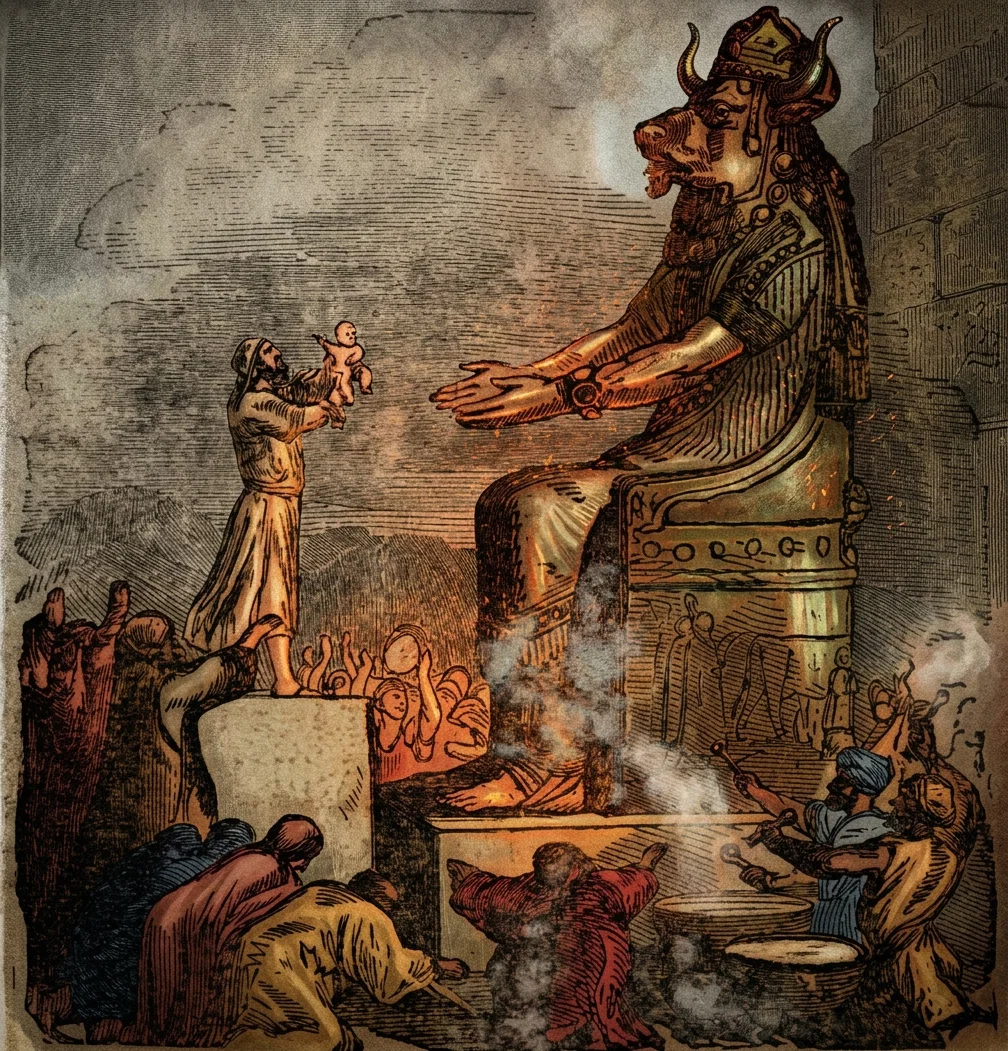
The next noteworthy feature of this religion was the offering of human sacrifices. In those countries where Molech was worshiped, children, and at times adults, were burned alive to appease his anger. Says one writer:— This religion silenced all the best feelings of human nature, degraded men’s minds to a superstition alternately cruel and profligate, and we may seek in vain for any influence for good it could have exerted on the nation. The moral character of the people is well illustrated by their religion. They were usually unruly and at the same time servile, gloomy, and cruel, corrupt and ferocious, selfish and covetous, implacable and faithless.
The heartlessness of Molech-worship was so great that it is almost incredible. We read that great worth was attached to the sacrifice of children if the parents were but heartless enough to see their own flesh burn to ashes without a sigh or a tear. If, however, the parent was not cruel enough to see his child tortured without being affected by the horrible sight, the god was displeased. So when one had entirely divested himself of natural affection, he had gained a high degree of virtue.
This sacrifice of human beings was not practised in every country where heathenism held sway, but it was known in Phœnicia, Palestine, Carthage, Egypt, and Ionia in early times. But its equivalent was practised in countries the most exalted in culture and civilization. “Plato taught the expediency and lawfulness of exposing children; and Aristotle, also, of abortion.” Is there a possibility that this doctrine crept in to counteract the fruits of their systematic religious prostitution?
The worship of Molech. The image of the god was said by the rabbins to be of brass, and in his superheated arms, infants were placed.
If the greatest minds of antiquity,—those men whom the Christian world has denominated the forerunners, as it were, of the Gospel,—taught that such vices were virtues, what better could we expect of those who were far below them in mental ability, and who were led by them? But this was not the worst of it. We read that “it was enacted” that certain infants should be killed or exposed. This not only gave permission to do this but compelled it. “At Athens, the great seat and nursery of philosophers, it was enacted that infants which appeared to be maimed, should either be killed or exposed.”—Horne’s Introduction, vol. I, chapter I.
Note another step. In “Words and Their Uses,” by W. Matthews, LL.D., page 70, we read: “One of the most formidable obstacles which the Christian missionaries have encountered in teaching the doctrines and precepts of the Gospel to the heathen, has been the absence from their language of a spiritual ethical nomenclature. It is in vain that the religious teachers of a people present to them a doctrinal or ethical system inculcating virtue, and addressed to the faculties whose very existence their language, and consequently their conscious self-knowledge, of the people do not recognize.”
How does it happen that any people have a language that does not express to them real morality?—The reason is that the words which should express holy ideas were used to express unholy things, and so if one would use words that in the beginning of the language would have expressed holy thoughts, they would after the language was corrupted express only evil ideas. This was carried on so long that those who used the language could not understand anything good; for nothing could be expressed that to them seemed good.
We can better understand this by taking a word that was thus perverted. In the common version of the Bible there is a word that is always translated “sodomite.” “This word does not denote one of the inhabitants of Sodom or their descendants, but in the A. V. of the O. T. equals one who practised as a religious rite the abominable and unnatural vice from which the inhabitants of Sodom and Gomorrah have derived their lasting infamy. The Hebrew kadesh is said to be derived from a root katash, equals to be pure, and hence to be holy or consecrated. This dreadful ‘consecration,’ or rather desecration, was spread in different forms over Phœnicia, Syria, Phrygia, Assyria, and Babylon.”—Smith’s Bible Dictionary, art. “Sodomite.” Thus we see that the more terribly wicked they became, the more pure and holy they counted themselves. What an abyss has man dug for himself by giving up God’s Word! C. L. EMERSON.