MARGARET DONALDSON walked up the garden path, and an expression of weariness and sorrow spoke from face and attitude. Grandma watched her from her low chair by the window. She entered the room, and did not seem to realize that any one was there, but sat down by the table, dropping her face into her hands, as if in great perplexity or pain.
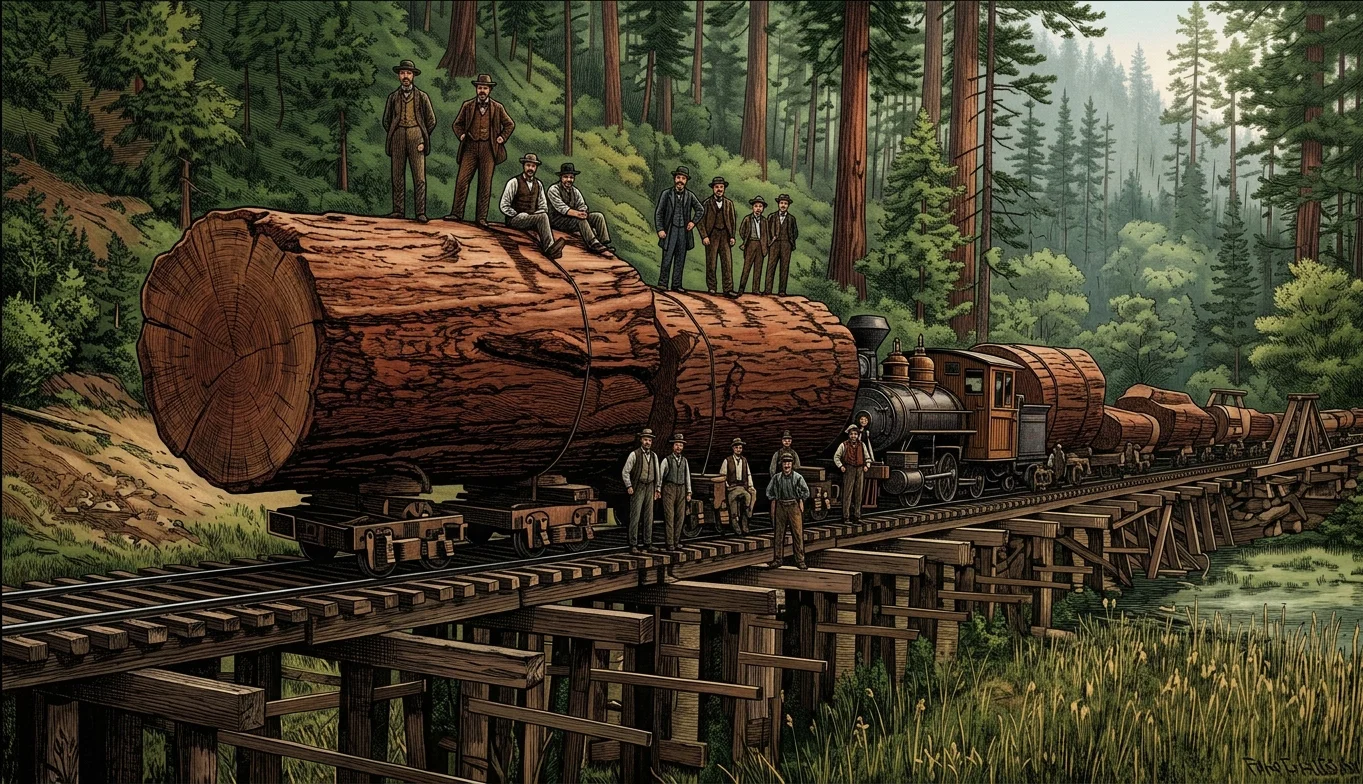
CALIFORNIA SCENERY, No. 18.—Among the striking forest trees of California are the great redwoods (Sequoia sempervirens), oftentimes reaching a diameter at the base of 13 feet, and a height of 250 to 300 feet. Similar scenes to the above are common in the redwood lumber regions. The diameter of the logs may be judged by the height of the men. One of the grandest places one ever walked, is in an unbroken redwood grove; a stronger feeling of worship is enkindled than dim-aisled and vaulted cathedral ever knew.
“What’s the matter, my bairn?” questioned Grandma. “Has the world gone ill wi’ ye the day?”
“O grandma, it goes ill with me every day! Everything is a great mystery to me, and I seem like a poor bird, beating its wings against the wires of a cage in a vain attempt to find liberty of spirit. What is truth? I ask over and over.”
“Why, bairn, ha’ ye lost your hold on God and His Word?”
“Grandma, I have never before breathed a word; but the greatest of my troubles is that I can find no harmony in God’s Word, and the story of Jesus seems to me like a beautiful story alone.”
“O my bairn! is it possible that ye ha’ come to this state of darkness?”
“Yes, grandma. Ralph has talked his doubts to me, and showed me the inconsistencies of those who profess to be Christians. The long, cruel history of the world itself seems to say that God, if there is a God, cares naught for His creatures. I was down in the city to-day, and the people’s faces seemed full of unrest and trouble. Poverty and wealth were side by side, and the contrast was too painful. The papers teem with reports of murders, atrocities, and crimes, of famines, pestilences, and wars, and even the church is full of pride, vanity, and selfishness. And there’s no truth in anything or anybody.”
“And so, my bairn, ha’ I so poorly represented my God that ye can say these words before me?”
“O grandma, if there is anybody I have confidence in, it is you! You are true, but we can not believe alike. Hush, there is some one coming! Don’t breathe a word of my trouble, dear grandma.”
“O, it’s your mother and sister! How long they ha’ been out this afternoon! So ye ha’ come at last,” said grandma, as they entered.
“Yes,” said Mrs. Donaldson, “and we have had a strange, glad experience. We met a missionary and his daughter at Mrs. Brown’s, where he was holding a Bible reading, and I have invited them to spend the evening with us. They seem to be devoted Christians; and, grandma, my heart beats with joy as I tell you they think that we are living near the coming of our Lord.”
“Do they? I ha’ been thinking of His coming to-day; for I read in Titus this morning where it says we are to be ‘looking for that blessed hope, and the glorious appearing of the great God and our Saviour Jesus Christ.’ It is a ‘blessed hope,’ and will be a ‘glorious appearing.’ I wonder will these old eyes see that day of days?”
“O grandma!” exclaimed Bertha, “how can you talk so? I should be frightened out of my wits if I thought the coming of the Lord was near. Why, that means the end of the world, doesn’t it?”
“It means the end of all sorrow and evil, and the coming of all that is beautiful and bonny. He that is robed in the wedding-garment of Christ’s righteousness need never fear for His coming. It will only mean to such the entering in to the marriage supper of the Lamb. It will only furnish the chariots of God to conduct us to the palace of the King,” said Mrs. Donaldson.
“But, mama, suppose you are more interested in getting a dress to appear at Margaret’s wedding than one for a marriage far away in heaven; then what will become of you?”
“Bertha, do not talk in this light way. No wedding-garment of earth can be compared to the heavenly garment that was purchased with the precious blood of Christ. It is whiter than any fuller of earth can white it. My heart’s desire for you, Bertha, is that you may become one of the King’s guests, and don the spotless wedding-garment. Without it you may well tremble at the thought of the coming of the Lord, lest you be found naked before Him.”
“Ah! well, mama, I do not think it will come in my day. I intend to live a long, merry life, and then repent when I get old. In this way I can have this world and the next too.”
“Get all you can,” said Ralph, as he entered the room. “But what is it that you are so earnestly discussing?”
“The coming of the Lord,” said grandma.
“What lord?” asked Ralph.
“The Lord Jesus Christ, who was once despised and rejected of men, but who will some day come in great power and glory, to be admired by all who believe.”
“O, well, do not trouble yourselves about the Lord’s coming! You know that according to the orthodox faith the millennium must first come. Of course, you all know that I have little faith in the orthodox doctrine, but rather believe that the world will go on as it has done from the beginning. There is no telling what is to happen.”
“That’s so,” said grandma meditatively. “The millennium must first come, I suppose. There are puzzling things about the coming of the Lord. But then I know that the Judge of all the earth will do right. We shall not be left to go astray; but the honest seeker after truth will be led into all truth.”
“It does not look as if the millennium were coming very soon,” said Margaret. “My heart is fairly broken in looking on the terrible troubles in the world. In the last few years we have heard of pestilences, earthquakes, famines, and rumors of wars. Only the other night my blood ran cold hearing Stitt Wilson lecturing on the appalling social problem that confronts the world. The Stundists have been banished in Russia to Siberia; the Armenians have been slaughtered by the Turks; the Indians have starved by the million; the Chinese have been engaged10in terrible massacres; the Jews have been driven from country to country in pitiful persecution; fearful disasters by land and sea have desolated the world; Cuba is under an iron hand, and our own land is plunged into war.”
“Talking of suffering in the world,” said Ralph, “it seems to me that the poor are the most wretched victims. Look at any large city where the homeless, friendless, outcast masses are pouring in. Tenement houses are fairly stuffed with classes whose condition is almost indescribable for hopelessness. I saw sights in London that cling to me like a nightmare. The rich are getting richer and richer, and the poor, poorer and poorer. Looking at the social world alone, one can but conclude that some terrible revolution must take place. The history of the past promises that a bloody revolution is at hand.”
“Everybody seems to feel that we are on the eve o’ some great crisis,” said grandma.
“Yes, but it’s not the coming of the Lord,” said Bertha; “for has there not always been poverty, trouble, pestilences, famines, and national difficulties. It looks to me as tho there are two opposite forces warring together in this world. The question is, Which is the strongest? One would be a frightful pessimist to think that evil would overcome good. I believe that we shall soon see the golden age again. You know that they have long talked of arbitration. The war can not last long. No doubt the old world will never again take up arms. The dream of Tennyson is about to be fulfilled, when he says,—”
“‘The war drum throbbed no longer, and the battle flags were furled,
In the parliament of men, the federation of the world.’”
“That is a poet’s fancy, sure enough,” said Ralph. “Why, child, do you suppose that the nations have invented the most atrocious, death-dealing weapons for nothing? All Europe is armed, as they say, to the teeth. There’s Russia with her bear’s paw over Turkey and China, and Germany and England and France and Spain all watching like so many hungry wolves, ready at the first possible opportunity to join in the scramble for territory. War has always been a terrible thing, but the war that is ahead of us, that statesmen declare inevitable, will be something unparalleled in the history of the world. If there is anybody left after the war is over, maybe there’ll be a thousand years of peace. The world will need it in order to replenish its inhabitants.”
“Well, I am weary of the whole thing,” sighed Margaret. “I know that inventors seem to be inspired with diabolical ingenuity in devising implements of destruction. One would be led to conclude that men were not made to love one another, by a God of love, but by a God of hate, to hate one another. I look toward the future with dread, and I know that statesmen fear that there threatens the world one of the bloodiest war storms that ever burst upon men. Grandma says that God is love, and that He is long-suffering. I can hardly see how He can forbear to put an end to all the sorrow and strife of the world. But there, mama, come the missionaries, and Mr. McClaren is with them.”
“McClaren is a man that I put little confidence in,” said Bertha. “Whatever has brought him with these missionaries? He always reminds me of the text, ‘O Israel, thy prophets are like the foxes in the deserts;’ for he is always finding new holes through which to crawl out of the conclusion of an honest argument.”