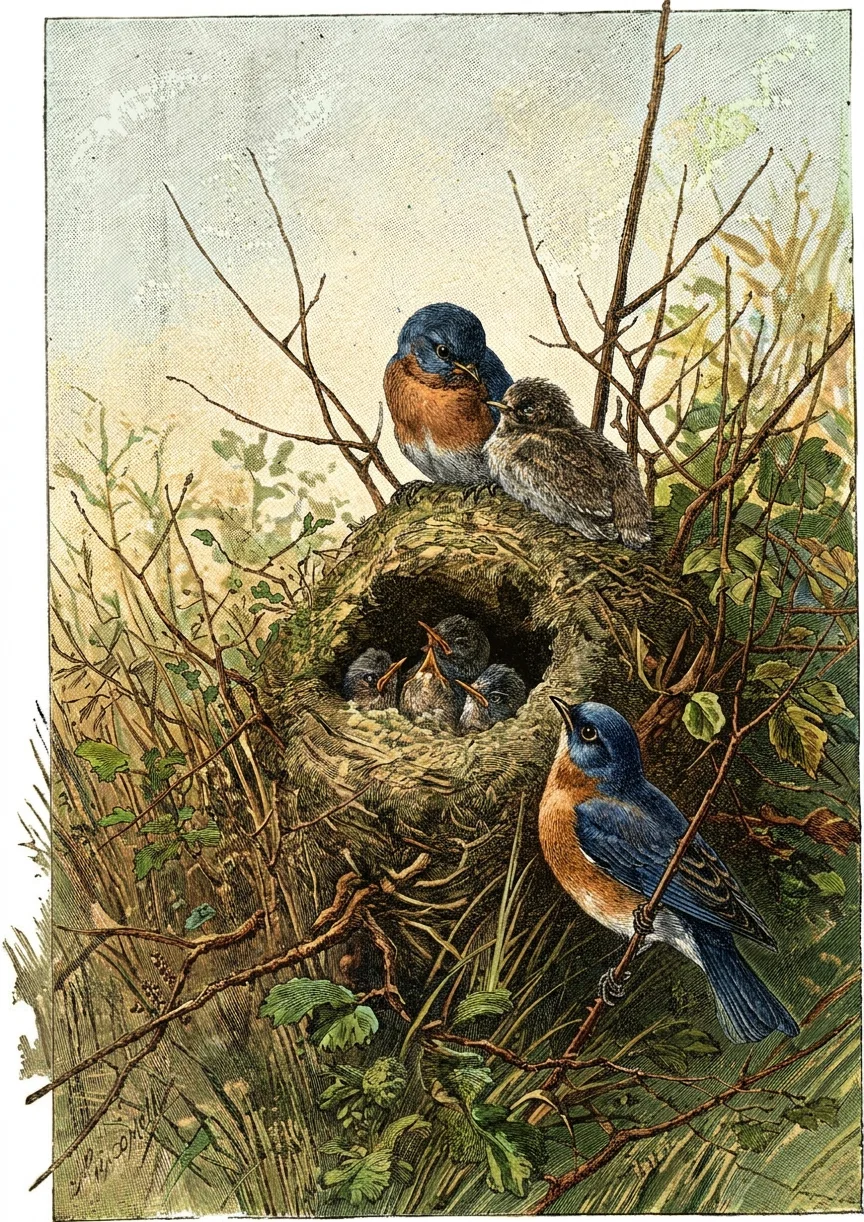
IT was a beautiful June day; the sun was shining brightly, and the soft summer air, laden with the sweet odor of flowers, was kissing with tender touch the leaves as it moved them to and fro; the earliest apples had ripened and hung invitingly from the boughs; the happiest season in the life of birds had come, which was shown not only by their merry and cheery notes of song, but by the loving care with which they were feeding their young.
Down in the orchard were some children enjoying with delight the pleasant morning scene. The bright sunshine, the ripe fruit, the soft air, the twitter of birds, the hum of bees, all made them bright and happy.
“Look out, boys! here comes a bluebird with a worm in her mouth. Let us watch her and find her nest,” cried one, as the mother bird flew by with a nice morsel in her beak for her young ones in their little home nest. “Yes, yes, there she goes; she’s gone into the hollow of the old apple tree. Listen to them as they are crying while she is feeding them. Now give me a push up the tree and I will get them out.”
The boy climbed up the tree and frightened away the old mother bird, that alighted on a tree close by and with pitiable cries flew to and fro trying to protect and save her little brood, but was afraid to venture nearer. It was enough to touch the hardest heart to hear her cries of distress and to see her pain.
But a merciless hand was thrust into the little nest, and out was drawn a poor little bird, fluttering and screaming with fright; its cries of distress pierced the mother bird’s heart, and she, wild with pain, flew at the boy and seemed to entreat him for her poor offspring; but he cried to his companions, “Get a stick; get a stick, boys, and when she flies down to her bird, you can knock her over and catch her.”
In an instant it was done, and as the poor bird in her grief and distress flew to try to help her young one, a blow was aimed at her, and the poor bird’s pain was over, for it killed her dead. The boys picked her up, and looked at her; there she was, a poor dead mother bird, killed while trying to save the little one that she loved so well.
There was a moment of silence as the boys held the dead bird in their hands; it was a painful scene. One said as he held the dead bird in his hands and looked at the limp, lifeless form: “What shall we do with the young bird? If we put it back in the nest, it will die, and so will the others; for there is no one to feed them now. I will put it back into the nest, anyhow.” And he put it back into the nest, and as he did so the young ones in the nest cried out for joy, for they were hungry, and thought it was the mother bird come to them with food. But they were never to hear her loving chirp again—no more to be warmed by her soft breast and sheltering wings. That night, through cold and hunger, they died.
The boys did not stay in the orchard much longer. The sun had lost its brightness, the fruit its sweetness, the air its soft caress; their consciences accused them of meanness and cruelty, and nothing seemed pleasant to them now.
Did not the great God who made heaven and earth make them conscious that the bird was His bird—that in wanton cruelty they had taken the life of a little creature that He cared for and for whose preservation He had given a law (Deut. 22:6, 7) to His people? Was not the shade that came over their spirits caused by His displeasure at their cruelty?
They were enjoying the beautiful summer morning which God had sent, eating the delicious fruit which grew on His trees, and repaying His kindness by killing His mother bird.—Our Dumb Animals.