CHRYSANTHEMUM

2%

Pacific Press Publishing Company · Oakland, California · May 12, 1898

FromSigns of the Times, Vol. 24, No. 19.

Read the full edition

CHRYSANTHEMUM

It was away down south, in a little, tumble-down old house, that Mrs. Carew, a city missionary, first found Sukey, sick and delirious with typhoid fever. Sukey’s small, thin, dark face, lying on the hard pillow that was covered with a highly-colored print slip, had touched her with its beauty and pathos. The lustrous, dark eyes looked so large, and so like the eye of some frightened doe of the forest, that Mrs. Carew felt her heart softened with compassionate feeling. Sukey’s dark face had a very gentle, attractive beauty, that was even more apparent as the flesh wasted under the fever. Mrs. Carew took her into her heart, as one of the dear Lord’s lost lambs, and tenderly cared for her until she was convalescent. But as she visited her from time to time afterwards, she was perplexed in finding Sukey in the same languid condition.
“Not getting on well, are you, Sukey? What is the trouble?”
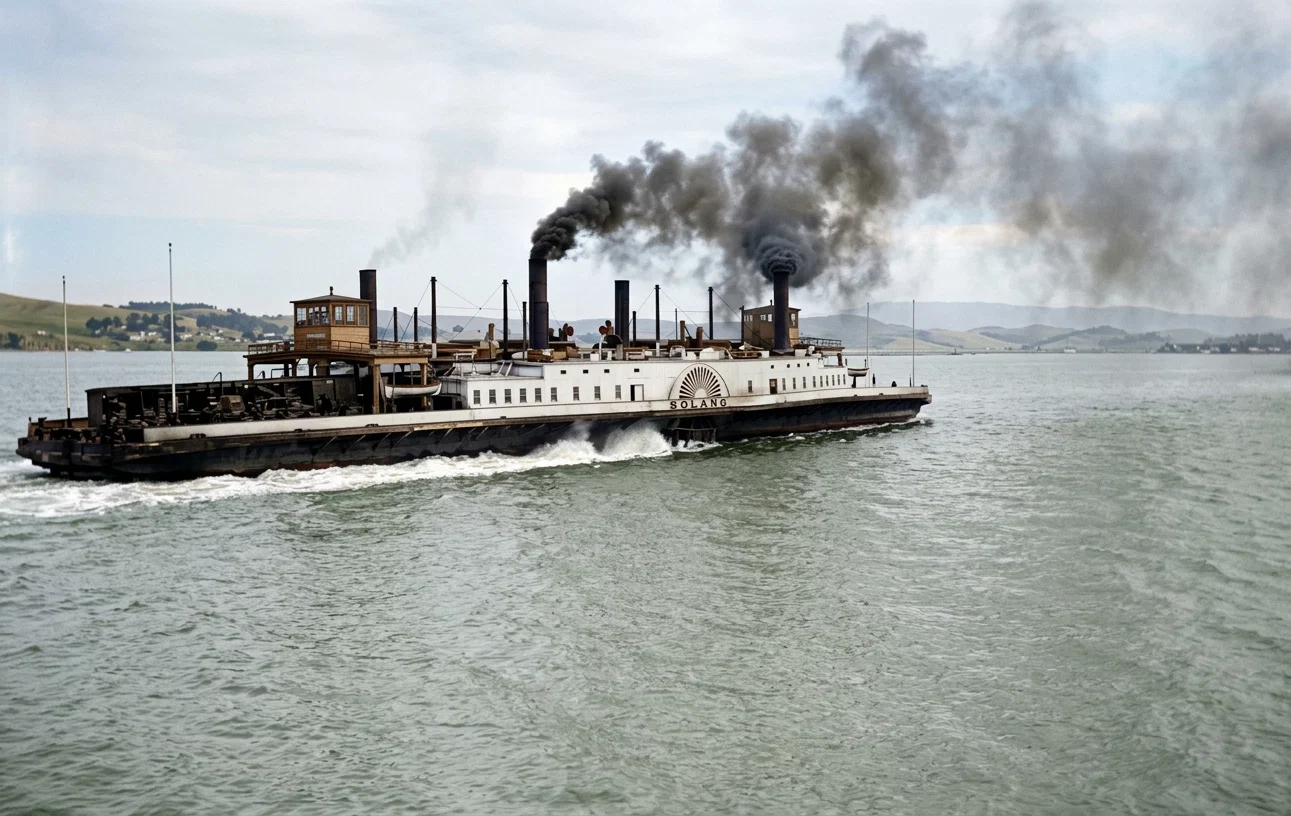
CALIFORNIA SCENERY, No. 17.—California is noted for big things, good and bad. Our illustration is from a photograph of the monster ferry-boat SOLANO, the largest in the world. It is practically the moving bridge on the Southern Pacific Railway line from Sacramento to Oakland, crossing the Straits of Carquinez from Benicia to Port Costa, a distance of a mile. The SOLANO is 424 feet long, and sufficiently wide to take four trains of cars abreast, the capacity being 24 passenger coaches with two engines, or 48 freight cars. She carries daily from 300 to 600 cars, and the usual time of running the cars from the land to the boat, or vice versa, is but little if any longer than it would be to switch the same cars to the same relative positions on land. One needs to be on the boat to appreciate its size.
“Dat’s what I kan’t understand nohow,” said Sukey’s mother, slamming a heavy flat-iron on the ironing-board. “We’se been a-doin’ what you said for her,—gettin’ her all sorts of nick-nacks and notions”—
“Don’t gib her any mo’ notions for de land sake,” said Bob, who was sitting by the kitchen fire, smoking a dirty clay pipe. “Neber did see such a notional piece in my life, Mis’ Carew. Lor! if it hadn’t ha’ been for mam, I belib I’d gib her a spankin’, and tuk it outen her. What you t’ink, Mis’ Carew? She says she kan’t sleep nohow, if de clock am tickin’, and de oder night she hops up and puts my ’larm clock into de oben. Haw! haw! haw!” guffawed Bob. “An’ a feller kan’t walk across de flo’, nor shet de do’, nor rattle de newspapah, nor eben blow his nose, athout you see her cringin’ as tho’ yo’ had gib her a lick.”
“Well, it hurts,” said Sukey. “It does hurt, and it hain’t no notion.” Two tears stood in Sukey’s black eyes and splashed over her brown face.
“Pooh!” said Bob, “all your wants is another serenade like de boys gib you las’ night.”
“Naw, Bob,” said her mother deprecatingly, “Sukey’s been sick, and we must mek allowance fur her.”
“What kind of a serenade did they give you, Sukey?” said Mrs. Carew.
Sukey shuddered. “O Mis’ Carew, it was worse dan ’lection night when de ol’ mill whistle sounded lik’ as if de debil was blowin’ off steam outen his boilers. Bob gadered up a whole crowd wid horns and combs and tin pans, and gib me a reg’lar shibberee, jest as if I’d done ben foolish enuf to git up an’ git married.”
“Yes, it was a shibberee, I can tell you. Dat gal sot an’ shibbered, ’til I thought she’d fall off de cheer. Den bimeby she keeled ober in a kind ob a faint, an’ I skeered dem boys away. Dar Sukey,” said her mother soothingly, “if dey come a’gin, I’ll frow hot water ober de fence on dem.”
Mrs. Carew’s face turned pale. “It is a wonder Sukey is alive. Bob,” she said severely, “go and put that old pipe away, and then come back. I have a word for you. Do you know that you might have killed your sister with your nonsense? You don’t deserve to have a sister. You never was sick and
nervous, and don’t know what it means to have noise hurt. Thank the Lord, I do. Now, Sukey, you shall come home with me this very afternoon, and I am going to see if we can not get you a place in the Convalescence Hospital until you are stronger.”
Bob’s face looked quite serious now. “Do you really t’ink de noise hurts her, Mis’ Carew?”
“Certainly, I do. It’s a wonder the child hasn’t had a relapse and died.”
“Fer de land’s sake!” exclaimed Bob. “Well, I’se powerful sorry.”
Mrs. Carew’s heart suddenly warmed to the great, untaught boy, in pity for his ignorance.
“Yes, you ought to be sorry, and I am sorry for you. It was not because you were wicked but ignorant that you came so near breaking your sister’s slender thread of life. However, she is to go home with me. So run out and hire a cab for me, and have it here within twenty minutes.”
Sukey’s mother looked her astonishment, and Sukey her delight.
“It’s a lucky thing I washed all her clothes yesterday, but dey hain’t all i’oned yet.”
“Never mind that. I will iron them myself. Let’s gather Sukey’s things together, and get her ready as quietly as possible.”

Among the Pillows.

“’Pears like, Mis’ Carew, jest as if I’d got to de borders ob de kingdom, it’s so still, an’ eberyt’ing is white and clean, an’ dar ain’t no bad smells ob de boys’ boots, nor de cabbage an’ onions boilin’, an’ dars de blue sky outen de windah, an’ de pictures on de wall, an’ de books, an’ de pianer, an’ de smell ob dose flowers is jest as if angels was walking ’round somewhere.”
“Yes, dear, I am so glad I brought you home with me! If I only could get the time to nurse you, you should stay right here till you are well.” Sukey’s lip looked a little quivery, but Mrs. Carew lifted her up, placed a white serviette on a little tray, and a glass of egg-nog daintily flavored thereon.
“There, eat this, my pet.”
Sukey took up the spoon and began to eat, with a look of increasing wonder on her face.
“I neber knew dey could make such nice t’ings dis side ob de kingdom,” said Sukey.
Mrs. Carew laughed. “You’re a funny little thing,” she said, “but you are one of the Lord’s lambs, I believe.”
“Do you t’ink so, Mis’ Carew? All de time you was away dis mornin’, I was lookin’ at dose pictures der, wid the lamb in His arms, an’ de sheep follerin’, an’ den at de oder where de Shepherd am lookin’ at de cross, an’ de sheep am strayin’ around. Since you told me about de cross, Mis’ Carew, my heart’s been bery still. ’Pears like I could b’ar no mo’ noise nowhere, ’cept it was singin’ in de chu’ch. O Mis’ Carew, you came so still an’ gentle, an’ now He’s come so still an’ gentle, an’ eberyt’ing dat’s nice an’ so quiet! Kin I be still an’ gentle? an’ what kin I do to be His little lamb?”
“Why, you are already, you poor little thinthing! Just now you must feed beside the still waters, and in the green pastures.”
“How lubly dat sounds, Mis’ Carew. But what kin I do when I git well? Will I be goin’ back to de noise ob de washin’ an’ i’onin’ an’ de rows? ’Pears like I couldn’t.”
“What would you like to do, pet?”
“Well, I don’t ’pear to know ’xactly, but I wish I could go whar dar was sick folks, an’ keep all de do’s from bangin’, an’ all de’ windows from ratilin’, an’ jest make ’em feel like I do, as ef dey was on de border of de kingdom.”
“Well, maybe you can. The dear Shepherd will lead you right, but now, hush!” said Mrs. Carew, pulling down the blinds; “you must go to sleep; for you are going to the hospital this afternoon. It will be quiet there, too, so quiet!”

In the Hospital.

Sukey sat up in her bed at the hospital, after Mrs. Carew and the nurse had folded her few clothes away, and stowed them in the drawers beside her bed. She looked around her at the long, high room. How quiet it was! Yes, there were the two Shepherd pictures, and there were texts on the wall, too. “He leadeth me;” “In quietness and confidence shall be your strength,” and over the mantel, “Emmanuel, God with us.” Sukey spelled out the texts, and then her dark eyes roved over the rows of beds on either side. There were not many patients in them now; but she could see them through the door out on the veranda, wrapped up, and sitting in their big chairs. Then the nurses would trip in and out so quietly. How pretty they were! Sukey’s eyes followed them up and down, in and out. My! if she was only a white girl, she said to herself, and had such pretty hair and rosy cheeks, and could wear such a nice dress, long white apron, and pretty little caps—“Well, she wasn’t, and couldn’t, and so”—Sukey sighed so heavily that the nurse turned to look at her.
“You’re a new patient, aren’t you?” questioned one of the pretty nurses as she rolled up some bandages.
“I ’spect I is patient, an’ sumpin’ new to me, too,” said Sukey. “But I kan’t help wonderin’ how anybody could be cross when eberyt’ing is so still and kind. I ’spect it’s dat way ’cause dat Shepherd am here, an’ you all are His sheep. I’se only a new one, you see, jest one ob de little lambs.” But a smile broke over Sukey’s face as she pointed to the picture: “He carries the lambs. So how could I be anyt’ing but new an’ patient?”
The nurse looked wonderingly at her. Perhaps the little dark girl was still in her fever. No, her head and hands were cool, and Sukey took the gentle touch to mean a touch of love, so new to her that it seemed to her, as it is, like something angelic and heavenly.
The bright, peaceful days passed so quietly, and Sukey grew rapidly better, and was soon able to walk about. What a pet they made of her! What a little missionary lamb she was, telling old and young of the gentle Shepherd and the quiet pastures “jest like de green fields by de riber”!
The ladies who visited the hospital every Sunday and Wednesday, found her a very unique piece of originality.
“The loikes of you will be loiking flowers, I’ll venture,” said an old Irish lady, who was recovering from a broken arm.
“Yes, mam,” said Sukey; “I like to look at ’em f’rew de fences, but I’se neber had none ob my own.”
“Well, yez’ll be havin’ some of yer own the day thin.”
Sure enough, what a day it was for flowers! The greenhouse man had sent over a wagon load of chrysanthemums for the hospital. Some were in large cut bouquets, and were distributed by young ladies throughout the hospital to the eager patients; but the most glorious ones were in pots, and they would bloom through Christmas. How lucky it was that Sukey’s bed was just near the table where they were to stand! There were white ones, “snowy as snow,” said Sukey; and red ones, “like folks dressed up in velvet,” but it was the yellow ones that took deepest hold of Sukey’s heart. “’Pears like dey’s jest ketched de sunshine, and boiled it down fer de winter, don’t it now?”
“Well, yes, they look full of it.”
“What makes dat one have flowers so much bigger dan de oders? Yes, an’ de leaves look so starchy up like, only softer, more like velvet.”
“It’s because the gardener cut back the buds, and let the plant give all its strength to those few great beauties,” said one of the nurses.
“You don’t say!” said Sukey.
“Yes, the gardener deals with his flowers just as our heavenly Gardener deals with His human flowers, you and me, Sukey.”
“Do you mean He’ll nip off de buds ob t’ings to make us flower up a better kind ob flower?”
“Yes, you’ve got it.”
“But I wonder He didn’t make us flower jest as He wanted us to flower at de first. Den He wouldn’t have needed to have nipped us back.”
“Well, He did,” said the nurse. “He made us to bloom love, gentleness, goodness, and peace by the Spirit He put into us. Then His enemy came along, and we let his wicked spirit in to fight out the good Spirit; but when we cry to the great Gardener, He takes us in training again. He won’t nip us back unless we want Him to. He will let us flower out just what we want to. But if we want a rare flower, why, He’ll see to it that it will come, only we must submit to the process.”
“What’s dat?”
“Tribulation worketh patience, and patience experience, and experience hope, and hope maketh not ashamed, because the love of God is shed abroad in our hearts by the Holy Ghost which is given unto us.”
Sukey looked puzzled. “There, pet,” said the nurse, “learn your lesson from the flowers, and God will teach you the rest. As for chrysanthemums, it seems to me they are like what our lives ought to be anyway, whether they have specially beautiful flowers or not.”
“Why, Miss Nurse?”
“Because they bloom when other flowers are dead. They brighten up our homes and hearts, when fall and winter set in; and so, dear, when people find the pleasures of earth have failed them, when health is gone, and sorrow and affliction overtake them, God means that they shall find sweet souls so full of His love that they will be like chrysanthemums when the leaves fall.”
“There is no getting Sukey away from the flowers,” said the Irish patient. “Poor little thing, she makes me think for all the world of a brown butterfly, or a bit of a hummin’-bird, over thin things, an’ she is that lovin’ and gentle that if she was white, I would be for callin’ her an angel without wings.”
• FRANCES EUGENIA BOLTON.
(Concluded next week.)