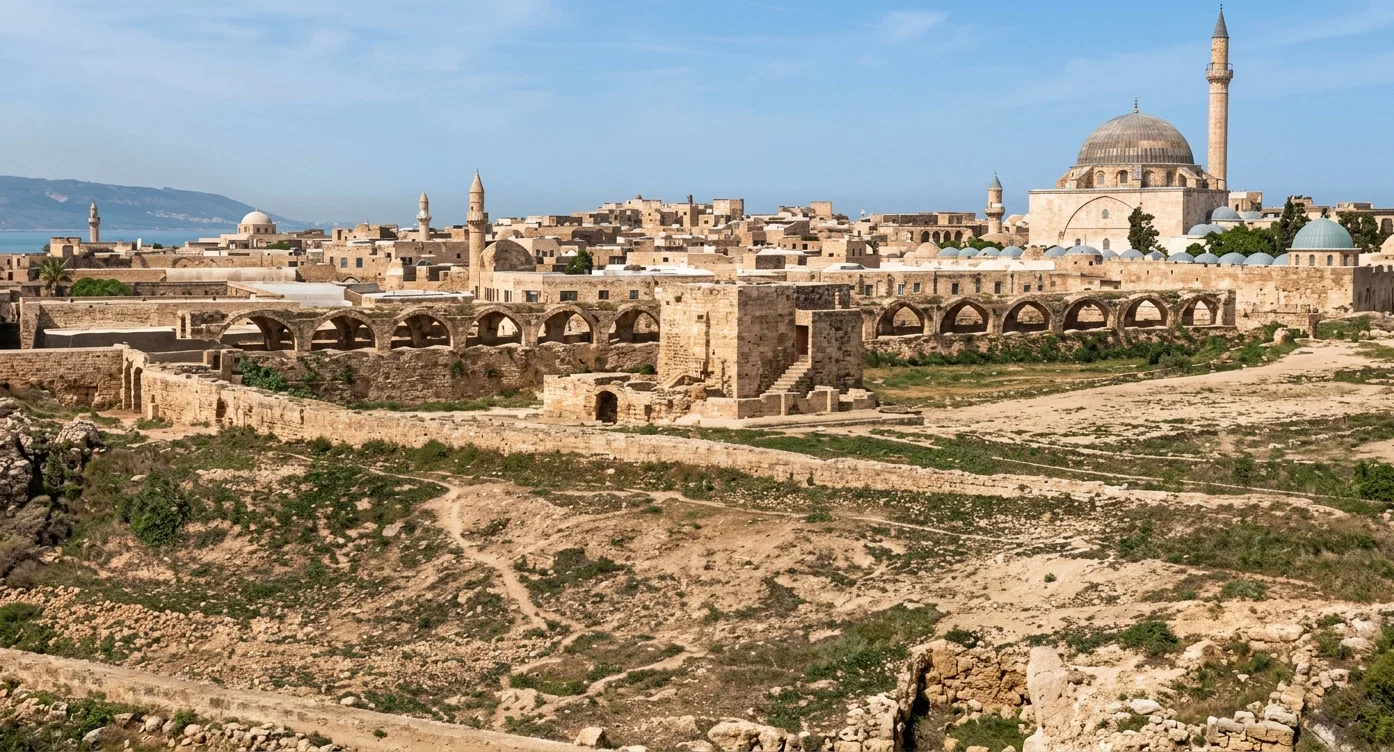
HERE we are on Mt. Carmel. It is the first week in January, when most of the Christian world are in regions of snow and ice; but on Carmel the farmers in their shirt sleeves are working in the fields and gardens. The day is bright and sunny, like May in Switzerland, and here and there wild flowers in full bloom remind one of the departed glories of Carmel. But the sun now sinking down into the blue Mediterranean, reminds me that I must return to my hotel, or run the risk of an unsafe encounter with Arabs after dark. As we descend the slopes of Carmel to the north, before us stretches the fine bay of Acre, and ten miles across on the opposite shore nestles the city of Acre (Accho), while far in the distance Mt. Hermon pushes up its hoary head into the region of eternal snows. Our winding path down Carmel leads through vineyards of the German colony. Carmel wine has a fair reputation and sells at a good price in Europe, and hence is a source of gain to the colonists.
Next morning we were to start for the interior; it was planned to go horseback; but the wind from the northeast was blowing too strong, so we concluded to go with a coach. A tolerable road has been built from Carmel to the Sea of Galilee by way of Nazareth; but in the rainy season portions of it are almost impassable. At Haifa there are several Arab teamsters who make frequent trips to Nazareth; but their wagons are better for freight than for passengers. Some of the German colonists have imported extra strong-built spring wagons from America; with these one can make a comfortable journey. A fixed price is charged for the trip; hence the greater the number of passengers, the less the individual fare.
Altho we began early in the morning, it took till noon to muster a company of four. One was a German just come from the Transvaal; another, a Jewish professor whose purpose was to establish a school at Tiberias; and the third was a German who is engaged in building a hotel on the banks of Galilee.
At last we are off! And now for our first ride through Palestine! How freighted is every step with thrilling memories! Could all past events of each locality pass in panorama before us, what scenes would we behold! Soon we have made our way through the narrow, crooked streets of Haifa. Our road leads along the north side of Carmel. At our left is the sandy beach of the Mediterranean, sweeping in a curve northward to Accho (in Christ’s time, Accho was called Ptolemais,11where Paul spent one day, Acts 21:7); to the northeast is the low, marshy plain of Accho, through which the brook Kishon flows to the Mediterranean; near the sea are many palm trees. For some distance the land to the north of our road is low and marshy; to the right, on the slopes of Carmel, are some wretched Arab huts.
For about two hours our course is beside a railway, which is finished for several miles from Haifa. It was begun by an English company, and was laid out from Carmel to Damascus, its course being through the plain of Jezreel, and over the Jordan just south of Galilee, through the country of the Gadarenes, and to the east of Mt. Hermon. But this company having had an experience somewhat similar to the Panama Canal Company, the work is for the present at a standstill.
In consequence of long neglect, the plain of Accho has become the abode of malarial poisons. To drink of its water, or to sleep on it overnight, is sure to saturate one with fever germs.
VIEW OF ACCHO, OR ST. JEAN D'ACRE, WITH MT. CARMEL IN THE BACKGROUND TO THE LEFT.
A few miles to the east of Haifa the plain narrows down between Carmel and the foot-hills of Galilee. Here the Kishon flows from the valley of Jezreel to the plain of Accho. At this point we leave the foot-hills of Carmel and cross to the hills of Galilee, which is not an easy undertaking at this season of the year.
A short distance ahead of us is a group of Bedouins. As we draw nearer, we see that in crossing a slough the wagon has fallen into the mud so deep that the horses can not pull it out. Fearing a similar fate, we all leave our coach, and pick our way across on foot; and with the lighter wagon, our teamster succeeds in crossing. However, the worst is not yet passed; after a short distance, all attempts to make a road have been abandoned, and each driver avoids the track of others in the hope of sinking less deeply into the mud. For some distance our three horses patiently wallow through the mire; the rank grass is grown up thick as high as our vehicle. At last we are through, and begin to ascend the foot-hills of Galilee.
On the first hill is an Arab village; it is composed of one long house, each family having a small portion, sometimes without a partition between them. A large tract of land here is owned by a rich Arab, who rents to the poor fellahs, or farmers.
On the summit of this hill, we pause to take in the surrounding view. To the west is a clear view of the plain and city of Accho, Haifa, Mt. Carmel, and the sea; to the southeast stretches the large triangular plain of Jezreel, called Esdraelon in the Greek; along the south of this, the greatest plain of Israel, extend Mt. Carmel and the hills of Samaria; on the north are the hills of Galilee; and to the east, between Jezreel and the Jordan, are the hills of Gilboa, Little Hermon, and Mt. Tabor.
Our course now lies southeast, over the foot-hills of Galilee and bays of the plain of Jezreel. On portions of the hills which we cross are forests of oak; the trees are rather low and scrubby; the acorns are narrow and long. In the valleys, birds are quite plenty, specially the snipe, plover, ravens, and sparrows. Here and there a scarecrow, dressed a la Arabe, indicates that the birds to-day, as in the time of Christ, are at the heels of the sower, as mentioned in the parable.
Some of the land is cultivated, the old-fashioned wood plow, with iron point and one handle, being used. Generally, the plow is drawn by one yoke of oxen. Large portions of the land are overgrown with weeds. Along the road in places are hedges of huge cacti. Among the weeds on the plain we saw two jackals, called foxes in Eze. 13:4, in illustration of the tricky prophets of Israel. One of the passengers, having his gun along, attempted to shoot one; but the moment he began to level his piece, the jackal took the hint and lost no time in increasing the distance between us. As we saw him scampering through the weeds, we thought of his progenitors which Samson caught, and, having tied flaming torches to their tails, liberated them in the wheat-fields of the Philistines. The jackal looks very much like the red fox, and is about the same in size. Soon after dark we heard them yelping in the distance, first on one side, then on the other. Evidently, they are quite numerous here.
When the roads are fair, the trip from Haifa to Nazareth is made in six hours; but at this season of the year, it required eight hours. Nazareth lies in the hills of Samaria, about an hour from the plain of Jezreel, at considerable altitude above the plain. It being situated on the slope of the hill facing the southeast, when approaching it from the west, the town is not seen till one is right upon it. As we reach the hill-top, all at once the town bursts upon the view, presenting a pleasing picture. As we arrive quite late, we will retire for the night, and at another time take a glimpse at Nazareth.