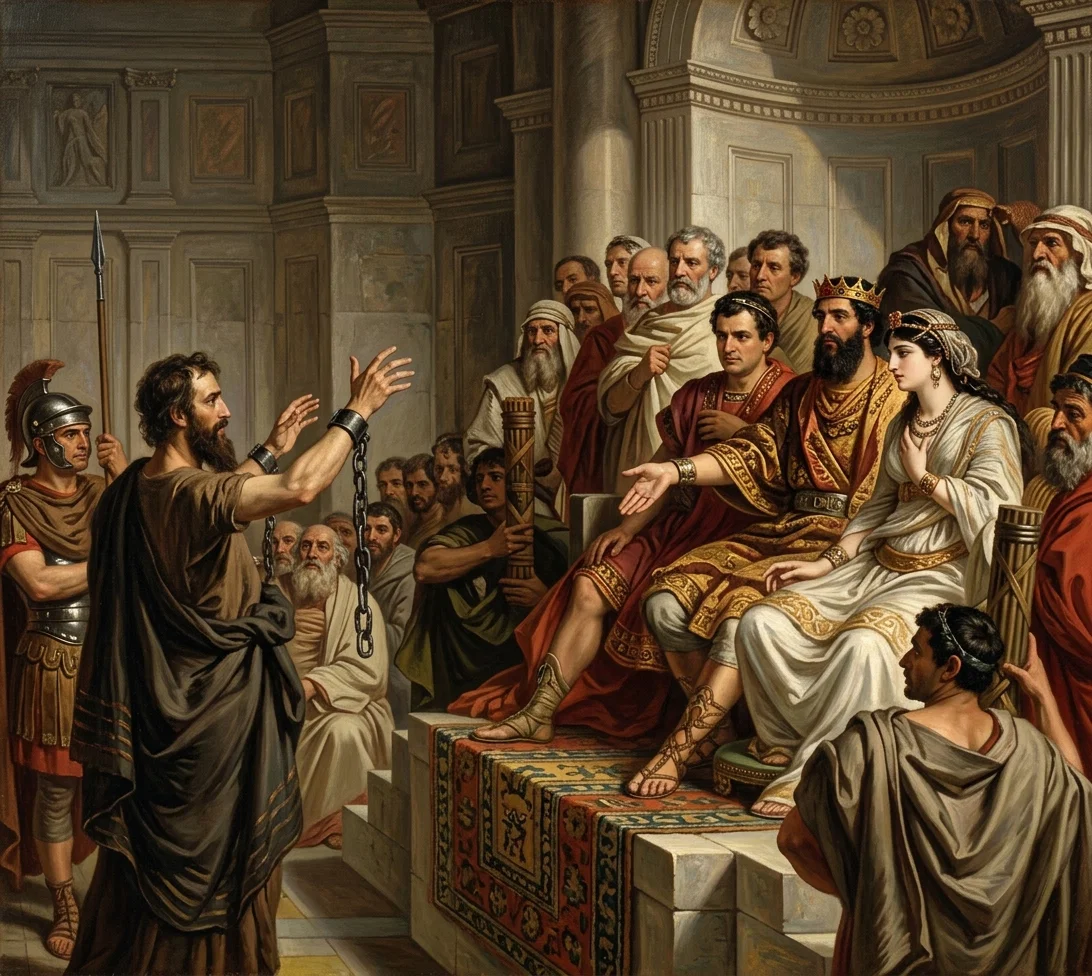
23 “So on the morrow, when Agrippa was come, and Bernice, with great pomp, and they were entered into the place of hearing, with the chief captains, and the principal men of the city, 24 at the command of Festus Paul was brought in. And Festus saith, King Agrippa, and all men which are here present with us, ye behold this man, about whom all the multitude of the Jews made suit to me, both at Jerusalem and here, crying that he ought not to live any longer. 25 But I found that he had committed nothing worthy of death; and as he himself appealed to the emperor I determined to send him. 26 Of whom I have no certain thing to write unto my lord. Wherefore I have brought him forth before you, and specially before thee, King Agrippa, that, after examination had, I may have somewhat to write. 27 For it seemeth to me unreasonable, in sending a prisoner, not withal to signify the charges against him.
1 “And Agrippa said unto Paul, Thou art permitted to speak for thyself. Then Paul stretched forth his hand, and made his defense:
2 “I think myself happy, King Agrippa, that I am to make my defense before thee this day touching all the things whereof I am accused by the Jews; especially because thou art expert in customs and questions which are among the Jews; wherefore I beseech thee to hear me patiently. My manner of life then from my youth up, which was from the beginning among mine own nation, and at Jerusalem, know all the Jews; 4 having knowledge of me from the first, if they be willing to testify, how that after the straitest sect of our religion I lived a Pharisee. 6 And now I stand here to be judged for the hope of the promise made of God unto our fathers; 7 unto which promise our twelve tribes, earnestly serving God night and day, hope to attain. And concerning this hope I am accused by the Jews, O king! 8 Why is it judged incredible with you, if God doth raise the dead? 9 I verily thought with myself, that I ought to do many things contrary to the name of Jesus of Nazareth. And this I also did in Jerusalem; and I both shut up many of the saints in prisons, having received authority from the chief priests, and when they were put to death, I gave my vote against them. 11 And punishing them oftentimes in all the synagogues, I strove to make them blaspheme; and being exceedingly mad against them, I persecuted them even unto foreign cities. 12 Whereupon as I journeyed to Damascus with the authority and commission of the chief priests, 13 at mid-day, O king, I saw on the way a light from heaven, above the brightness of the sun, shining round about me and them that journeyed with me. 14 And when we were all fallen to the earth, I heard a voice saying unto me in the Hebrew language, Saul, Saul, why persecutest thou Me? It is hard for thee to kick against the goad. 15 And I said, Who art thou, Lord? And the Lord said, I am Jesus whom thou persecutest. 16 But arise, and stand upon thy feet; for to this end have I appeared unto thee, to appoint thee a minister and a witness both of the things wherein thou hast seen Me, and of the things wherein 17 I will appear unto thee; delivering thee from the people, and from the Gentiles, unto whom I send thee, to open their eyes, 18 that they may turn from darkness to light, and from the power of Satan unto God, that they may receive remission of sins and an inheritance among them that are sanctified by faith in Me. 19 Wherefore, O King Agrippa, I was not disobedient unto the heavenly vision; but declared both to them of Damascus first, and at Jerusalem, and throughout all the country of Judea, and also to the Gentiles, that they should repent and turn to God, doing works worthy of repentance. 21 For this cause the Jews seized me in the temple, and assayed to kill me. 22 Having therefore obtained the help that is from God, I stand unto this day testifying both to small and great, saying nothing but 23 what the prophets and Moses did say should come; how that the Christ must suffer, and how that He first by the resurrection of the dead should proclaim light both to the people and to the Gentiles.
QUESTIONS.
(1) Relate all the circumstances that led Paul to appeal to Cæsar. (2) Who was Agrippa, and how did it happen that Paul appeared before him? (3) Was this appearance anything in the nature of a trial? Give proof. (4) What sort of assembly was it before which Paul appeared on this occasion? Verse 23. (5) How did Festus introduce Paul to them? (6) What had the Jews declared? Verse 24. (7) Yet what had he himself found? Under what difficulty did Festus say he had labored in the matter? Verse 25. (8) What, therefore, did he wish to gain by the present examination before these dignitaries? Verses 26, 27. (9) What permission was then given Paul? By whom? Chapter 26:1. (10) Whom did Paul address? How did Paul say he regarded this privilege? Why? Verses 2, 3. (11) At what point did he begin his narrative? What did he say as to his manner of life from his youth? By whom could this be proved? Verses 4, 5. (12) For what did he say he was now judged? V. 6. (13) What did he say was the relation of the twelve tribes to this promise? Nevertheless, by whom was he accused on account of that same hope? Verse 7. (14) What question did he put to Agrippa? Verse 8. (15) What did Paul say that he himself had thought? Verse 9. (16) How about his action? What did he do to the saints at Jerusalem? How did he stand related to their death? Verse 10. (17) How vigorously did he carry on the persecution? What did he compel the disciples to do? How did he feel towards them? How did he show his madness? Verse 11. (18) What further showed that it was not because he had been prejudiced in favor of Christianity that he accepted it? Verse 12. (19) What did Paul again relate in detail? Verses 13–15. How many times has the story of Paul’s conversion been told? (20) From this narrative what do we learn as to the purpose of the Lord’s appearance unto Paul? Verse 16. (21) What did Jesus say He would do for Paul? To whom had he been sent? For what purpose? What great work was Paul intrusted with? What was he to be instrumental in bringing to the Gentiles? Verses 17, 18. (22) What did he do on receiving this vision from heaven? Verse 19. (23) Where had he first preached? Where next? What had been the burden of his preaching to both Jews and Gentiles? Verse 20. (24) For what cause was it that the Jews sought to kill him? Verse 21. (25) By what means had he been able to continue his preaching so long? To what classes of people had he testified? To what had he confined his testimony? Verse 22. (26) What had Moses and the prophets said should come? What had they said that Christ should do by the resurrection from the dead? Verse 23.
SUGGESTIVE QUESTIONS.
(1) What does this lesson show as to the fulfilment of the promise made to the fathers? (2) What was, and is, the great feature of that promise? (3) Who only, then, ever had any ground for hope in the promise? (4) What does this lesson teach us as to the distinguishing characteristic of those who really constitute the twelve tribes? (5) What does Paul elsewhere say of some who are nominally Israel? Give reference. (6) Compare Acts 26:6–8 with Acts 23:6 and 25:19. (7) What does the statement in verse 10, “I gave my voice against them,” show as to Paul’s standing among the Jewish people before his conversion? Revised Version, “I gave my vote against them.” (8) What do we learn as to the Gospel in the writings of Moses? Can the Gospel be preached if Moses is discredited or ignored? Give proof.
“And Paul said, I would to God, that not only thou, but also all that hear me this day, were both almost, and altogether such as I am, except these bonds.” Acts 26:29.