The Chinese emperor, “the son of heaven,” as he is called, used to rule in awful state at Pekin. From north, west, south, there came every year stately processions humbly bringing tribute and splendid presents to his celestial majesty. Embassies from the hot, sunny coasts and tropical forests of Annam and Cochin-China, were always on the march with gifts. Annam sent elephant tusks, rhinoceros horns, nuts, spices, sandalwood, and one hundred pieces of satin, and one hundred rolls of white silk. A letter written in gold from the king of the South said: “As is my duty as your vassal, gazing from afar at the heavenly abode, I have sent my envoy bearing these presents; I humbly wait your acceptance of them.” Tonquin and Cambodia did the same.
But all is changed now, for France has annexed the whole great S-shaped coast, reaching back to the great river Mekong. Driving back the yellow troops of Cochin-China, she has made herself a splendid empire in Southern Asia; so no more tribute will reach Pekin from the South. Tonquin means the “Eastern land.” It is the most northerly of the three provinces we are considering, and the nearest to China. Inland it is very mountainous, but with fertile coasts and valleys.
The coast south of the Gulf of Tonquin is Annam proper, and the great, flat region trending to the southwest is called Cambodia; all three provinces are now really France in Asia. The country is extremely lovely. Palms, bamboos, and giant-flowering trees grow faster than man can destroy them. Teak and gum trees yield splendid timber. Gutta-percha trees, dye-woods, vanilla plants, and spices grow wild. The great staple crop is rice, vast quantities being raised. The indigo plant, the sugar-cane, coffee, tea, pepper, cloves, and excellent cotton, are grown.
From Cambodia comes the yellow pigment called gamboge. Oils and resins are made into brilliant lacquer, and the glossy, coral-red, and gilded wares seen in some museums are the work of these artistic peoples of “farther India.”
In the forests roam the elephant, rhinoceros, tiger, leopard, and apes of many species. Among the birds are peafowl, gold and silver pheasants, and bright-plumaged macaws. In11the marshy deltas of the great rivers Mekong and Saigon are crocodiles, serpents, boas, and venomous reptiles.
Cambodia is a network of river channels, all emptying into the great inland lake of Bein Hoa. Here are the haunts of fever, ague, and cholera. It is death for a European to sleep in these beautiful but deadly glades. Still, people do live there, for where is the temperate or tropical spot which is not “home” to some human beings? The French port of Saigon is fast becoming a rich and busy trade center.
TEMPLE AT NAM-DINH.
STREET IN NAM-DINH.
A LADY OF RANK.
SILK SPINNING.
TONQUINESE BANQUET.
FRUIT & DRUG STORE.
MARRIAGE CEREMONY.
TONQUINESE.
FUNERAL PROCESSION.
ALTAR OF ANCESTORS.
OPEN AIR THEATRE.
PALANQUIN.
GOING TO BATTLE.
ANNAMESE SMITHS.
TOMB OF BONZES.
EDIBLE SWALLOW'S NEST.
CHINESE PHEASANTS.
FLOATING VILLAGE.
FISHING ON THE LAKES.
Hidden among the forest jungles are the famous ruins of Angkor. No man or woman treads the richly carved palace halls of that deserted city. They are a lair for tigers, a haunt for venomous reptiles. Trees and climbers for a thousand years have choked the galleries and courts. When the city was built, and by whom, there is no record. The people must have been far advanced in the arts, and very rich. Now the silence is broken only by the peacock’s cry, or the growl of some beast of prey.
The religion of the richer inhabitants of Cochin-China is Buddhism, founded by Buddha, who is represented in temples by an image sitting cross-legged in deep contemplation; but the poor worship good and evil spirits, which they call Nats. There are many Jesuit missionaries following the French conquerors, but few converts are made. By race the people are a mixture of Malays and Chinese, and are brave, lively, and peaceable. They live very coarsely, eating rice, snakes, locusts, rats, and drinking only tea. They chew betel-nut till their teeth are worn down to their gums. They make and embroider some excellent silk and cotton fabrics, while their houses are mainly of wood, the bamboo furnishings being gaily colored.
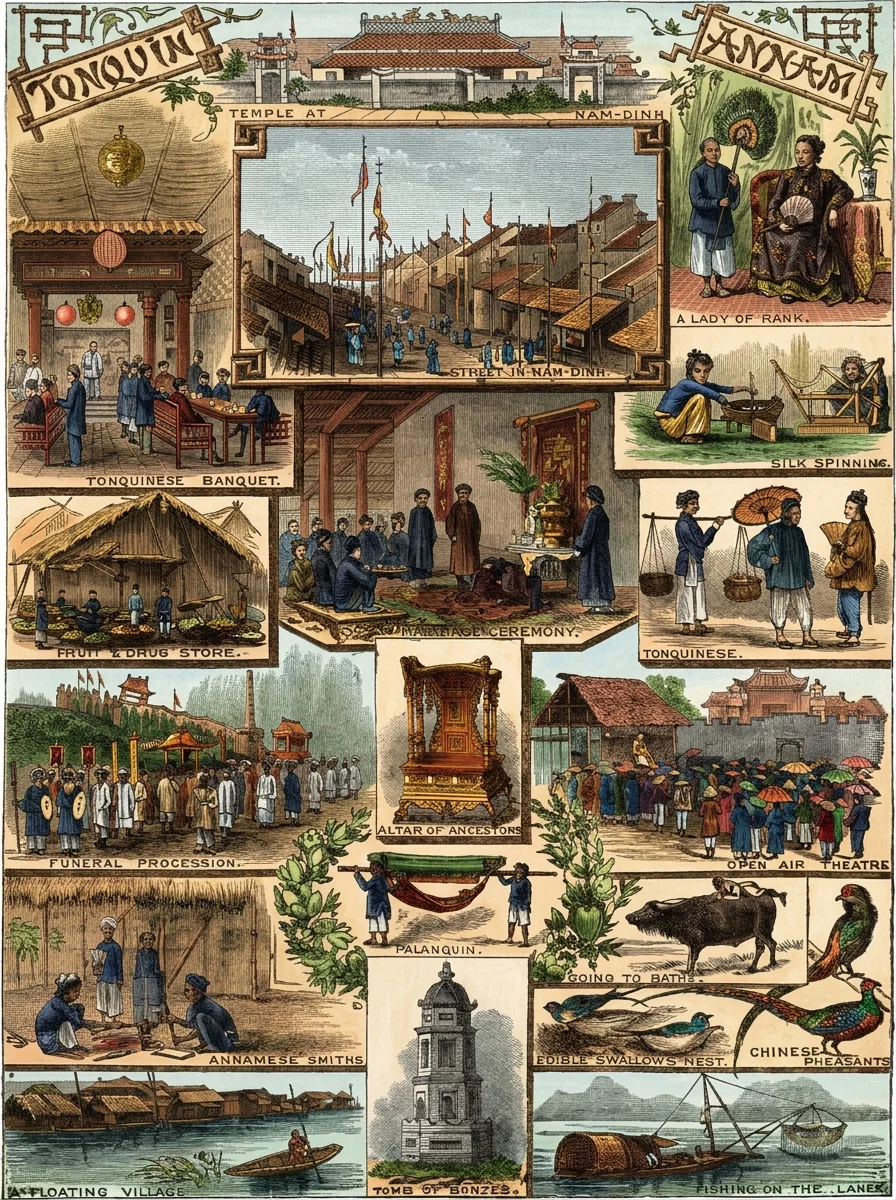
Turning to our illustrations, you may see a scene in Nam-singh, a strongly fortified town captured by the French.
Next comes a Tonquinese mandarin’s banquet, which is a very ceremonious affair. Endless are the dishes,—live fish, bird’s-nest soup, sea slugs (tripang), roasted puppy, and half-decayed eggs. The cooks are said to be very skilful, and delight in surprising the guests. With everything is served snowy white rice.
In the center of the page is a wedding scene, which is a long, costly ceremony. The poor bride bends low before her husband, confessing herself his slave. Lower down we show a native forge. With a stone for an anvil, and a few simple tools, a little charcoal, and goatskin bellows, the men do really very fine smith’s work.
Below is a floating village on the Mekong River, and a fisherman with a great square net, which he moves up and down with a kind of crane.
Other features to be mentioned are the altar of ancestors, whose worship is held sacred; a palanquin, showing the mode of traveling; a tomb of the bonzes—that is, the burial-place of the Buddhist priests—and an elaborate funeral procession. You can also see how the women spin silk, and the way in which the people amuse themselves in the open air.
Almost nothing has been done among these people to enlighten them as to the way of salvation. Roman Catholics claim in the entire territory of Annam and Tonquin about 800,000. There are no Protestant missions in either territory. May the time soon come when the true Gospel of Christ shall be preached so that every soul may hear the glad tidings.