Man’s View.—If we were to ask of men their opinion as to the greatest prophet of sacred story (always excepting Jesus of Nazareth), some would say Enoch, some Noah, some Abraham, some Moses, or Isaiah, or Daniel, or Elijah, others Paul, or John. And surely these were all great men, made great by God’s grace, great in the influence they have exerted upon the church and the world.
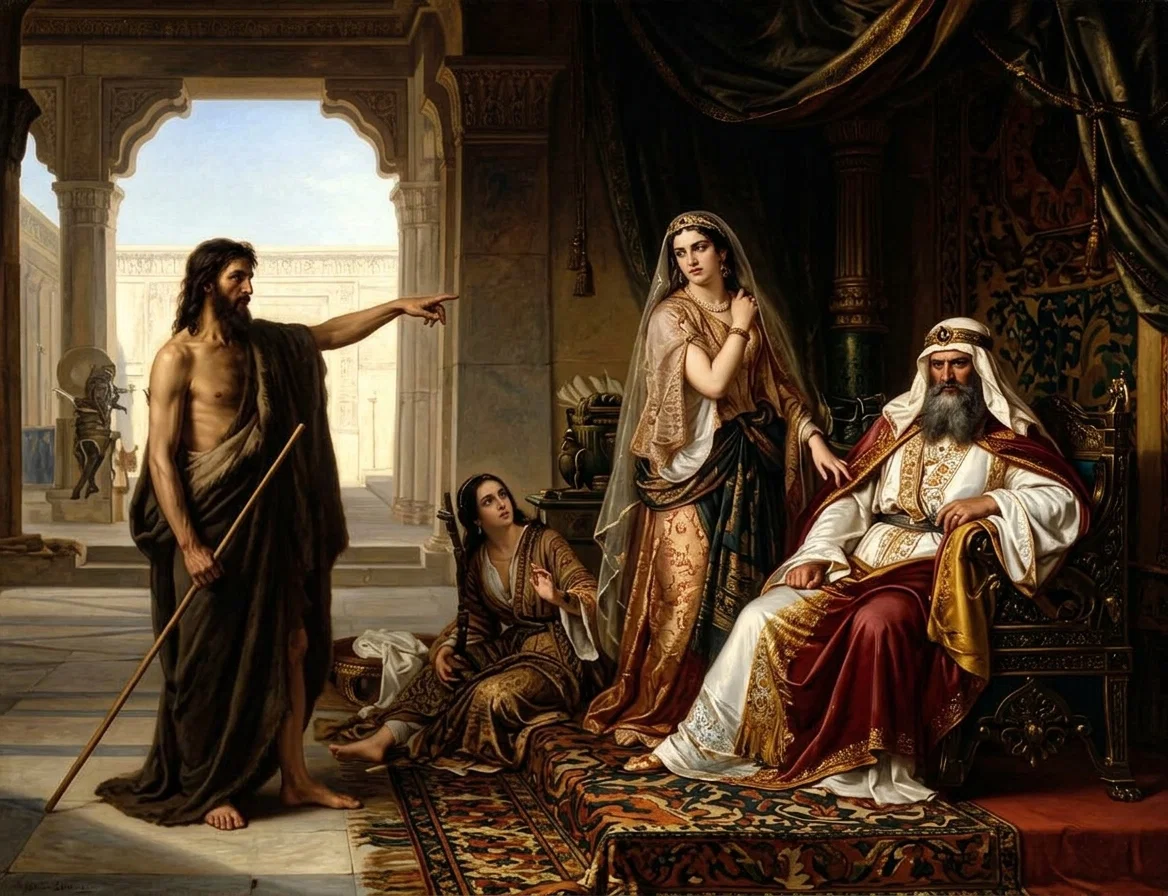
For John had said unto Herod, It is not lawful for thee to have thy brother’s wife. Therefore Herodias had a quarrel against him, and would have killed him; but she could not; for Herod feared John, knowing that he was a holy, and observed him; and when he heard him, he did many things, and heard him gladly. . . . executioner; . . . and he went and beheaded him in the prison.” Mark 6:18–27.
What Is the Divine View?—We ask the Word, and we are told: “Verily I say unto you, Among them that are born of women there hath not risen a greater than John the Baptist.” According to Him who should “not judge after the sight of His eyes,” a greater than all is John the Baptist.
Why the Difference?—Man sees not as God sees. The Lord sees chaff where we deem that we see wheat. He is the better judge of the relative fineness of the gold; for it is tried in His furnace. If America’s highest elevation, Mt. St. Elias, were placed beside Mt. Everest, it would not be counted worthy of consideration. Its shadow would be lost in the greater shadow of the king of mountains.
Looking at the matter from a wholly worldly consideration, the star of John the Baptist had the misfortune of dawning upon the world’s horizon just as the Sun of Righteousness was rising. The splendor of the star was lost in the glory of the sun. But from a divine view, this was a part of the preparation for the greater character.
In What Was He Great?
1. He Was Great in His Consecration.—“Filled with the Holy Ghost, even from his mother’s womb.” Trained by a godly father and mother when a child and youth, when he came to the years of accountability he early separated himself from the gay and thoughtless throng, from the covetousness and strife of the marts of the world, from the traditions, the vain scholasticism of the priests and scribes, and found in the study of God’s law and the solitudes of the Judean desert companionship with God and angels. “He was in the desert [wilderness] till the day of his showing unto Israel.” Here, amid the solitude of nature, under the bending, star-filled skies, he learned of man’s littleness and God’s greatness. He saw God in His works and in His Word. He saw the results of sin in the riven rock, in the barren land, in the dead tree and twig, in the savage beast, in every marring of the beauty of God’s handiwork. But above all these he saw God’s wisdom, goodness, love, and power to redeem, to restore, and to uphold.
2. He Was Great in Meekness.—Moses was meek. He learned it in his forty years’ schooling in the wilderness of Midian, keeping his flocks under the stars of God. John the Baptist learned meekness and humility in the wilderness of Judea. He saw God in His greatness, and doubtless over and over again came the inspired song of his lips, “When I consider Thy heavens, the work of Thy fingers, the moon and the stars, which Thou hast ordained; what is man, that Thou art mindful of him? and the son of man, that Thou visitest him?” He knew God, and, knowing God, he knew himself, and how small he was. Surely of whom can we learn as from God, in whom is all knowledge. This trait of character was exhibited in his work when he told of the Coming One, and when Jesus came to him to be baptized. To the multitude who thronged to hear him speak, he declared that he was not worthy to unloose the sandals of the One who was coming. To Jesus, he who was filled with the Spirit said, “I have need to be baptized of Thee, and comest Thou to me?” Yet he obeyed when the Master commanded—and without hesitation. When the priests and Levites sent a delegation to ask him who he was, he might have said that he was of the tribe of Levi and the son of Zacharias, a priest, authorized to speak, but he made no such claim. That he was not the Messiah, he plainly told them. Finally, to their insistent request, he replied, “I am the voice of one crying in the wilderness, Make straight the way of the Lord, as saith the prophet Isaiah.” The meek man knew his mission. He knew that the prophecy given seven centuries before was fulfilled in him. It was no hypothesis, no uncertain conclusion, no church dogma of succession of the priesthood. God had delivered the message to the meek man of the desert. The meek will He guide in judgment, and the meek will He teach His way.” John had listened to God’s voice in His Word and works; he was content to be a “voice” for God to the great, needy world.
3. He Was Great in Fearlessness.—So was Elijah the Tishbite, his prototype, and also a prophet of the desert. When a man has seen God, when God has accepted him, why should he fear mortal man? He had heard and received the word: “I, even I, am He that comforteth you; who art thou, that thou shouldest be afraid of a man that shall die, and of the Son of man which shall be made as grass; and forgetest the Lord thy Maker, that hath stretched forth the heavens, and laid the foundations2of the earth?” He bore a strong message to a strong people, whose hearts were hardened in pride and lust. To the great and learned of the leading sects, he preached the Gospel of repentance. They to be saved must repent, and “bring forth fruits meet for repentance.” Their place in the house of God would otherwise be filled, even from the very stones if necessary. More than this, John came before the proud, haughty, licentious, yet vacillating king, Herod Antipas. Herod was living in adultery with Herodias, the legal wife of his brother, Herod Philip. John said to him, “It is not lawful for thee to have her.” Such preachers are needed to-day,—men who can stand before kings and princes, and fearlessly, yet in the love of God, bear God’s message of reproof and healing. Men great in national, state, and municipal councils, members oftentimes of large and popular churches, are as licentious as Herod, in league with saloon-keepers, and are friends and companions of those who are corrupting and ruining the virtue of the youth of the world. Would to God that the watchmen in the various churches to which these men belong, would bear the same plain message that John the Baptist bore, “It is not lawful” according to God’s law; as Elijah did, “As the Lord God of Israel liveth, before whom I stand,” “ye have forsaken the commandments of the Lord, and thou hast followed Baalim.”
4. He Was Great in Unselfishness.—He did not long for the highest place. He did not worry and fear lest his greatness or ability should not be recognized. His burden was for God’s work. When our Lord came, and the wonderful message of power and healing fell from His lips, the great throngs left John and went to Jesus. His friends grew solicitous. Satan through them hoped to stir up jealousy. They went to John, and said: “Rabbi, He . . . to whom thou barest witness, behold, . . . all men come to Him.” But the prophet answered: “A man can receive nothing, except it be given him from heaven. Ye yourselves bear me witness, that I said, I am not the Christ, but that I am sent before Him.” “He must increase, but I must decrease.” John knew it. The light of the rising sun hides the brightness of the morning star. The star-worshipper may mourn, but not God’s star. Said John, “He that hath the bride is the Bridegroom [Christ]; but the friend of the Bridegroom [John the Baptist], which standeth and heareth Him, rejoiceth greatly because of the Bridegroom’s voice: this my joy therefore is fulfilled.” It matters not tho the greater glory eclipsed John’s light; he rejoiced in the added glory that had come to God’s people. The Saviour had come; he asked for no more—wanted no more.
5. The Greatness of His Work.—What wonder that God chose such a man for the immediate herald of His Son, the special messenger of the King of kings and Lord of lords, even tho that king came in lowly garb! Mighty, searching, humiliating, sadly joyful was indeed John’s work. He would not see the triumph. While yet our Lord was unrecognized save by few, John was cut off by Herod, cut off because he preached a Gospel of saving truth, which would have saved the one who killed him had it been received. No wonder that the demons of discouragement pressed upon his soul in the latter days of his prison life—not that he had doubt of the message he bore; he only questioned whether Jesus fulfilled it; but he asked not of the enemy or his agents, but of Jesus Himself. And Jesus did not reply in words, but let His own works witness to John’s message.
A Prototype.—Elijah was a prototype of John the Baptist. Elijah and John the Baptist are prototypes of the people of God who shall bear His last message to proud and popular churches, to the downcast, downtrodden, and poor of earth, to the vilest and hardest of sinful hearts. (See Mal. 4:5, 6; Matt. 11:7-14; Luke 1:17.) What must be the character of those who would be voices for God? Read the answer in the Book of God, of which these notes are the merest echoes. Yield to God everything, as did John. “Be filled with the Spirit.” “Receive ye the Holy Ghost.” Then will God’s messengers not be reeds shaken by the wind, liberal in all things save the pure Gospel of the Word; they will not be noted for the soft raiment of ease and luxury, proficient in all the manners of kings’ courts; but they will be voices for God, messengers of the Coming One, whose glory is soon to fill the earth. Blessed mission of life and light and love! Precious lessons are these which God gives us! O soul, study them in the light of God! And that you may do God’s work and herald His coming, “receive ye the Holy Ghost.”