This was the subject of an address by Mr. H. P. Beach, educational secretary of the Student Volunteer movement, at the recent convention held in Cleveland, Ohio. The speaker was for several years a missionary in China, and treated his subject from the standpoint of personal contact. The following excerpts from the address were taken by our correspondent at the convention:—
“The complexity of Confucianism arises from the fact that it is at once a system of politics, of economics, of ethics, and of religion. Not only so, but within each of these departments there is great heterogeneity. Failure by the missionary to apprehend this complexity, and a tendency to attack the system indiscriminately, have led to great misunderstanding, while the emphasis of its strong points only has been an unfortunate compromise.
“The literati of the empire are a serious obstacle in the way of Christian missions. They are not only numerous—a quarter of a million of these scholars having presented themselves last year at the second degree, or M. A., examination alone—but are also found in every village and hamlet of the empire. These leaders and rulers of the people are usually inaccessible to the missionary, and when seen by him, are so steeped in conceit, and so full of contempt for everything foreign, that little impression can be made upon them. Their corruption in official life is the source of China’s greatest weakness, and this, coupled with their power, which is really greater than that of the emperor, have been twin evils pitted against Christianity.
“The difficulties presented by its doctrinal11teachings arise from a combination of theoretical atheism with a very practical polytheism and idolatry, from a deficient and in some respects false theory of man’s nature, and from its consequent doctrine of self-salvation. Its hopeless future leads men in this life into oriental epicureanism. Perhaps the most serious obstacle met with on Confucianism’s doctrinal side is its marvelous system of ethics, which, in spite of defects, so fully satisfies the Chinese mind that Christianity is felt to be a needless superfluity.
“A mighty empire, the most populous in the world; an antiquity not only remote, but filled with noteworthy deeds and striking inventions; a people which to-day is perhaps the best fitted to survive in the family of nations; intellectual ability akin to the German and destined to produce the leading scholars of the twentieth century; these and other equally significant traits are under the control of a nominal Confucianism, and other impulses coming from effete forms of Taoism, Mohammedanism, and Buddhism. The combined influence of these factors in the broader situation is one of profound apathy on religious subjects, and of virtual atheism in many leading minds.
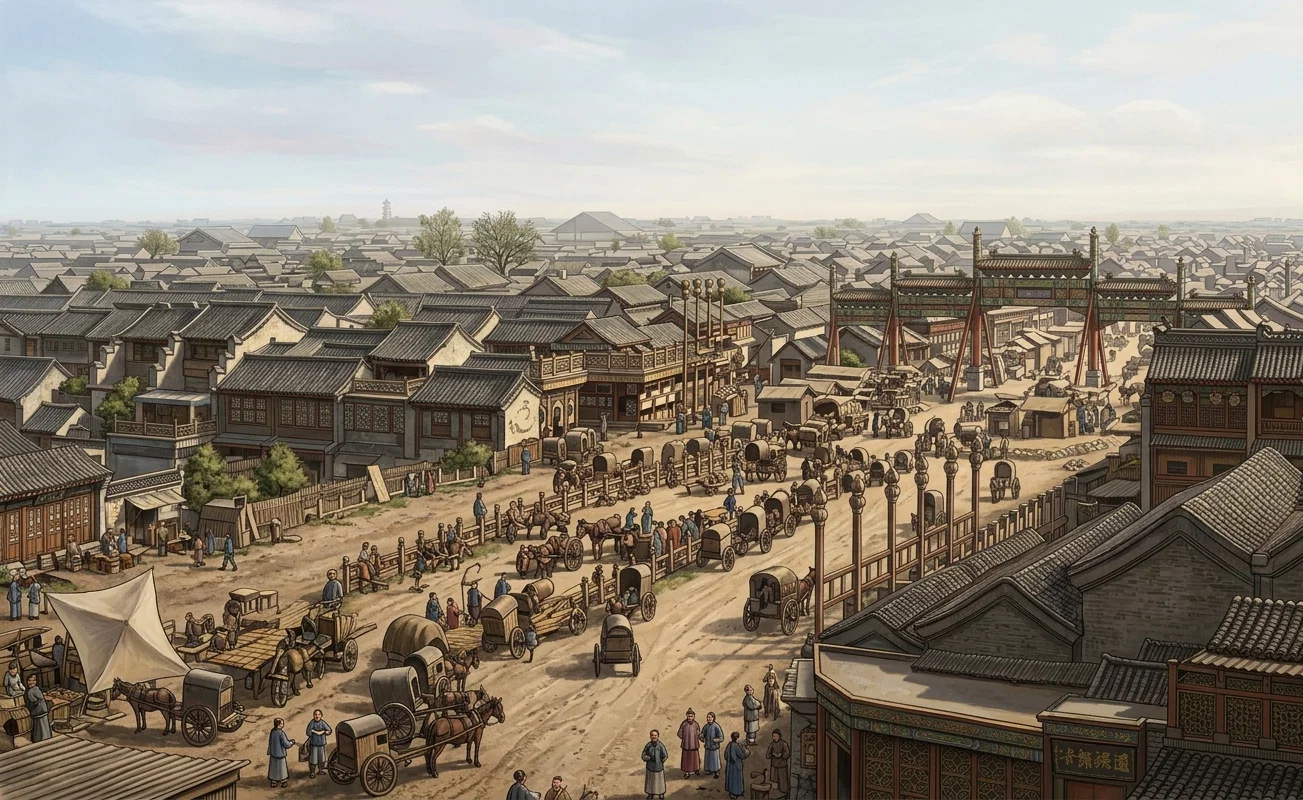
View in Peking, capital of China. This city is situated in the province of Chihli, about 100 miles from the Gulf of Pechili, near the Pei Ho River. Its population is estimated at 1,300,000. Among the great temples found here is the temple of Confucius, known as the Kwo-tsze-keen. This temple is very plain, one hall containing all that is accounted sacred. The objects of worship therein for the countless followers of the Chinese sage are the tablets of “the soul of the most holy ancestral teacher, Confucius,” and of his ten principal disciples.
“The first solution of these problems is that attempted by western civilization. Successive wars with western powers have forced upon the unwilling empire a navy, a foreign-drilled army, and railroads and telegraphs so fatal to the hitherto all-powerful system of Feng Shui, or geomancy. As an indirect consequence, the customs service was organized under foreign supervision, and has been an object lesson of official honesty. Industrial progress has been especially marked since the conclusion of the Japanese war, and is already beginning to affect for good China’s economical situation, through the starting of mills, and the exploitation of mines. More important still is the encouragement of western science resultant upon the opening of national doors.
“A second attempt to solve China’s problems has been that of storming Confucianism’s high places. The New Testament, costing $1,200, that was presented to the emperor’s dowager on her sixtieth birthday; the emperor’s purchase of copies of the same; his interest in the study of English; Li Hung Chang’s contact with missionaries and board secretaries; the success of the publications of the Christian Literature Society in reaching the chief official opponents of the foreigners; the Reform Club in Peking, under the influence of two former missionaries, —these have all been efforts of great significance.
“The essential solution of China’s greatest problem—that of the regeneration of her people—must be a more radical one. It lies first of all in a reproduction of the life of Jesus in the persons of foreign missionaries, who are sent to touch life at all points as He did in Palestine. His Spirit must be the leaven in the lives of native Christians and Christian helpers who come into closest contact with Confucianism. The Word of God, so largely used hitherto in China, will be a silent missionary in tens of thousands of homes, and His Spirit must be believed in and prayed for and possessed by every Christian in the empire before the final victory is won.”