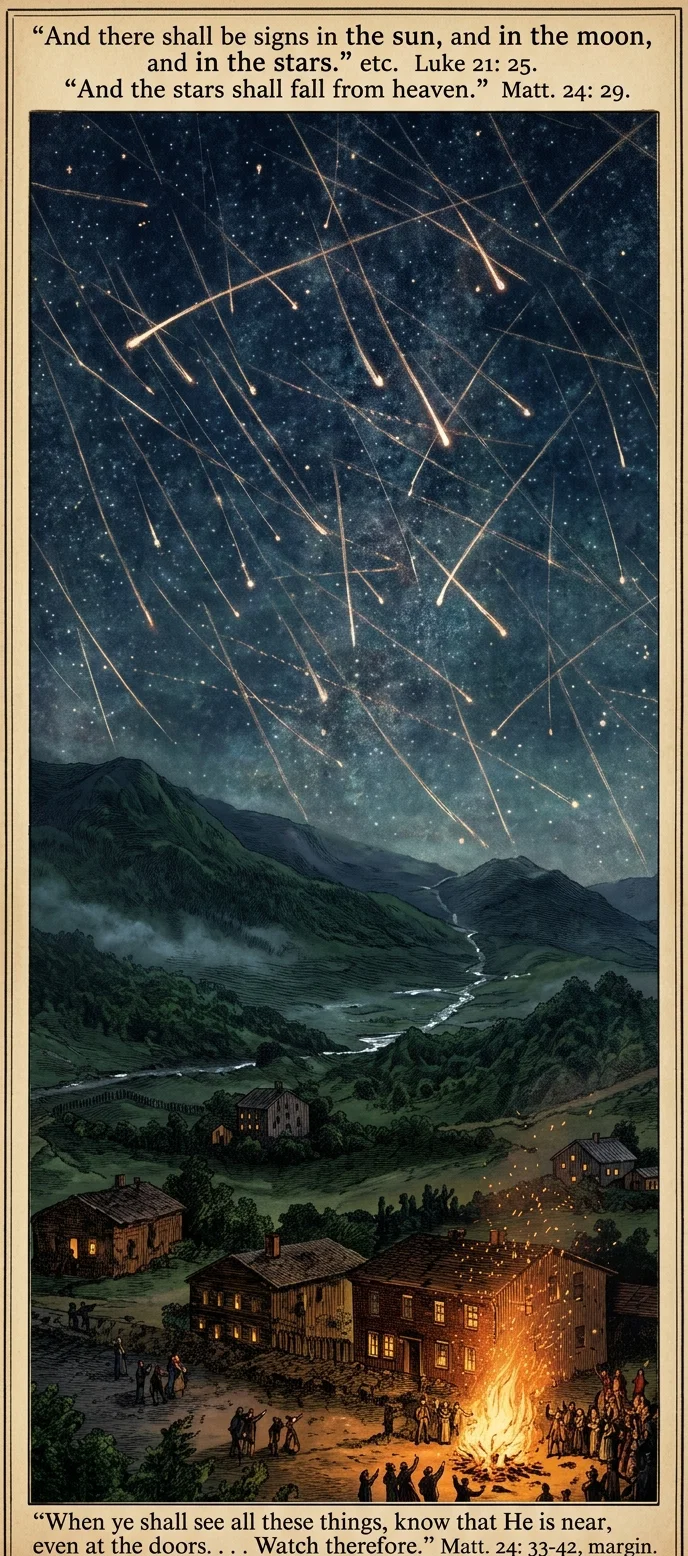
Note.—The full import of this lesson, the “meat in due season,” can be appreciated only by a study of this whole chapter and the next. These two chapters, beginning with verse 4 of chapter 24, are Christ’s answer to three questions propounded by His disciples. They had spoken to Him of the greatness and grandeur of the temple, and He had replied, “Verily I say unto you, There shall not be left here one stone upon another, that shall not be thrown down.” Then, “as He sat upon the Mount of Olives, the disciples came unto Him privately, saying, Tell us, when shall these things be? and what shall be the sign of Thy coming, and of the end of the world?” His reply to these questions, of which the present lesson is a part, is full of warning and earnest instruction, which is of the utmost importance to-day. That these warnings are for us is stated in Mark 13:37: “What I say unto you I say unto all, Watch.”
42 “Watch therefore; for ye know not on what day your Lord 43 cometh. But know this, that if the master of the house had known in what watch the thief was coming, he would have watched, and would not have suffered his house to be broken 44 through. Therefore be ye also ready; for in an hour that ye 45 think not the Son of man cometh. Who then is the faithful and wise servant, whom his lord hath set over his household, 46 to give them their food in due season? Blessed is that servant, 47 whom his lord when he cometh shall find so doing. Verily I say unto you, that he will set him over all that he hath. But 48 if that evil servant shall say in his heart, My lord tarrieth; and shall begin to beat his fellow-servants, and shall eat and 49 drink with the drunken; the lord of that servant shall come in a day when he expecteth not, and in an hour when he 50 knoweth not, and shall cut him asunder, and appoint his portion with the hypocrites; there shall be the weeping and gnashing of teeth.”
Golden Text: “Watch therefore; for ye know not what hour your Lord doth come.”Matt. 24: 42.
Suggestive Questions.
(1) What injunction is here given by our Lord? Verse 42. (2) Why are his disciples to watch? Same verse. Note 1. (3) How is the importance of watching illustrated? Verse 43. Note 2. (4) What is the conclusion from this parable? Verse 44. Note 3. (5) What pointed question follows this repeated warning? Verse 45. Note 4. (6) What is said of such a servant? Verse 46. Note 5. (7) What reward shall that servant receive? Verse 47. (8) What does an evil servant’s course virtually say? Verse 48. Note 6. (9) What is an evil servant? Note 6. (10) Into what grievous error is he liable to fall? Verse 49. (11) What grave consequences are sure to follow such a course? Verses 50, 51.
Notes.
1. Watch therefore.—Why watch?—Because “ye know not what hour your Lord doth come.” The Lord is coming again. He was explaining this fact to them, in reply to their question about this very thing. But people who do not believe in the second, personal, visible coming of the Lord (as promised in John 14:1–3; Acts 1:10, 11; 1 Thess. 4:14–18) will not watch for it. A very small proportion of the professed disciples of Christ believe these scriptures in a practical way; therefore they do not watch for His coming. And some who profess to believe in the second advent say, “We do not know the day or the hour, therefore we need not spend time considering the matter.” But that is the very reason why the Lord says, “Watch.” We may know when “it is nigh, even at the doors” (Mark 13:29), and the signs by which we may know this, are already in the past. The importance of watching lies in the fact that “unto them that look for Him shall He appear the second time without sin unto salvation.” Heb. 9:28.
2. If the good man had watched.—He was a “good man,” but that did not avail him anything in his dilemma, because he had not watched. He learned when it was too late that for which he might have been prepared if he had watched. So the professed Christian who fails to look for the Lord’s coming will be taken unawares, and lose all, because of his unbelief and consequent lack of preparation.
3. The warning repeated.—The reason for watching, for being always on the alert, always obedient, ever awake to opportunities to do good, is so important that it is repeated in verse 44: “In such an hour as ye think not,” etc. A neglect of the commandment of the Lord, a neglect of the truth, always leads to a false conclusion, and therefore to disappointment.
4. Meat in due season.—Fruits raised out of season by artificial means may look well, sell well, and be highly prized, but they are never so well flavored as those grown in their natural season. The Lord has told us when His coming is near, therefore at that time the proclamation of His soon coming would be “meat in due season.” At a later date it would be valueless, as at an earlier date it was misguiding. See 2 Thess. 2:1–5.
5. The servant who receives blessing.—The profitable servant is one who works as his employer directs. Especially in tilling the ground, various kinds of work must be done in the proper season or it is of no use to do it at all. The master is the one who is supposed to know best what is to be done, how to do it, and when to do it. The servant who disregards his directions, and does work at the wrong season, or in the wrong way, can not meet the approbation, or blessing, of the master. When the Lord comes, His blessing will be upon the servant who has been engaged in proclaiming His coming, and in endeavoring to prepare the people for that glad event.
6. The result of not giving spiritual meat in due season to the church and to the world is very disastrous. This is what the Jewish teachers refused to do prior to and at the time of the first advent of Christ. Hence the rejection of Him by that people, and His subsequent rejection of them. The popular church of to-day assumes much the same attitude toward the second advent that the Jewish Church did toward the first advent. Their teaching is so freighted with the traditions of men that the plain Word of God is to a great extent hidden beneath the rubbish of “philosophy and vain deceit.” Like causes always produce like effects. To withhold the message that “the coming of the Lord draweth nigh” (James 5:8), which is “meat,” or “food,” spiritual food, “in due season” at this time, is virtually saying, in practice, “My Lord delayeth His coming.”270To such teachers apply the words of Jesus: “Wo unto you, scribes and Pharisees, hypocrites! for ye shut up the kingdom of heaven against men; for ye neither go in yourselves, neither suffer ye them that are entering to go in.” Matt. 23:13. An evil servant is one who disobeys his lord’s command, either by express purpose or neglect.