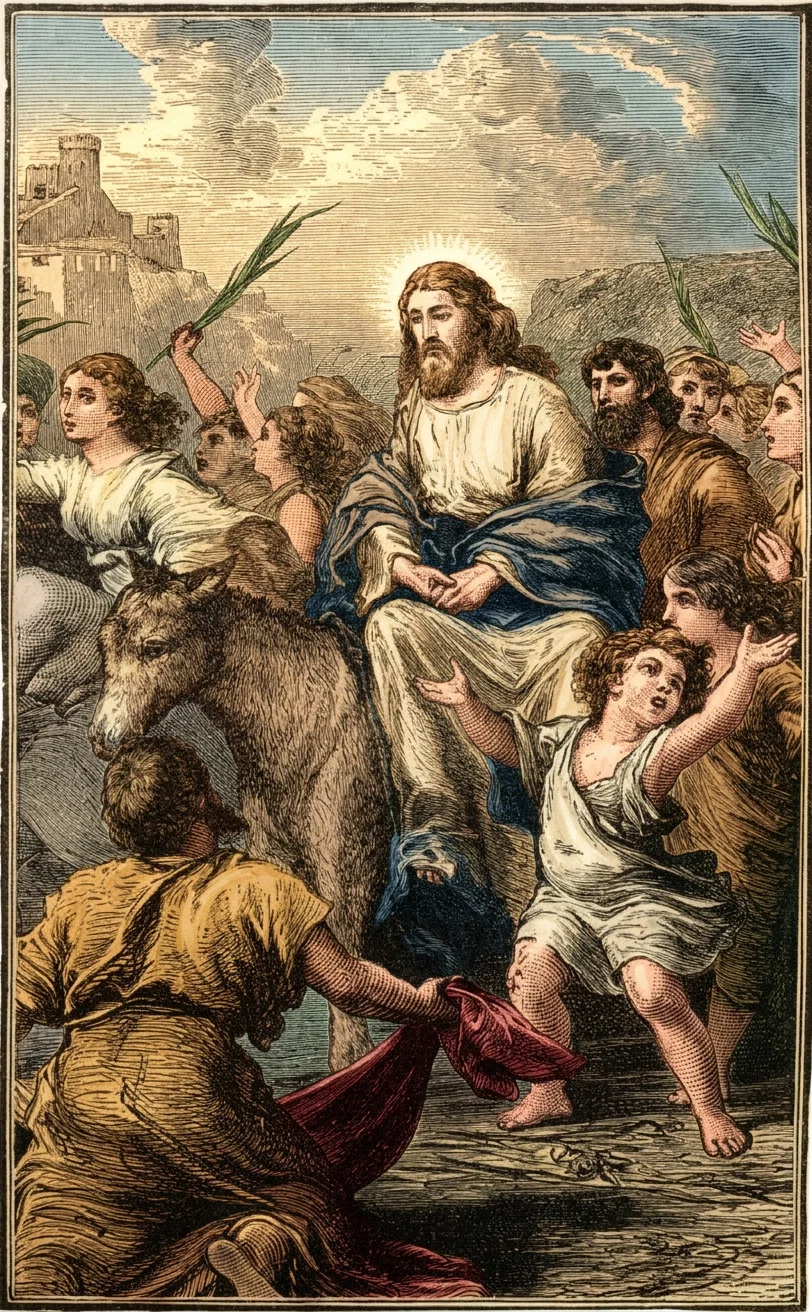
THE TRIUMPHAL ENTRY

6%

Pacific Press Publishing Company · Oakland, California · Apr 14, 1898

FromSigns of the Times, Vol. 24, No. 15.

Read the full edition

THE TRIUMPHAL ENTRY

Lesson V.—Sunday, May 1, 1898.

THE TRIUMPHAL ENTRY.

Note.—The time of the present lesson is the last week of Christ’s life upon earth. Parallel accounts of this entry into Jerusalem are found in Mark 11:1–11; Luke 19:29–44; and John 12:12–19. The record of the first cleansing of the temple will be found in John 2:13–22. The present lesson section includes the account of the triumphal entry as found in the four Gospels. Trace on the map the journeys of Jesus, and point out Bethany and the route of the triumphal procession. About five months intervene between the incidents of to-day’s lesson and those of the lesson of one week ago. The miracle of raising Lazarus was performed during this time. The teacher should make the two principal features of to-day’s lesson as vivid as possible to the members of his class, and connect it with the final glorious triumph of Christ when He enters His kingdom to reign.

Lesson Scripture, Matt. 21:6–16, R.V.

6 “And the disciples went, and did even as Jesus appointed 7 them, and brought the ass, and the colt, and put on them their 8 garments; and He sat thereon. And the most part of the multitude spread their garments in the way; and others cut branches 9 from the trees, and spread them in the way. And the multitudes that went before Him, and that followed, cried, saying, Hosanna to the Son of David; Blessed is He that cometh in the 10 name of the Lord; Hosanna in the highest. And when He was come into Jerusalem, all the city was stirred, saying, Who is 11 this? And the multitudes said, This is the Prophet, Jesus, from Nazareth of Galilee. 12 “And Jesus entered into the temple of God, and cast out all them that sold and bought in the temple, and overthrew the tables of the money-changers, and the seats of them that sold the 13 doves; and He saith unto them, It is written, My house shall be called a house of prayer; but ye make it a den of robbers! 14 And the blind and the lame came to Him in the temple; and He 15 healed them. But when the chief priests and the scribes saw the wonderful things that He did, and the children that were crying in the temple, and saying, Hosanna to the Son of David; 16 they were moved with indignation, and said unto Him, Hearest thou what these are saying? And Jesus saith unto them, Yea; did ye never read, Out of the mouth of babes and sucklings, Thou hast perfected praise?”
Golden Text: “Hosanna to the Son of David; Blessed is He that cometh in the name of the Lord.” Matt. 21:9.

SUGGESTIVE QUESTIONS.

(1) What act did the disciples perform in obedience to Christ’s command? Verses 6, 7. Note 1. (2) What was done to the colt and its mother to prepare them for the event? Verse 7. (3) When the Saviour was seated upon the colt, how did the people show their homage for Him? Verse 8. Note 2. (4) What did the multitude do as they went on toward Jerusalem? Verse 9. Note 3. (5) What effect did His entry have upon the inhabitants of Jerusalem? Verse 10. (6) What did they say? Same verse. (7) What did the multitude reply? Verse 11. (8) Where did He go when He entered the city? Verse 12. (9) What did He do there? Same verse. (10) What did He say to those whom He treated in this way? Verse 13. Note 4. (11) Who came to Him here? Verse 14. (12) What did He do for them? Same verse. Note 5. (13) Who looked on and observed what the Saviour was doing? Verse 15. (14) What did they see and hear? Same verse. (15) How did it affect them? Same verse. (16) What did they ask of Jesus? Verse 16. Note 6. (17) What reply did He make to their question?

NOTES.

1. Did even as Jesus appointed them.—The command is found in verse 2. By the account here given it is not clear whether Jesus rode upon the colt or its mother, but reference to the parallels will show that the Saviour sat upon the colt during this triumphal procession.
2. The most part of the multitude.—By a census taken in the time of Nero, it was ascertained that there were 2,700,000 Jews present at the Passover. There was probably no less a number present on this day, and, being visitors, would have abundant leisure for a procession of this kind. “It was customary in royal processions to spread decorative cloth, or carpet, upon the ground, that the feet of royalty might not be defiled, or that dust might not arise.”—Morrison.
3. Blessed is He that cometh.—The words were taken in part from Ps. 118:25, 26, a hymn which the people were accustomed to apply to the Messiah. Hosanna meant, “Save, we pray,” and was used as an expression of praise, as “Hallelujah,” or “Hail.” In comparison with this entry and the final entry of Christ into His kingdom, which this typified, how weak, how insignificant, are the triumphal processions of the kings and queens of this earth!
4. A house of prayer.—This part of the temple was the court of the Gentiles—the only part to which the Gentiles had access, the only part to which they could come to learn of the true God; and the love of money had turned it completely aside from its intended purpose. This was the second time that Jesus had cleansed the temple. The other occasion is recorded in John 2:13–22.
5. And He healed them.—What a contrast between the work which He, the One to whom all the services of the sanctuary pointed, was doing in the temple of that building, and the work which the money-loving priests had fostered and encouraged within its sacred walls!
6. Hearest thou what these are saying?—The question is asked with the idea of influencing the Saviour to rebuke those who were singing, “Hosanna to the Son of David.” The Saviour refers them to Ps. 8:2. “Thus the Old Testament expressly approved and praised just that which here took place.”—Peloubet. “The Greek word translated ‘perfected’ is in Gal. 6:1 translated ‘restore.’ It is more literally ‘restorest praise.’ True praise of God had perished from the temple; in the mouths of these children of the temple it was being restored.”—Abbott.
Christ’s Entry into Jerusalem.