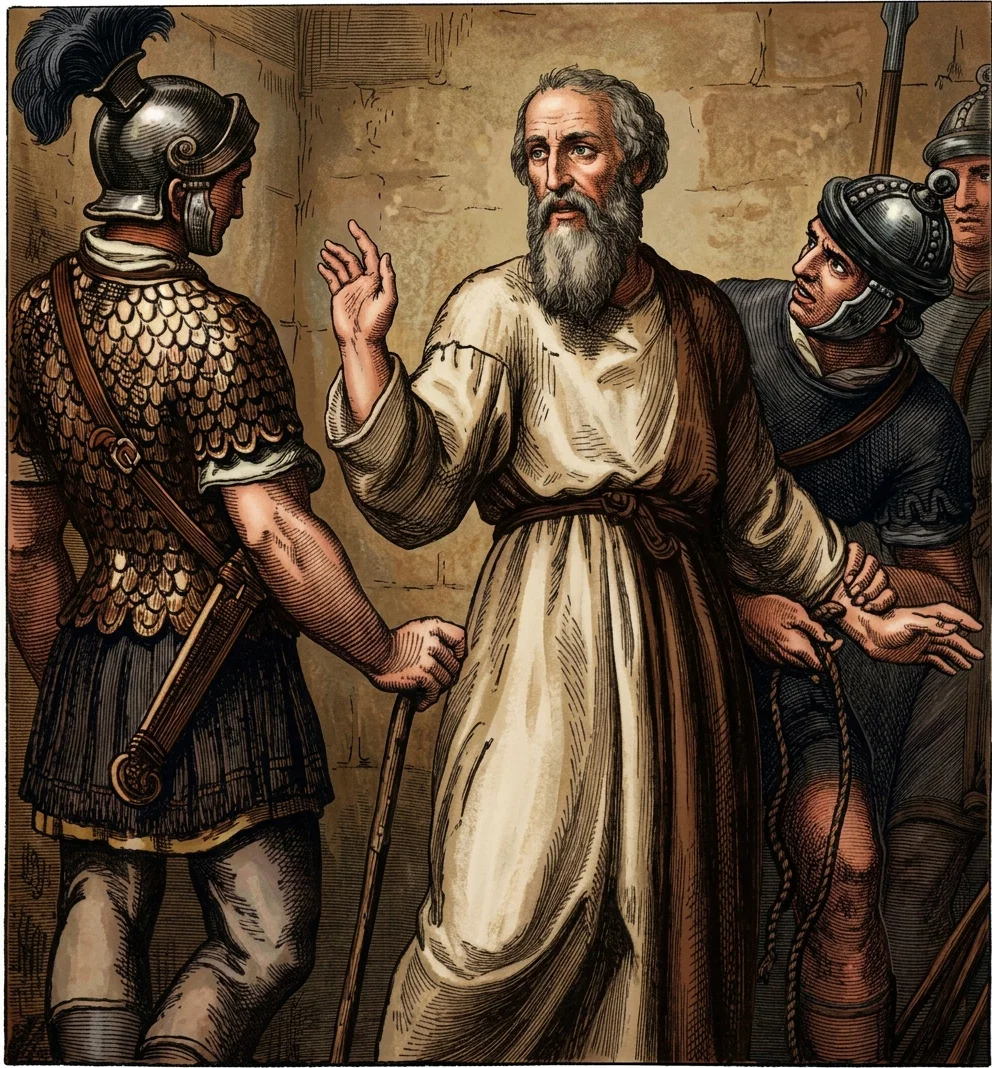
23 “And as they cried out, and threw off their garments, and cast dust into the air, the chief captain commanded him to be brought into the castle, bidding that he should be examined by scourging, that he might know for what cause they so shouted against him. 25 And when they had tied him up with the thongs, Paul said unto the centurion that stood by, Is it lawful for you to scourge a man that is a Roman, and uncondemned? 26 And when the centurion heard it, he went to the chief captain, and told him, saying, What art thou about to do, for this man is a Roman? 27 And the chief captain came, and said unto him, Tell me, art thou a Roman? And he said, Yea. 28 And the chief captain answered, With a great sum obtained I this citizenship. And Paul said, But I am a Roman born. 29 They then which were about to examine him straightway departed from him; and the chief captain also was afraid, when he knew that he was a Roman, and because he had bound him. 30 “But on the morrow, desiring to know the certainty, wherefore he was accused of the Jews, he loosed him, and commanded the chief priests and all the council to come together, and brought Paul down, and set him before them. 1 “And Paul, looking steadfastly on the council, said, Brethren, I have lived before God in all good conscience until this day. And the high priest Ananias commanded them that stood by him to smite him on the mouth. 3 Then said Paul unto him, God shall smite thee, thou whited wall: and sittest thou to judge me according to the law, and commandest me to be smitten contrary to the law? 4 And they that stood by said, Revilest thou God’s high priest? 5 And Paul said, I wist not, brethren, that he was high priest: for it is written, Thou shalt not speak evil of a ruler of thy people. 6 But when Paul perceived that the one part were Sadducees, and the other Pharisees, he cried out in the council, Brethren, I am a Pharisee, a son of Pharisees: touching the hope and resurrection of the dead I am called in question. 7 And when he had so said, there arose a dissension between the Pharisees and Sadducees: and the assembly was divided. 8 For the Sadducees say that there is no resurrection, neither angel, nor spirit: but the Pharisees confess both. 9 And there arose a great clamor: and some of the scribes of the Pharisees’ part stood up, and strove, saying, We find no evil in this man; and what if a spirit hath spoken to him, or an angel? 10 And when there arose a great dissension, the chief captain, fearing lest Paul should be torn in pieces by them, commanded the soldiers to go down and take him by force from among them, and bring him into the castle. 11 “And the night following the Lord stood by him, and said, Be of good cheer; for as thou hast testified concerning me at Jerusalem, so must thou bear witness also at Rome. 12 “And when it was day, the Jews banded together, and bound themselves under a curse, saying that they would neither eat nor drink till they had killed 13 Paul. And they were more than forty which made this conspiracy.”
QUESTIONS.
1. Give the substance of Paul’s speech on the castle stairs.
2. What caused the excited mob to listen attentively to him?
3. What expression awakened all their rage against him?
4. What did they cry out against him?
5. With what demonstrations did they accompany their cries? Verse 23.
6. What did the chief captain command concerning Paul? What was the object of this? Verse 24.
7. What did the soldiers at once proceed to do? As they were making preparations for the torture, what did Paul ask the centurion in charge? Vs. 25.
8. What was the effect of this question? Vs. 26.
9. Describe the interview that followed between Paul and the other chief officer. Repeat their conversation. Verses 27, 28.
10. What was the result of Paul’s statement that he was a free-born Roman citizen? Verse 29.
11. What did the chief captain do with Paul the next day? Why? Before what assembly did he bring Paul? Verse 30.
12. When Paul stood before the council, what solemn declaration did he make? Chapter 23:1.
13. Upon hearing this statement, what unjust order did the high priest Ananias give? Verse 2.
14. In what vigorous language did Paul denounce this piece of injustice? Verse 3.
15. What did those that stood by say to him for using the language that he did? Verse 4.
16. How did Paul excuse himself? What words did he quote showing his respect for the law? Verse 5. Where are these words found?
17. Of what two classes did he perceive the council to be composed? What did he therefore cry out? What did he declare to be the cause of the persecution against him? Verse 6.
18. What was the immediate result of this declaration? Verse 7.
19. What was the great point of difference and of contention between the Pharisees and the Sadducees? Verse 8.
20. As the result of Paul’s declaration, what did the Pharisees in the council cry out? Verse 9.
21. What kind of a scene ensued in the council? How fierce was this strife over Paul? What did the chief captain therefore do in order to save Paul’s life? Verse 10.
22. Who visited Paul the night following? What assurance and comfort did the Lord give him? Verse 11.
23. What took place the next day? What did they swear to do? How determined were they? Vs. 12.
24. How many were in this company? Verse 13.
NOTES AND QUESTIONS.
1. Why was it that the chief captain did not know the cause of the rage against Paul?
2. Quote (and give reference) words of Paul in the epistles concerning how we should regard rulers.
3. “As thou hast testified of Me in Jerusalem, so must thou bear witness also in Rome.” What did this assure Paul as to the manner of his appearance in Rome?