The question of healing by faith is one that in these days of increasing disease and sickness is occasioning much discussion. So ready are the sick to avail themselves of any means which promises relief from suffering, that, like the drowning man catching at straws, they follow up every avenue in the hope of gaining much-sought health.
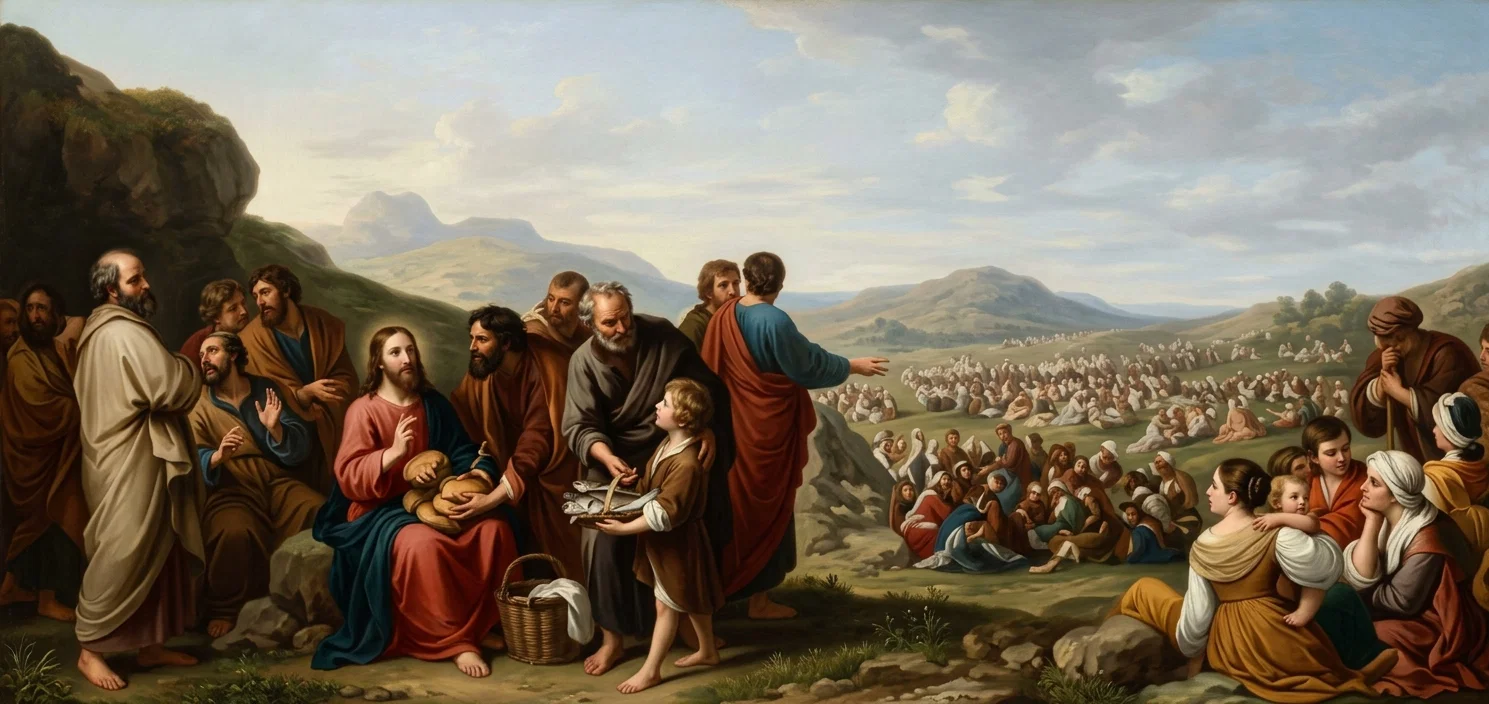
FEEDING THE FIVE THOUSAND.
“Jesus said unto them, They need not depart; give ye them to eat. And they say unto Him, We have here but five loaves, and two fishes. He said, Bring them hither to Me. And He commanded the multitude to sit down on the grass, and took the five loaves, and the two fishes, and looking up to heaven, He blessed, and brake, and gave the loaves to His disciples, and the disciples to the multitude. And they did all eat, and were filled.” Matt. 14: 16-20
It is desire rather than faith which leads to the large patronage of patent medicines and nostrums. And the power of such men as Schlatter over the masses is a power achieved through a hope on their part that possibly in some way there may be in the man power to heal disease. The quackery and charlatanism practised by such deceivers lead many of the disappointed sufferers to feel that there is no power which can alleviate their distress, and has an effect to cause the more conservative to regard with contempt everything under the name of divine healing. But entirely aside from all of these delusive movements, considering the question alone from the teaching of the divine Word, and from the standpoint of unbiased reason, is it consistent to believe that the Lord now, as in days of old, will manifest His divine power in the healing of disease? All admit that the first century witnessed the working of miracles. Was it the design of the great Miracle-worker that this power should continue with His church? That it was, is evident from the great Gospel commission, as recorded in the Gospel by Mark: “And these signs shall follow them that believe: In My name shall they cast out devils; they shall speak with new tongues; they shall take up serpents; and if they drink any deadly thing, it shall not hurt them; they shall lay hands on the sick, and they shall recover.” In the twelfth chapter of I Corinthians, one of the gifts of the Spirit is set forth as the healing of disease and the working of miracles; and the gift of the Holy Spirit, and all that follows in its train, is promised to as many as the Lord our God shall call, throughout the extent of the Gospel work. Acts 2:38, 39. Hence we must conclude that there has been no lessening of the power and willingness of God to heal to-day even as of yore. The Lord God changes not. With Him is no variableness, neither shadow of turning. He is the same yesterday, to-day, and forever. Therefore, if we do not see the same divine manifestations, the fault is with us, and is because our faith is too weak to claim the fulness of the promise.
The world to-day is so prone to subject every question and proposition to the test of so-called reason that faith is made difficult to exercise. And yet if we would but open our eyes and recognize the workings of God in nature, it would be more easy by faith to lay hold of the unseen. Paul inquires of Festus, “Why should it be thought a thing incredible that God should raise the dead?” Not alone by divine revelation, but also from the great book of nature, may we learn of God’s power to raise the dead and to heal disease . In the accomplishment of His work, either in a general way or for the special help of His people, God works by what we might term direct and indirect methods.
In the great book of nature we have the indirect method illustrated, while in the written Word we have a record more particularly of the employment of direct methods of working. We will illustrate. The husbandman plants in the bosom of mother earth the seeds of wheat. By a slow and gradual process it comes up through the various stages of development until it reaches maturity. It is warmed by the sun; it is watered by the rain; it draws strength and nourishment from the soil; and when it has reached its full development, it is taken and by another and more mechanical process is converted into bread. This is God’s indirect method of bread-making. Take now the record of His direct method. Nearly two thousand years ago, when the great Teacher was on earth, occasion found Him instructing a great multitude of five thousand men besides women and children, in a desert place in the vicinity of Galilee. All day long had the people listened to His word, forgetful of their own physical necessities, in the delight they felt at the gracious truths which fell from the Master’s lips. The day was far spent, and before the people could reach the neighboring towns to supply themselves with food, extreme fatigue and exhaustion must have overcome them. The Master supplies their needs, not by the indirect process of bread-making, but by a more direct method. Five barley loaves and two2 (194)small fishes were brought forward, and these by the power of God were multiplied to that extent that after the large multitude had eaten their fill, more remained of the fragments than had been contained in the original quantity of bread. Is there any more of a manifestation of the divine power in the multiplication of the five loaves in the wilderness of Galilee than may be daily witnessed in the multiplication of the bread product growing in our fields? It must be admitted that in both instances it was the same power, only manifested in different ways. The turning of the water into wine serves another illustration of where God worked by a direct method instead of the indirect, and yet in that miracle there was no more of the power of God shown than in the converting of water into wine to-day through the growing of the grape, and the process of wine-making.
In the relation the Lord has sustained to the sick and suffering, as brought to view in His Word, we see the employment of the same two methods. The direct method is shown in the cleansing of the leper, the healing of the woman with an issue of blood, the raising of Jairus’ daughter, the resurrection of Lazarus; and many other miracles that might be noted. In the indirect method the healing was accomplished usually through the employment of natural agencies. An example of this kind is shown in the case of Hezekiah, king of Israel. He was afflicted with a terrible boil that in its natural course would have brought him to the grave. In answer to his prayer God sends assurance that he will live, and as a means for the recovery of health, directs that a plaster of figs should be placed upon the boil. As the result, Hezekiah recovered. In the case of the blind man, Christ covered his eyes with an ointment of clay. The question naturally arises, Did the figs in the case of Hezekiah, or the clay in the case of the blind man, possess any medicinal value or restorative virtue? To claim that they did not would be to impute to the Lord the performance of senseless service. Is it as truly a manifestation of divine power where cures are wrought by the employment of agencies as where they are wrought directly? It was certainly so regarded by Hezekiah, and by the blind man who received healing at the hands of Christ. These examples must forever settle the question whether it is right in combating disease to employ means and agencies. From the action of Isaiah, and also of our Saviour, we must conclude that it is.
Where the cure of disease is wrought by the employment of means, the great danger is that the credit will be given to the means, and that the power of God operating through the means will be left out of mind. A physician may employ electricity in the accomplishment of a desired result, and the patient, ignorant of the power of this influence, may look at the metal electrode through which the power is conveyed, and feel that the metal itself imparts to him the sensations which he experiences, not realizing that the metal is only the agent by which the electricity is conveyed.
If in dealing with the afflicted to-day every physician would realize that he must prescribe in faith, every nurse that he must administer the treatment in faith, and every patient that the treatment must be received in faith, the power of God working through the means would be much more effective and efficient. It is for none to direct his mind to the means as the power in the accomplishment of the work, but to the power of God back of the means and working through the means for the recovery of health.
We would not contend that the employment of rational means would not benefit a man who failed to recognize the power of God behind it. The world in its wickedness, even though it recognizes not God, is still blessed by Him. But as it is certainly true that in the application of the power of God in the spiritual way, that power works effectually in the believer, so it is just as evident that the power of God in a physical sense will be more effectual in the case of him who recognizes its divine source and authority. If the power of God is indeed manifested in the indirect methods in the healing of disease, it is but a step to recognize that same power working in a direct manner to-day as in the times of Christ. Whether the method of healing is direct or indirect, it is the power of God that accomplishes the work. And if that power is recognized and appropriated, and received in faith, it becomes healing by faith. God will honor the faith that recognizes Him. F. M. W.