Once upon a time, on a beautiful summer day, you might have seen thousands of people streaming out of Vienna into the green country. It was a feast day, and happy smiles seemed on everybody’s face. They walked about, or played games, or rested on the grass under the shade of the trees.
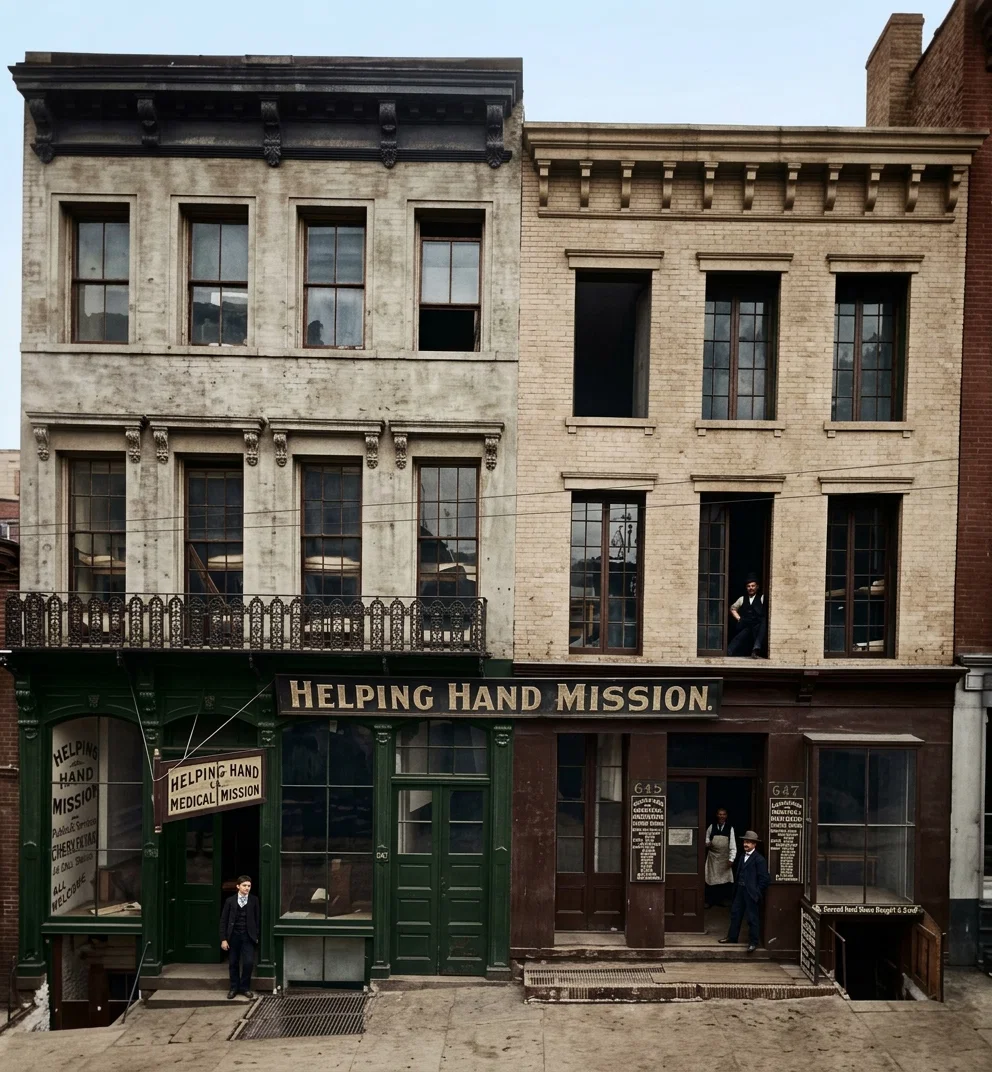
The Mission buildings as they appear at present. The upper stories of both are occupied with sleeping apartments. The basement at the left is used for baths and laundry purposes; at the right, for a shoeshop, over the door of which is the legend, “Second Hand Shoes Bought and Sold”—and sold as well. The first floor at the left is a chapel and reading-room; the first floor at the right is a restaurant, where one can get a good, clean, hearty meal for from three to five cents.
In the crowd was a poor, one-legged old man. He had been a soldier and had fought bravely for his country; but in a great battle a cannon-ball had taken off one of his legs. So, to make a living, he took to playing the violin, of which he had been fond as a boy.
He was not a good player, but he did his best to give pleasure to those who heard him. “If they do not give for my music,” thought he, “they may take pity on my snow-white hair, my one leg, and my old patched coat.”
So he sat down under a tree by the wayside, and began to play his little pieces. Close by him sat his old poodle, which he had taught to go round with his hat, into which many a penny had been cast by kind-hearted folk.
But to-day the people passed by, laughing and chatting gaily, and the hat remained empty. Had they but given one look at the old soldier, his sad face might have touched their hearts. His last penny had been spent in buying new strings to his fiddle, and he was very hungry and weak, and did not know where his next meal was coming from.
As the old man played, he glanced sadly at the happy crowd, and the sting of pain entered into his heart. To-morrow he must starve upon a straw mattress in his little attic room. The poodle was really better off than he; he could always pick up a bone for an evening meal.
It was now late in the afternoon. Many of the crowd were returning home, but still no penny had fallen into the hat. His hope was as near setting as the great sun in the sky.
He had no idea that there stood not far from him a gentleman who for some time past had been listening to his playing, and who was now looking at him with deep pity in his eyes.
The old man, weary and hopeless, at last sat down on a stone and covered his face with his hands. The gentleman standing under the linden tree saw him wipe the tears away with his rough hand. He then hurried across and handed the player a gold piece, and said:—
“Lend me your fiddle for a short time.”
The aged man looked up, full of wonder and thanks, and then handed the fiddle to the stranger. It was not such a bad fiddle. The gentleman tuned it as clear as a bell.
“Friend,” said he, “you take the hat round whilst I play.”
Then he began to play in such a wonderful manner that the old man looked up at his fiddle, as if to ask where it had got its beautiful tones, and why it lent them to the stranger and not to him.
Yes, the old fiddle was played now as it never had been played before. It was all song, and every note found its way to the heart. Sometimes it sang with joy, sometimes with deep sorrow that moved to tears.
The people no longer thought of going home. They stood still and listened breathlessly to the wonderful things the stranger played. The circle of listeners increased; even the carriages of great people stopped and swelled the throng.
The old soldier took round his hat. The coins rained into it—gold, silver, copper. All gave something, even the hardest-hearted, being touched with pity. The poodle snarled, perhaps with pleasure or perhaps he thought it his work to hold the hat.
At length the hat was full and the old man had to empty it. But the stranger played on, and moved the hearts of the people so greatly that it was again filled to overflowing.
The eyes of the stranger beamed with delight, and he played so that the crowd became still as death, and then burst out into a storm of cheering. Again he played, and the stillness deepened until one could hear the beating of one’s own heart.
By degrees it grew cold, and the stranger began the song, “God Save the Emperor,” which every Austrian knows and loves. Every hat and cap flew off, and the delight of the people became so great that soon thousands of voices joined in the song.
Then suddenly the player put the violin in the hands of the old soldier, and, taking his hat, went away before the old man could say, “God bless you, sir.”
“Who was that?” cried the people, as they crowded round the soldier.
“I do not know,” answered he, “but God has sent him to help me. Without him I should have had to starve.”
Then a gentleman stepped forward and said: “I know him well; it was the great violinist Alexander Boucher, who has been in Vienna for some days and has used his art here in the service of charity. Let us not forget his example.” He then raised his hat, and went on: “Boucher played to-day for this poor soldier whom we all forgot.”
Once more the coins poured into the hat, and then the gentleman cried, “Long life to Boucher!” and the people sent up cheer after cheer.
Hot tears rolled down the cheeks of the old soldier, and he prayed silently to himself, “Master, do Thou reward him.” And so the crowd broke up and each went to his home, happier for having helped a poor neighbor. But the happiest of all was the one-legged soldier and the great violinist.—From the German.