THE PRIZE

3%

Pacific Press Publishing Company · Oakland, California · Mar 3, 1898

FromSigns of the Times, Vol. 24, No. 9.

Read the full edition

THE PRIZE.

One morning before starting to school, when Katie came in, as was her custom, to her mother for her good-by kiss, her eyes shone brighter than usual, and her cheeks glowed with excitement.
“Are you not glad, mama,” she asked, “very glad for me?”
“Certainly, my child,” was the reply, “I should rejoice with all my heart if you should win the prize.”
“If I should win!” cried Katie in astonishment; “who else could receive it?”
“Do not build too much on it, Katie; for disappointment is very hard to bear.”
“But, mama, Anna Schulter is the only one that can compare with me; and every one says that my work is better than hers.”
“Perhaps ‘every one’ has told Anna Schulter that her work is better than yours.”
“O mama, what a funny idea!” laughed Katie; “but you shall see my return crowned with the prize.”
Scarcely an hour had passed when the street bell sounded, and the mother listened with beating heart. But the heavy, tired step did not resemble the usual light tread of her little daughter. The door opened, and Katie, with pale, troubled face, entered. She paused a moment as if gaining composure, and then, rushing to her mother’s arms, she sobbed as if her heart would break. There was no need to tell that not she, but Anna Schulter, had gained the prize from the art school; and the mother’s first care was to soothe her disappointed child.
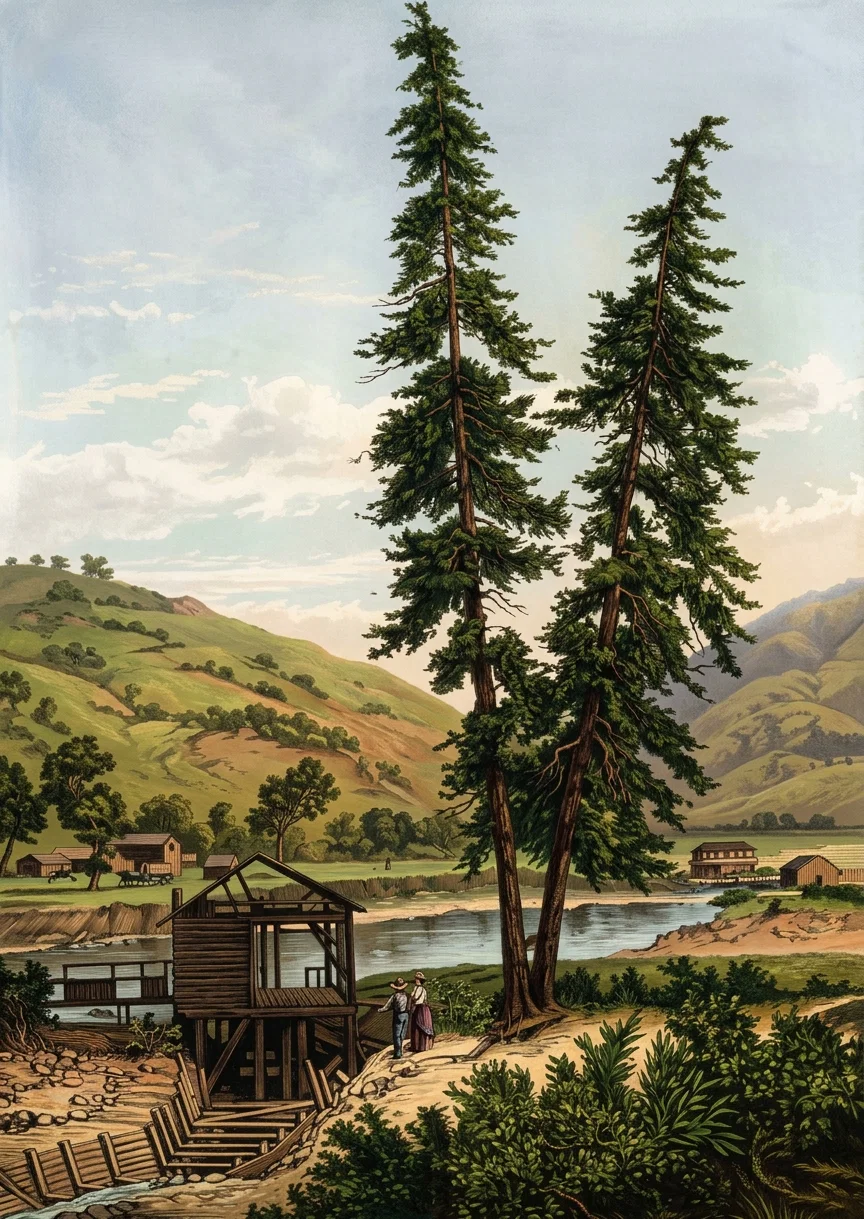
CALIFORNIA SCENERY. NO. 9.—It may be of interest to our readers to see, in this time of gold excitement, a picture of the place where J. W. Marshall, an employee of Gen. John A. Sutter, discovered the precious metal in California, Jan. 24, 1848, in Sutter’s mill-race. It is a circumstance worthy of note that both of these men died poor. So will many others who are now setting their hearts on the mines of earth.
“Restrain yourself, my dear,” she said; “this is not the worst grief that could befall you.”
“Not the worst?” sobbed Katie; “why, mama, you can’t imagine how terrible it was to see all those scornful faces, and to stand there like an outcast.”
“Are you not exaggerating, dear?”
“No, indeed, mama; every one left me and crowded around Anna, who, I am sure, did not deserve the prize.”
“Do you not think the art critics have better judgment than you?”
“But Anna received help.”
“Katie,” said her mother sternly, “if you have worked faithfully, there is no disgrace in losing the prize; but it grieves me to see my little girl so governed by envy. How do you know that Anna received help?”
A painful pause followed, during which Katie did not dare raise her eyes to her mother’s. She began to see how foolishly she had acted.
“But,” she thought, “could any one bear such humiliation quietly?”
“Forgive me, mama,” she whispered softly; “I shall try to drive away these wicked thoughts; but I am so disappointed!”
Her mother kissed her tenderly and said, “Think, Katie, if you had won the prize, could you be happy when you knew some one was very miserable over losing it?”
“But Anna did not know how grieved I was. She was the center of a great crowd, praised by all, while I stood at one side alone. No one seemed to notice me; so I hurried home to you.”
The next morning Katie appeared with eyes much inflamed by weeping; but she had thought of a remedy for her sorrows, and chatted pleasantly with her mother all during breakfast.
“Mama,” said Katie, when the meal was over, “I see that it was very wrong in me to act as I did yesterday. I shall cherish no more ill-will toward Anna, and shall try to rejoice in her happiness; but please promise me that I may give up my studies in the art school.”
“That would be foolish, indeed,” replied her mother.
“Dear mama, I can not endure to go again where I have suffered such humiliation.”
“My child, you must conquer this envious spirit, and be earnest in your determination to do right.”
Katie was silent for a moment; but she wondered why her usually indulgent mama would subject her to such a severe trial. Her mother remained firm, altho Katie pleaded hard for permission to abandon her art studies. And when the new term began, it was with ill concealed displeasure that she entered the school. She was late as possible, in order to avoid all intercourse with other pupils; and soon after her arrival the instruction began. As Katie took her seat and bent over her work, every eye seemed to turn toward her, either in pity or scorn, and she scarcely dared to raise her head to nod to Anna, who gave her a friendly smile in return. Katie blushed deeply and looked down. She heard some whispers near, and thought they certainly were concerning her and her disappointment. Her cheeks burned hotly, and she wondered if the hour would ever end.
At last the time came to go home. She had determined to say a few words to Anna, but was so cordially met by her that the dreaded task proved an easy one.
“I must tell you, Katie,” said Anna, “how sorry I am that you did not win the prize. I could not enjoy it at all until mama said that you were such a sensible girl that you would try harder and win next time.”
Katie was deeply mortified. But she took up her work with new zeal, resolving that she would deserve the title of “sensible girl.”
That evening, as she sat by her mother’s side, she whispered, “Mama, I have conquered now, and I shall do the best I can without thinking of the prize.”
One day after Katie had been working diligently for several months, she was sent to a desk for some drawing materials, and there saw the model she had prepared for the last art exhibition. Her now practised eye readily detected many faults, and she blushed to think how blind her conceit had made her. She determined never again to elevate herself above others, and to let honest work and untiring diligence take the place of supposed natural skill.
At the next exhibition Katie won, and deservedly received the prize.—Anonymous.